EN-54 Originalbetriebsanleitung Allgemein
28.1 Checking tyre pressure
Warning
Seriousfallsduetolackofbicyclecontrol.Overinated
tyrescanburstorcomeotherim.Thetyrecanburst
and cause an immediate loss of control. If the tyre
pressureistoolow,thetyrecancomeotherim.
▪ The air pressure indicated on the tyre must not be
exceeded or undercut. A maximum air pressure
indicated for certain rims must not be exceeded. The
lowest maximum air pressure indicated on the tyre
or rim is applicable. The permissible tyre pressure
is given in bar or psi on the sidewall of the tyre and/
or on the rim. There are many tools on the Internet
that you can use to convert values from bar to psi,
or vice versa.
▪ You should also observe the recommendations given
on the websites and in the operating instructions of
the tyre and rim manufacturers.
Information
Use a standing air pump with integrated pressure
display. This will allow you to check and adjust your
tyre pressure at any time. You will need an adapter for
certain valves. You can purchase these together with
the pump from your specialist workshop.
28.2 Tubeless tyres
Warnings
Serious falls due to bursting tyres.
▪ Only use tubeless tyres on rims designed for this
purpose. These are identied accordingly with the
"tubeless ready” label.
▪ Mount and remove tubeless tyres as far as possible
without using tools. Where necessary, however,
a plastic assembly lever can also be used. Be
extremely careful not to damage the sealing tyre
bead. This can lead to leaks. If the sealing uid is
not able to prevent a defect, a normal tube can be
used after removing the valve.
▪ Tubeless tyres should be removed from the rim as
far as possible without using tools, otherwise leaks
may occur as a result. If the sealing uid is not able
to prevent a defect, a normal tube can be used after
removing the valve.
▪ Please follow the tyre manufacturer's instructions.
Today, so-called tubeless tyres can be found primarily on
modern mountain bikes, and less often on racing bikes.
28.3 Tubes
The tube is necessary in order to maintain the pressure
inside of the tyre. This is lled by means of a valve.
28.3.1 Valves
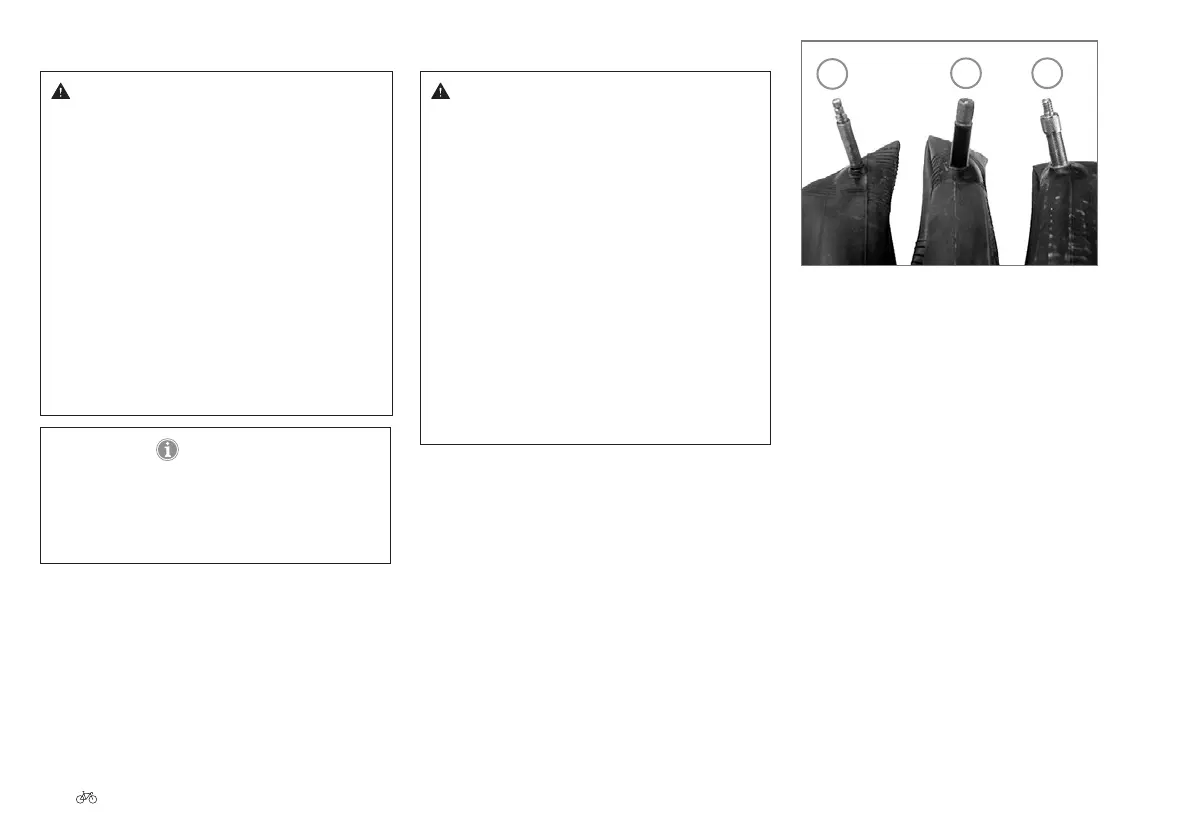
There are three types of valves: Sclaverand or racing
valves, Schrader or car valves, and Dunlop or Blitz valves.
All three types of valves are protected from dirt with a
cover cap. Allow your specialist dealer to advise you which
air pump is most suitable for your valve.
Fig. 128
1
2 3
1 Sclaverand or racing valve
2 Schrader or car valve
3 Dunlop or Blitz valve
28.3.1.1 Sclaverandorracingvalves
To inate a tube with a Sclaverand or racing valve, proceed
as follows:
1. Unscrew the valve cap counterclockwise using your
ngers.
2. Unscrew the knurled nut counterclockwise.
3. Push the knurled nut briey into the valve with your
nger until air escapes.
4. Inate the tube with a suitable air pump. Note the
pressure information on the tyre.
5. Screw the knurled nut back on.
6. Screw the valve cap clockwise onto the valve.



 To Next Page