5.3 - Handling for installation
Before starting pump handling, it is necessary to verify:
• Efficiency of lifting equipment and their capacity.
• During pump lifting or movement operations, it is necessary to adopt all possible precautions in
order to avoid dangerous movements that may cause accidents or damage to persons or property.
• Avoid using valves or the adjustment knob for lifting
6 - PUMP INSTALLATION
The manual contains all the necessary information for installing the dosing pump, taking into account all
safety aspects.
6.1 - Optimum installation conditions
• If the pump is to be installed outdoors, a suitable protective canopy is essential in order to avoid
exposure to sunlight or possible infiltration in the event of rain.
• If the pump works in closed environments, an average lighting level is to be considered important for
the safety of persons, work quality and the guarantee that symbols and markings are understood
correctly.
Altitude:
The power of the motor installed on the pump is suitable for use at a maximum altitude of 1,000 m above
sea level. For higher altitudes, it is required to recalculate the power as it may be insufficient.
Temperature:
The standard pump can operate at room temperature ranging between -20°C and + 40°C, provided that
the pumped fluid remains liquid in these conditions.
6.2 - Pump location
The pump must be set above a strong base (metal, cement, etc.) that
is stable and properly levelled, avoiding tension on its axis.
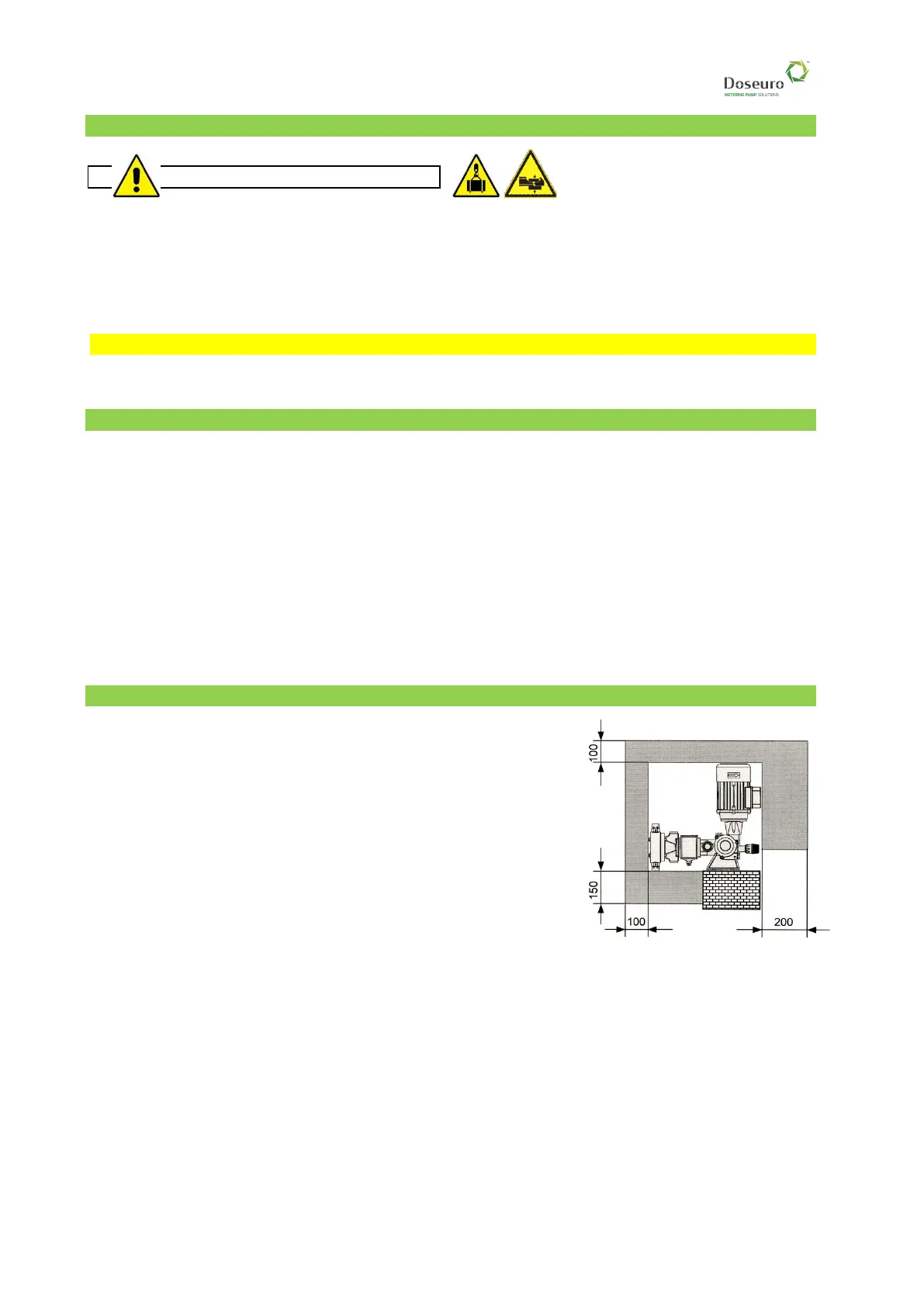
• Plan for sufficient space (operative areas), to be able to easily
inspect and calibrate the pump, or take apart the hydraulic part
(valve and pump head). Refer to the assembly drawing for the
recommended minimum distances.
• Avoid that piping along the path creates bottlenecks or stagnant
volumes and especially tension on the valve axis, caused by
improper alignment.
• Remove any burrs from components and clean piping of any
residues before assembly.
• Check for any lubricant leaks.
• In case of outdoor installation, protect the gear and motor from
direct radiation and weathering by installing screens or casings. Always ensure sufficient ventilation.
The venting and oil level control plugs must be freely accessible and inspectable



 To Next Page