8 - DESCRIPTION OF STANDARD PLANT ACCESSORIES
The control of the fluid dynamics is essential to
guarantee efficiency and use of the process system.
Failure to control moving fluids may seriously damage
the dosing system, its parts and the pump itself.
The correct choice of the accessories and their sizing,
ensures the efficiency and life-span of the system.
Each dosing pump can be fitted with accessories to
improve its operation and accuracy.
The benefits obtained from a correct installation and an
accurate control are:
- Increase of efficiency and life-span of the pump
- Reduction of interventions and maintenance costs
- Improved system operation
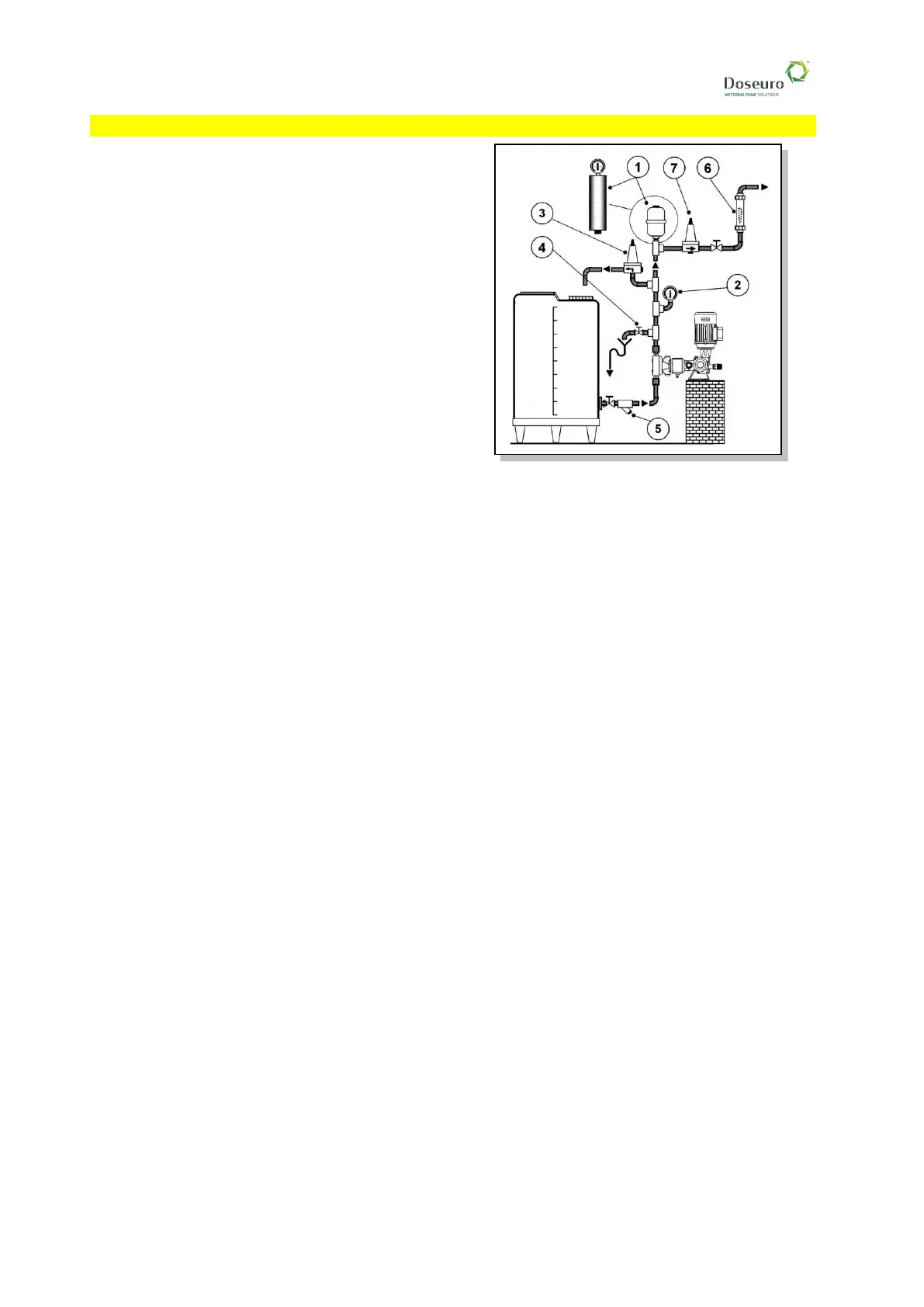
8.1 – Pulsation dampener
Reciprocating pumps provide a pulsating flow rate as
each pumping cycle has a suction and a pressing phase:
this can result in pressure peaks and even strong vibrations on the lines. Various benefits are obtained
by installing a diaphragm:
- Pump protection against pressure peaks;
- Elimination of vibrations along the length of the discharge pipe;
- A flow rate with a smoother flow useful for the process.
With consequent benefit on the duration of the pump's lifespan
8.2 - Pressure gauge
Instrument for measuring any pressure higher than that of the atmosphere used for liquids and gas
and installed on a shunt on the discharge pipe of the dosing pumps. It is necessary to set the pressure
relief valve's pressure value, which enables the user to determine the effective working pressure of the
pump.
Constant pressure monitoring and a flow rate check are used to verify the proper operation of the
pump.
8.3 - Safety relief valve
The pressure relief valves are used to protect the pump and the plant from possible damage caused
by overpressure deriving from defective accessories or obstructions in the plant's piping, caused by
sediments or the accidental closing of a shut-off valve. The pressure relief valve on the discharge pipe
must be installed immediately after the pump's coupling and before the shut-off valve.
However, the application of the pressure relief valve is essential for the above reasons as well
as for standards relating to accident prevention in the workplace.
8.4 - Sampling or draining
Sampling or draining is carried out by mounting the shut-off valve in a shunt on the discharge pipe,
which discharges in the open air. It is mainly used to drain the discharge pipe from the dosed fluid
when performing plant maintenance or to take a sample of the liquid for flow rate tests.
8.5 - Filter
Accessory with the function of retaining the impurities present in a flowing fluid.
We recommend installing the filter (on the suction piping) in order to prevent the impurities that may be
present in the liquid from being dosed from the pipes or the tank, which could impair the proper
operation of the valves or damage them, thus causing irregular flow or passage obstructions. The size
of the filter mesh must be chosen based on the impurities present while the filter surface is related to
the product flow rate, paying attention to the fact that the smaller the filter surface and the mesh
dimension, the higher will be the pressure drops produced by the filter. Do not place the suction pipe
attachment on the bottom of the tank to avoid sucking impurities, but ensure that the suction area is at a
height of at least 10 cm from the bottom.
8.6 - Flowmeter
It is an instrument consisting of a transparent Plexiglas casing with a graduated scale and a float inside to
visually indicate the dosed amount (volumetric flow) for an immediate check of the adjusted dosing



 To Next Page