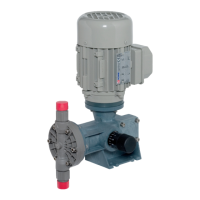
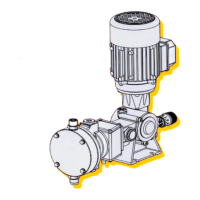
Fluid leak measured by the hole located under the lantern
• Determine whether the fluid collected is oil or pumped fluid.
• If it is pumped fluid, it means that the piston seal gasket is worn or damaged. It will therefore be
necessary to replace it.
• If it is oil, it means that the seal gasket of the slide is worn or damaged. It will therefore be necessary
to replace it.
15.2 - Maintenance of direct diaphragm pump heads type D
Due to negligence, malfunctions or operating problems may occur
such as to require extraordinary maintenance, by carrying out a
periodic visual check, it is possible to partially eliminate the
occurrence of situations requiring extraordinary maintenance.
In the presence of these anomalies we recommend readily
intervening in order to avoid safety problems, a reduced flow
rate and reduced efficiency of the pump.
Summarising, the checks to be carried out are:
✓ Periodic checks of the pump head must be carried out to
ensure that the pump is safe and operating correctly.
✓ Particular attention must be paid if the pump head installed is made of plastic as it is more sensitive
to temperature variations and settling phenomena.
Check for dosed liquid leaks from the valves and from the diaphragm pinching.
Before intervening on the dosing pump or on the piping, the necessary precautions must be taken so that
the pumped product, especially if harmful, does not endanger personnel or the surrounding elements.
Before intervention, personnel must be sure that:
➢ The pump is stopped and disconnected from the electrical supply mains.
➢ The pump head and the system have been depressurised and emptied of any liquid.
➢ The pump has reached a temperature level where it can be moved safely.
Proceed as follows, using the sections of the pump heads to identify the components and their
order of assembly:
➢ Disconnect the piping from the valves.
➢ Loosen the screws located on the front of
the pump head (pos. 14).
➢ Remove the head from the pump (pos. 1).
➢ Loosen the diaphragm (pos. 20 and the
diaphragm shield (pos. 22), removed the
diaphragm, replace if damaged.
➢ Tighten the diaphragm (pos. 20) with the
diaphragm shield (pos.22).
➢ Re-assemble the pump head (pos. 1)
paying attention to the direction of the
valve container arrows.
➢ Tighten the pump head screws (pos. 14).



 To Next Page