Horizon Compact Release 1.01.00 Wireless Ethernet Product User Manual – Volume 2
2.2.1 Radiation Pattern of Dish Antennas
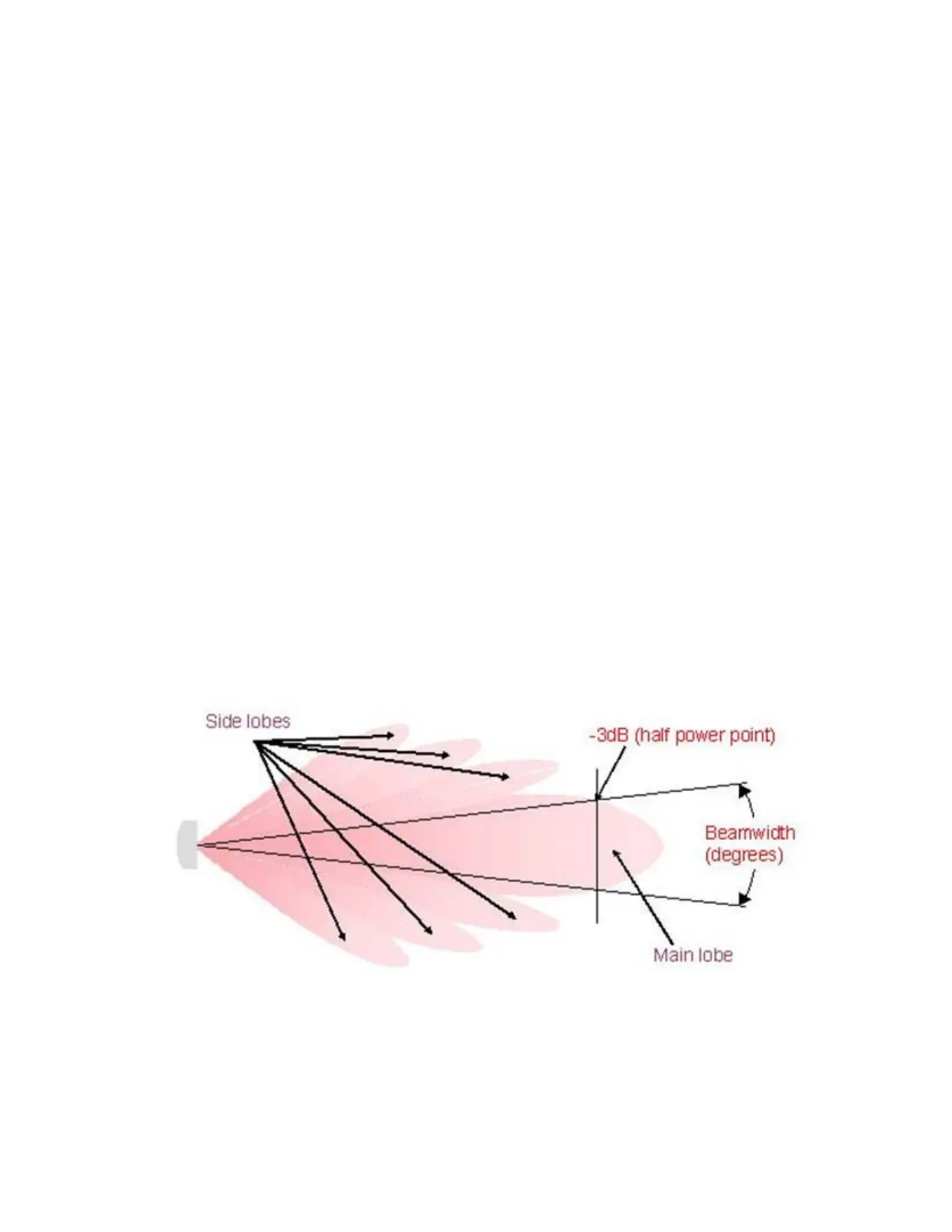
Dish antennas radiate a primary signal (main lobe) and a number of secondary signals (side lobes). The
main lobe is the strongest. When you align the radios, you must make sure to align to the main lobe of the
signal. If you mistake the first side side lobe for the main lobe during installation, there can be a 20-30 dB
loss of signal strength. For example, if the Calculated RSL = -42 dB then the side lobe would be at
approximately -62 dB, or 20 dB lower than the calculated level.
Although in most cases only the first two side lobes are detected, depending on antenna size and the
distance between sites, it may be possible to “see” several side lobes (see
Figure 2-3). It is wise to pan
the full 35 degrees available with the antenna alignment adjustment to locate all the lobes that may be
present, so that the main lobe can be positively identified. As you pan through the signal, the side lobes
will show up as peaks in the receive signal level (RSL), each peak getting stronger as you approach the
main lobe. The main lobe will always be the strongest.
The size of the beamwidth for the Horizon Compact systems is approximately 2 degrees. Two degrees is
approximately equivalent to a thumb's width when one’s arm is fully extended. Align as closely to the
centre of the 2-degree beamwidth as possible. It takes very little adjustment to swing past the main lobe,
as can be seen in
Figure 2-5. A beamwidth of 2 degrees is very narrow and alignment errors can occur
when you lock on to a side lobe instead of onto the main lobe. If you align to one of the side lobes, your
signal strength will be reduced. Make sure you align the antenna to the main lobe.
Note: Verify the RSL is within 2 – 4 dB of the calculated value.
Figure 2-3 Main and Side Lobes


 To Next Page