EasyManua.ls Logo

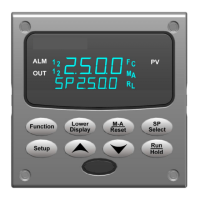
Eclipse UDC2500 Limit - User Manual

Eclipse UDC2500 Limit
128 pages
Print Icon
To Next Page IconTo Next Page
Loading...
Eclipse Universal Digital
Controller
UDC2500 Limit Control Model
08/2005
Information Guide 925-1

Table of Contents

Question and Answer IconNeed help?

Do you have a question about the Eclipse UDC2500 Limit and is the answer not in the manual?

Overview

The Eclipse Universal Digital Controller UDC2500 Limit Control Model is an industrial control instrument designed to accept input signals from various external sensors like Thermocouples (T/Cs) and Resistance Temperature Detectors (RTDs). It processes these signals to derive a Process Variable (PV) value, which is then compared against a Limit control setpoint. If the PV signal deviates from the setpoint (exceeding a high limit or falling below a low limit), an electromechanical, single-pole, dual-throw (SPDT) limit output relay de-energizes, initiating a "Lock Out" state. This state is indicated by a flashing "LIMIT" on the lower display and persists until the PV signal returns to an acceptable range and the controller is manually reset via the keyboard or a remote contact input.

Function Description:

The UDC2500 functions as either a High Limit or Low Limit controller.

  • High Limit Controller: The output relay energizes when the PV input signal is below the limit setpoint. If the PV exceeds the limit setpoint, the relay de-energizes, and the "LIMIT" display flashes. The controller can be reset manually or via a contact input once the PV returns below the limit setpoint.
  • Low Limit Controller: The output relay energizes when the PV input signal is above the limit setpoint. If the PV falls below the limit setpoint, the relay de-energizes, and the "LIMIT" display flashes. Resetting is possible manually or via a contact input once the PV returns above the limit setpoint.

Important Technical Specifications:

Power Supply:

  • 90 – 264 Vac or 24 Vac/dc
  • Power Consumption: 20 VA maximum (90 to 264 Vac), 15 VA maximum (24 Vac/dc)
  • Power Inrush Current: 10A maximum for 4 ms (under operating conditions), reducing to 225 mA (90 to 264 Vac) or 750 mA (24 Vac/dc) after one second.

Analog Inputs:

  • Accuracy: ± 0.25% of full scale typical (± 1 digit for display), field calibratable to ± 0.05% of full scale.
  • Resolution: 16-bit typical
  • Sampling Rate: Six times per second
  • Temperature Stability: ± 0.01% of Full Scale span / °C change—typical
  • Input Impedance: 250 ohms (4-20 mA), 200K ohms (0-10 Volt), 10 megohms (all others)
  • Maximum Lead Wire Resistance: 50 ohms/leg (Thermocouples), 100 ohms/leg (100, 200, 500 ohm RTD), 10 ohms/leg (100 ohm Low RTD)
  • Burnout Selections: Upscale, Downscale
  • Stray Rejection: Common Mode (120 dB AC/DC), Normal Mode (60 dB AC)

Digital Inputs (Optional):

  • One input, +30 Vdc source for external dry contacts or isolated solid state contacts.
  • Isolated from line power, earth ground, analog inputs, and all outputs except for the Second Current Output.

Controller Output Types:

  • Electromechanical Relay (SPDT): Resistive Load: 5 amps @ 120/240 Vac or 30 Vdc. Inductive Load: 3 amps @ 130/250 Vac (cosϕ = 0.4), 3.5 amps @ 30 Vdc (L/R = 7 msec). Motor: 1/6 H.P.
  • Solid State Relay (SPST, N.O.): Resistive Load: 1.0 amp @ 25°C (120/240 Vac), 0.5 amp @ 55°C (120/240 Vac). Inductive Load: 50 VA @ 120/240 Vac. Minimum Load: 20 milliamps.
  • Open Collector Outputs (One or Two): Opto-isolated, internally powered @ 30 Vdc. Maximum Sink Current: 20 mA. Short-circuit current limit: 100 mA.

Alarm Outputs (Optional):

  • One or two SPDT Electromechanical relays.
  • Up to four setpoints (high or low alarm, two per relay) on Process Variable, Deviation, PV Rate, Communication Shed, or Thermocouple Health.
  • Adjustable hysteresis: 0.0 to 100.0%.
  • Alarm Relay Contacts Rating: Resistive Load: 5 amps at 120/240 Vac or 30 Vdc.

Isolation (Functional):

  • Analog Inputs: Isolated from all other circuits at 850Vdc for 2 seconds.
  • Analog Outputs: Isolated from all other circuits at 850Vdc for 2 seconds.
  • AC Power: Electrically isolated from all other inputs and outputs to withstand 1900Vdc for 2 seconds.
  • Relay Contacts: Isolated from each other and all other circuits at 345Vdc for 2 seconds.

Communications Interface (Optional):

  • RS422/485 Modbus RTU: Baud Rate: 4800, 9600, 19200, or 38400. Data Format: Floating point or integer. Link Length: 2000 ft (600 m) max (Belden 9271 Twinax Cable, 120 ohm termination), 4000 ft (1200 m) max (Belden 8227 Twinax Cable, 100 ohm termination). Link Characteristics: Two-wire, multi-drop Modbus RTU protocol, 15 drops max (up to 31 for shorter links).
  • Ethernet TCP/IP: Type: 10Base-T. Link Length: 330 ft (100 m) max. Link Characteristics: Four-wire, single drop, five hops max. IP Address: 10.0.0.2 (shipped from Factory).
  • Infrared Communications: Type: Serial Infrared (SIR). Link Length: 3 ft (1 m) max (IrDA 1.0 compliant). Baud Rate: 19200 or 38400.

Environmental and Operating Conditions:

  • Weight: 3 lbs (1.3 kg)
  • Ambient Temperature: 0 to 55 °C (32 to 131 °F) for operative limits, -40 to 66 °C (-40 to 151 °F) for transportation and storage.
  • Relative Humidity: 5 to 90% (operative limits), 5 to 95% (transportation and storage). Maximum moisture rating up to 40 °C (104 °F).
  • Vibration: 0 to 200 Hz, 0.6 g (operative limits).
  • Mechanical Shock: 5 g, 30 ms (operative limits).
  • Enclosure Rating: NEMA3 and IP55 (front face), upgradable to NEMA4X and IP66. Rear terminals must be enclosed within the panel.

Usage Features:

  • Easy to Read Displays: Dedicated vacuum fluorescent displays with multi-language prompts for clear operation. Programmed display sequences ensure quick and accurate parameter entry.
  • Easy to Operate: Simple keystrokes allow selection of input and range configuration, setting operating parameters, and making changes as needed.
  • Mount Anywhere: Designed for industrial control applications, suitable for panel mounting with enclosed wiring terminals. Environmentally hardened to withstand ambient temperatures up to 55°C (133°F) and resistant to vibration and shock.
  • Process Instrument Explorer Software: Allows configuration on a desktop/laptop or Pocket PC, supporting live or offline configuration via infrared, RS-485, or Ethernet communication ports. Available in multiple languages.
  • Infrared Communications: Provides a non-intrusive wireless connection, maintaining NEMA4X and IP66 integrity. Enables quick upload/download of configurations and access to maintenance information. The infrared port is normally off and activated by pressing any key.
  • Lockout Feature: Inhibits unauthorized changes to functions or parameters via the keyboard, with different security levels (NONE, CAL, CONF, +SP).
  • Power Up Logic: Configurable to require a manual "RESET" after power-up or to resume normal operation, unless a limit condition was previously exceeded.

Maintenance Features:

  • Field Calibration: While factory-calibrated, the controller can be field-calibrated to improve accuracy for specific applications.
  • Restore Factory Calibration: The original factory calibration data is stored and can be restored, overwriting any field calibration.
  • Diagnostic Error Messages: The UDC2500 performs background tests and displays error messages (e.g., EE FAIL, IN1FL, CNFERR, IN1RNG, PV LIM, FAILSF, TCWARN, TCFAIL, OUT2 FL) to indicate malfunctions.
  • Troubleshooting Aids: Includes power-up tests, status tests, and continuous background tests to help identify and correct problems related to installation, application, or hardware/software.
  • Software Version Identification: A procedure is available to display the software version number, useful for customer support.
  • Parts List and Exploded View: Detailed diagrams and tables for identifying and replacing components.
  • Chassis Removal: Instructions for safely removing the chassis for servicing.

Eclipse UDC2500 Limit Specifications

General IconGeneral
BrandEclipse
ModelUDC2500 Limit
CategoryController
LanguageEnglish

Related product manuals