Need help?
Do you have a question about the Elstat Nexo CMS200 and is the answer not in the manual?
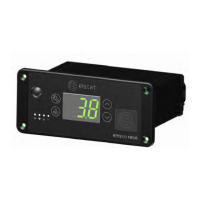
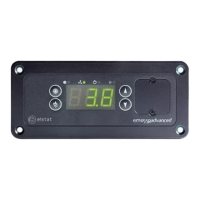
Describes the user interface and display module, including variants and components.
Details the power supply module, its dimensions, mounting, and electrical connections.
Specifies the IEC and UL ratings for the controller's relays.
Specifies the acceptable input ranges for appliance, condenser, and evaporator sensors.
Details the environmental specifications for the power supply and control display modules.
Details the types of temperature sensors and their proper placement and function.
Explains the door switches used for detecting door openings and their alignment.
Describes motion sensors for detecting activity and their installation requirements.
Outlines the sequence of displays shown during the controller's startup process.
Explains the functions of the controller's buttons for end-users and service engineers.
Describes the main menu options available within the SubZero firmware.
Provides a visual flowchart of the controller's menu structure and navigation.
Provides step-by-step instructions for accessing the controller's menus.
Details how to perform the relay test to check compressor, lights, and fan functionality.
Guides on testing sensors and door switch inputs for proper connection and readings.
Details how to test the motion sensor's ability to detect movement.
Explains how to view and interpret the last three recorded cooler faults or alarms.
Provides instructions for performing a half reset to clear the controller's self-learning matrix.
Describes how to access and interpret controller operational statistics like activity and runtime.
Explains the 'limp home' mode's role in managing faults and ensuring basic operation.
Describes door open alarms, including displays and the duration of alarm conditions.
Details the 'limp home' mode behavior for door alarms, including audio and display indicators.
Explains alarms related to temperature sensor failures and their associated limp home modes.
Describes appliance sensor failure alarms and the controller's response in limp home mode.
Explains refrigeration system failure alarms and their limp home operation.
Provides checks for Refrigeration System Failure (rSF) alarms.
Lists checks for issues related to the door switch input.
Lists checks for problems with the cooler door itself.
Lists checks for problems with the appliance sensor.
Lists checks for problems with the condenser sensor.
Lists checks for problems with the evaporator sensor.
Troubleshooting steps for issues related to freeze-up protection.
Troubleshooting steps for condenser high temperature alarms.
Addresses miscellaneous operational issues like lights, fans, and compressor problems.
Lists controller parameters categorized by their functional area.
Explains how the controller validates parameter values to prevent conflicts.
Defines the compressor cut-out temperature in ready mode.
Defines the compressor cut-in temperature relative to the set point.
Calibrates or offsets temperatures measured by the appliance sensor.
Sets the minimum time between compressor cycles for pressure equalization.
Defines the delay before the controller switches to saving mode.
Sets the delay for turning off cooler lights when entering saving mode.
Ensures product temperature readiness before retail outlet opening time.
Sets maximum continuous compressor runtime before triggering rSF alarm.
Option to set the controller's temperature units to Celsius or Fahrenheit.
Defines compressor cut-in temperature when added to the saving set point.
Defines the compressor cut-out temperature during saving mode.
Sets the temperature to stop cooling to prevent freeze-up.
Sets the period between defrost cycles for evaporator efficiency.
Defines the maximum time allowed for a defrost cycle.
Defines the active period of the evaporator fan when the compressor is off.
Defines the inactive period of the evaporator fan when the compressor is off.
Sets the maximum door open time before sounding the alarm buzzer.
Defines the duration of the buzzer for door open alarm conditions.
Enables or disables the input signal from the motion sensor.
Controls the rate of change for the displayed temperature for stability.
Defines the minimum voltage allowed before switching off the compressor.
Defines the maximum voltage allowed before switching off the compressor.
Sets the temperature at which the defrost cycle will end.
Defines maximum condenser temperature and triggers an alarm.
Defines minimum door openings or motion counts to indicate activity.
Sets evaporator fan operation to prevent condensation.
Enables or disables the warning buzzer for alarm conditions.
Disables saving mode temperatures, maintaining ready mode temperatures.
Defines whether a 1-day or 7-day learning period is used.
Determines if temperature or 'USE' is displayed in Ready mode.
Keeps cooler lights on at all times for display purposes.
Provides the option for time-based or temperature-based defrost cycles.
Option to end defrost by duration or temperature.
Defines evaporator sensor temperature that activates off-cycle defrost.
Enables auxiliary relay for defrost heater or solenoid valve control.
Allows logging of stock sensing data to be sent to the cloud.
Lists various certifications and compliance marks for the product.
Details Bluetooth specific certifications and approvals.
Explains common acronyms used throughout the manual.
Defines terms related to the controller and its accessories.
 General
| Brand | Elstat |
|---|---|
| Model | Nexo CMS200 |
| Category | Controller |
| Language | English |


 To Next Page