Reference Manual
00809-0100-4840, Rev. BA
July 2008
Rosemount 3100 Series
www.rosemount.com
Section 2 Transmitter Overview
Theory of Operation . . . . . . . . . . . . . . . . . . . . . . . . . . . . . . page 2-1
Components of the Transmitter . . . . . . . . . . . . . . . . . . . . page 2-2
System Architecture . . . . . . . . . . . . . . . . . . . . . . . . . . . . . . page 2-3
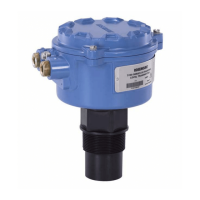
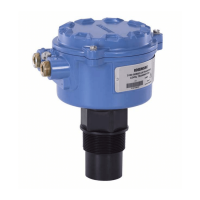
THEORY OF OPERATION The Rosemount 3100 Series transmitter is designed to be mounted above a
liquid, and uses ultrasonic pulses to continuously measure the distance to the
surface of the liquid. The microprocessor-controlled electronics calculates
distance to the liquid level from the time delay between the transmitting and
receiving of the signals (Figure 2-1).
When programmed with the bottom reference of the application – usually the
bottom of a tank – The Rosemount 3101 will compute the liquid depth (level),
and output a 4–20 mA signal proportional to that level.
The Rosemount 3102 and Rosemount 3105 can compute level,
distance-to-surface, volume, or flow, and output a 4–20 mA signal
proportional to the selected variable.
An LCD inside the enclosure displays the selected measurement.
Programming is achieved using integral push buttons inside the enclosure, or
by remote communication using HART
®
(on The 3102 and The 3105 only).
The 3105 may be mounted in a hazardous area if powered from a protected
power supply.
Figure 2-1. Typical Application
Using a Rosemount 3100 Series
Transmitter
Distance
Level


 To Next Page
 Loading...