211
WSG-1068 COOLING SYSTEM
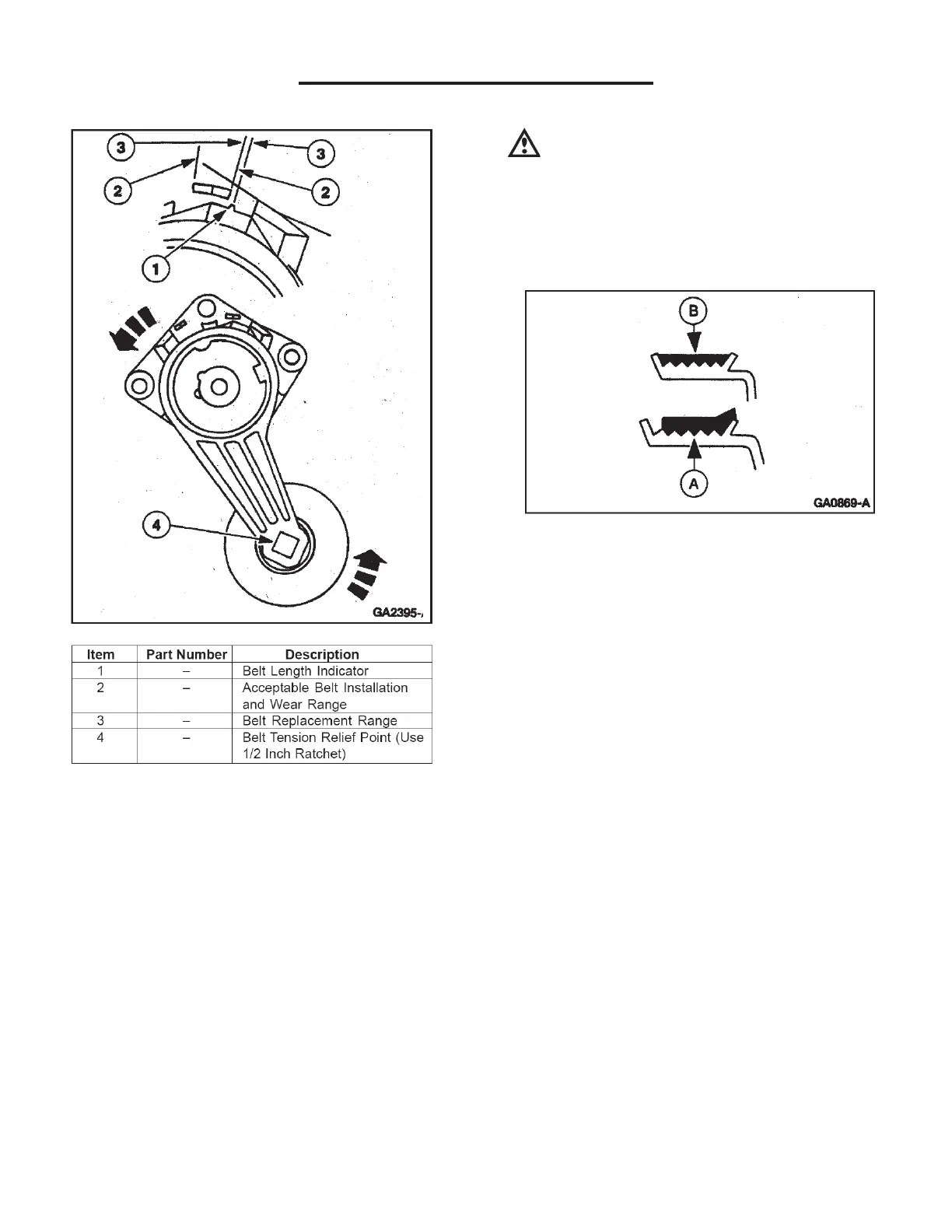
Drive Tensioner/Belt Length Indicator
Automatic tensioners are calibrated at the factory to
provide the correct amount of tension to the belt. Unless
a spring within the tensioner assembly breaks or some
other mechanical part of the tensioner fails, there is no
need to check tensioners for proper tension.
The only mechanical check that need be made, if you
have any doubt about the tensioner function, would be to
remove the belt in the area of the tensioner, to avoid belt
contact, then using the proper tool, rotate the tensioner
from its relaxed position through its full stroke and back
to the relaxed position to assure that there is no “stick,
grab, bind,” and to assure that there is tension on the
spring. It is a normal condition for the tensioner to be
moving, under certain conditions, when the engine is
running. If the tensioner meets this criteria, it should be
assumed to be a good tensioner.
Drive Belt Misalignment
CAUTION: Incorrect drive belt installation will
cause excessive drive belt wear and may cause the
drive belt to come off the drive pulleys.
Non-standard replacement drive belts may track
differently or improperly. If a replacement drive belt
tracks improperly, replace it with an original equipment
drive belt to avoid performance failure or loss of belt.
With the engine running, check drive belt tracking. If the
A edge of the drive belt rides beyond the edge of the
pulleys, noise and premature wear may occur. Make
sure the B drive belt rides correctly on the pulley. If a
drive belt tracking condition exists, proceed with the
following:
Visually check the drive belt tensioner for damage,
especially the mounting pad surface. If the drive belt
tensioner is not installed correctly, the mounting surface
pad will be out of position. This will result in a chirp or
squeal noises.
With the engine running, visually observe the
grooves in the pulleys (not the pulley flanges or
pulley front surfaces) for excessive wobble.
Replace components as required.
Check all accessories, mounting brackets and
the drive belt tensioner for any interference that
would prevent the component from mounting
properly. Correct any interference condition and
recheck belt tracking.
Tighten all accessories, mounting brackets, and
drive belt tensioner retaining hardware to
specification.
Recheck the drive belt tracking.



 To Next Page