276
WSG-1068 ENGINE CONTROLS
The actuator is limited to a maximum opening of 20%. If
“Power Derate 2” is active, it will remain active until the
active DTC goes away and the igniti n input to the GCP
(usually the ignition switch) is cycled.
DTC 2115: FPP1 higher than IVS limit.
DTC 2139: FPP1 lower than IVS limit.
DTC 2116: FPP2 higher than IVS limit.
DTC 2140: FPP2 lower than IVS limit.
DTC 2126: FPP1 higher than FPP2.
DTC 2121: FPP1 lower than FPP2.
DTC 1171: MegaJector delivery pressure higher
than expected.
DTC 1172: MegaJector delivery pressure lower
than expected.
DTC 1173: MegaJector communication lost.
DTC 1176: MegaJector internal actuator fault
detection.
DTC 1177: MegaJector internal circuitry fault
detection.
DTC 1178: MegaJector internal communication
fault detection.
DTC 606: COP failure (Internal GCP failure).
DTC 1612: RTI 1 loss (internal GCP failure).
DTC 1613: RTI 2 loss (internal GCP failure).
DTC 1614: RTI 3 loss (internal GCP failure).
DTC 1615: A/D loss (internal GCP failure).
DTC 1616: Invalid interrupt (internal GCP
failure).
DTC 601: Flash checksum invalid (internal GCP
failure).
DTC 604: RAM failure (internal GCP failure).
Fault Low Rev Limit
The engine RPM will be limited to a maximum of 1600
RPM. If the “Fault Low Rev Limit” is active, it will remain
active until the active DTC goes away and the ignition
input to the GCP (usually the ignition switch) is cycled.
DTC 2122: FPP1 high voltage.
DTC 2123: FPP1 low voltage.
DTC 2115: FPP1 higher than IVS limit.
DTC 2139: FPP1 lower than IVS limit.
DTC 2116: FPP2 higher than IVS limit.
DTC 2140: FPP2 lower than IVS limit.
DTC 2126: FPP1 higher than FPP2.
DTC 2121: FPP1 lower than FPP2.
DTC 1531: IVS/Brake interlock failure.
Force to Idle
The engine RPM will be limited to a maximum of 800
RPM. If the “Force to Idle” is active, it will remain active
until the active DTC goes away.
DTC 2122: FPP1 high voltage.
DTC 2123: FPP1 low voltage.
DTC 2128: FPP2 high voltage.
DTC 2127: FPP2 low voltage.
DTC 2115: FPP1 higher than IVS limit.
DTC 2139: FPP1 lower than IVS limit.
DTC 2116: FPP2 higher than IVS limit.
DTC 2140: FPP2 lower than IVS limit.
DTC 2126: FPP1 higher than FPP2.
DTC 2121: FPP1 lower than FPP2.
Intermittent MIL
Conditions that are only present from time to time are
called intermittents. To resolve intermittents, perform
the following steps:
1. Evaluate the history of DTC’s observed with this
particular engine.
2. Evaluate the symptoms and conditions described by
the customer.
3. Use strategy-based diagnosis, especially where it
relates to the elimination of bad connectors and
wiring.
4. When using a personal computer with Ford
software, data-capturing capabilities are available
that can assist in detecting intermittents. Contact an
EDI customer service representative at (1 800 220 2700)
for more information.
Malfunction Indicator Lamp (MIL) DTC
Retrieval Procedure
NOTE: DTC’s can be retrieved from the engine control
module (GCP) by using either the MIL or an IBM
compatible personal computer or hand held Palm Pilot®
using the optional serial interface available. Refer to
Equipment Setup for information about using a personal
computer to assist with unit diagnosis.
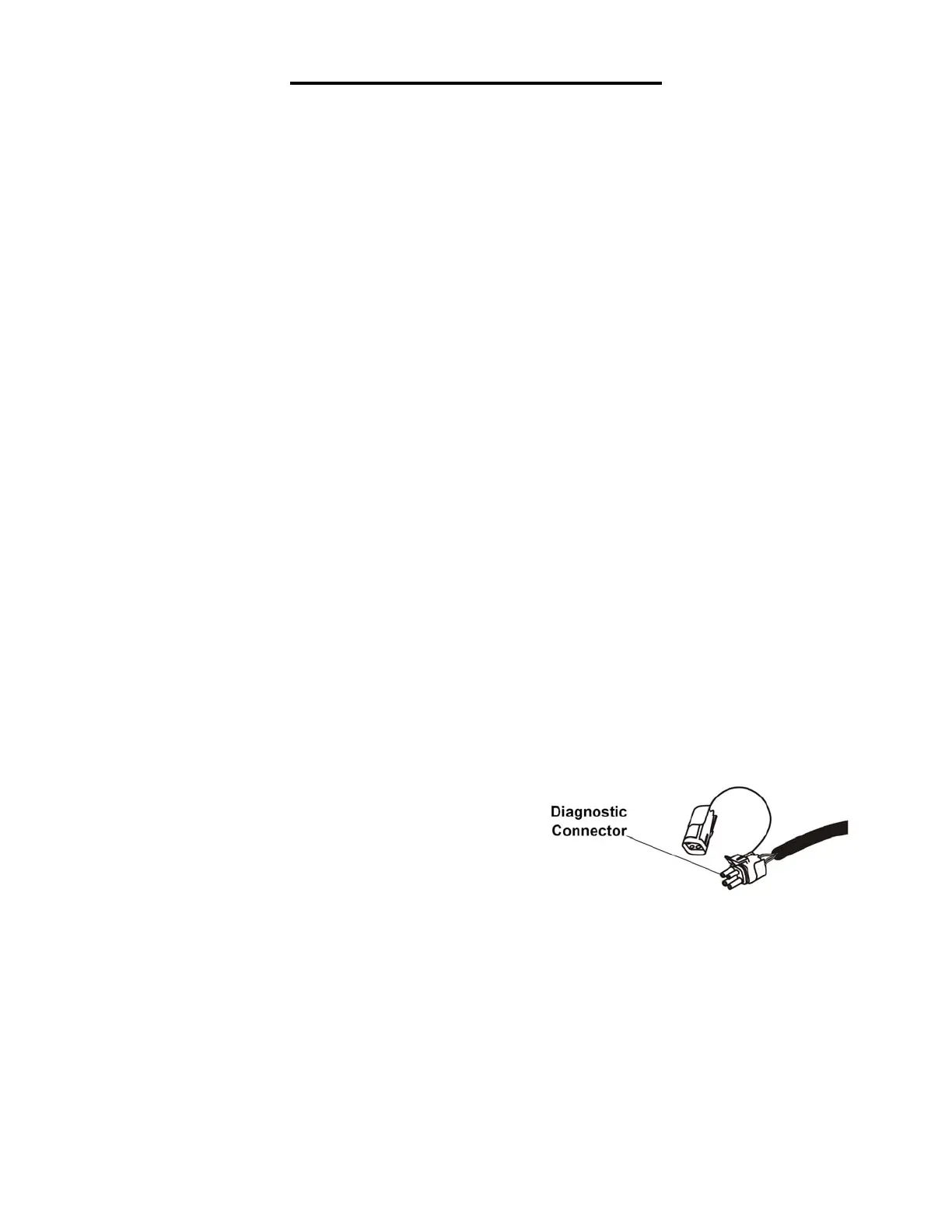
DTC’s can be retrieved by shorting the Self Test Input
(STI) connector to ground. The STI circuit is a white/
purple wire exiting pin 3 of the 42 pin connector. The STI
white/purple wire branches off to terminal “A” of the 4
pin diagnostic connector. If no DTC is stored with key
on/engine off (KOEO), a DTC 123 is flashed, indicating
that all systems are OK.
During key on/engine running (KOER) operation, with
no DTCs stored, the MIL is not illuminated. If during



 To Next Page