REV.-A
Because the carriage is driven by a step motor, the printing direction can be changed at any time, and
the carriage can be stopped at any position. Carriage motor control is effected by an open-loop system
which switches the phases in accordance with the set speeds.
-f-e’’Jw-JL&aau
(phase switching
1
II
1 1 1
1
t
1 1
1
I
1
;~;
#
:4
Itc
1
“
tcz
“
1
“tc28
;
t(constant)
I
‘“1
I
or tc14
;
+D28
;
Holding
-l
A
I
w
or
t014
#
Acceleration area “
Prlntln
area
“
(Accelerating)
!
Deceleration “
(constan speed)
area
(Deceierat ing)
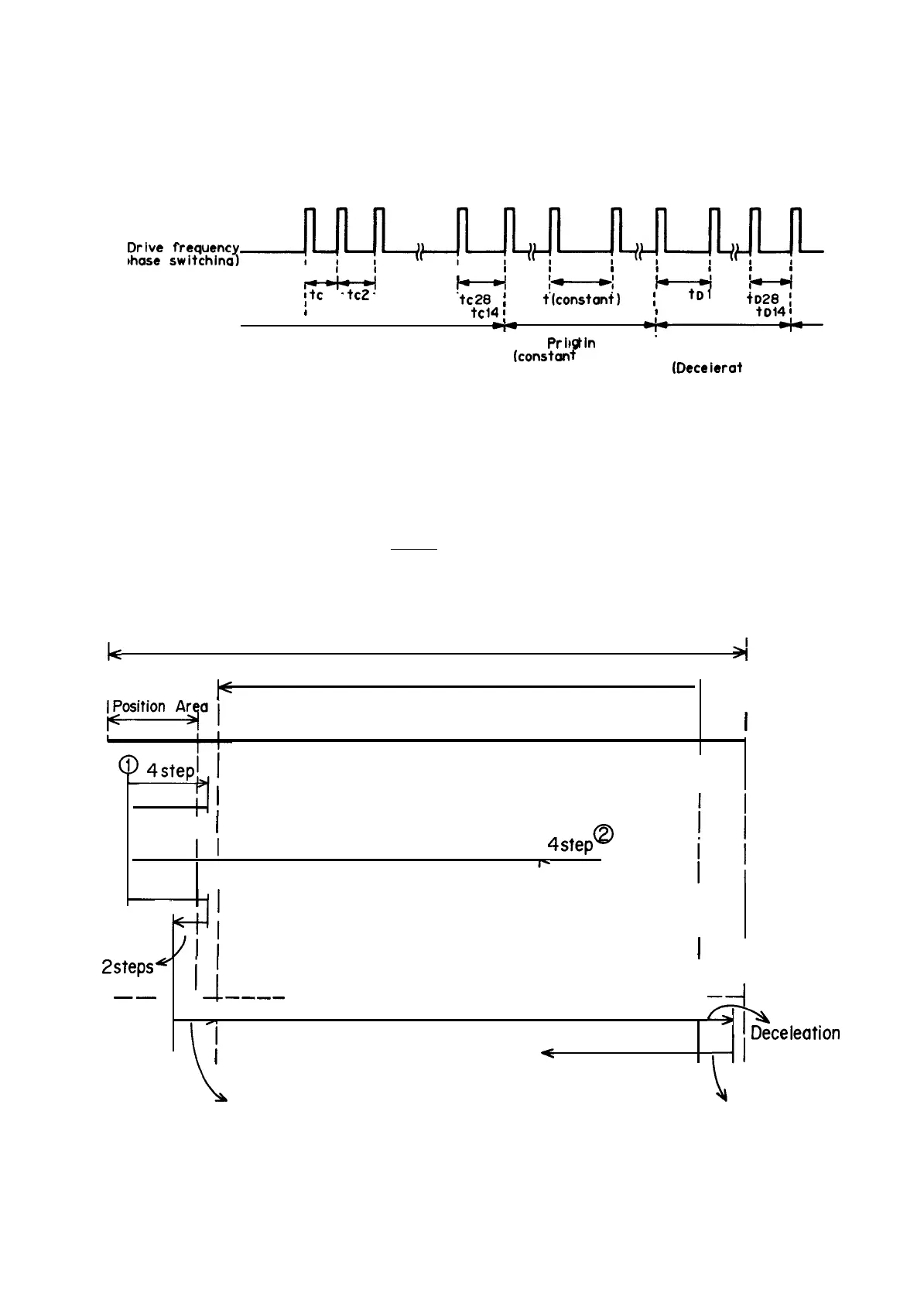
Figure 2-35. Carriage Motor Control
Home-Position Seek
The control that causes the carriage to move to the home position when the power is turned on is called
home-position seek. Figure 2-36 shows the home-position seek operation.
When power is applied, the printer executes 2-2 phase excitation for 20 or 30 ms (regardless of the
phase switching timing) and checks the HOME signal. The result of this check determines whether the
starting position should be 1 or 2. The carriage enters the home position only once during the
initialization.
k
CR Movable Area
I
I Home
Printing Area
i
>
I
I
I
<
I
a
Ii
<
II
4step
I
P
1’
I
2steps=
I
End of Home Position seek
I
I
.—
–
--t
-1
———.
—— — —— — — ——— ——— ———— —
Constant
\
I
+
>
Constant
Deceieation
I
<
i’
Acceleration
Acceleration
Figure 2-36. Home-Position Seek
2-33


 To Next Page
 Loading...