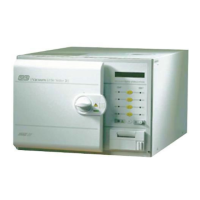
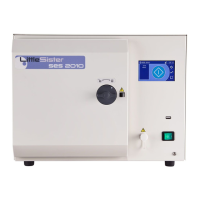
SES 2000 AUTOCLAVE Part 3
ST-SM8l Page 29 of 43
PART 3 MAINTENANCE
Calibration Procedure (Fig. 8)
3.48 The autoclave control programme contains a
special calibration sequence to ensure accurate
calibration in the shortest possible time. Do not set-up
the sterilizer by carrying out normal sterilizing cycles; it
is important to proceed methodically as follows:
a With the unit cover removed, insert needle
thermocouple probe from a calibrated chart
recorder into the manifold test port (Fig. 4, item 19)
at the rear of the chamber. Ensure that the chart
recorder has thoroughly ‘warmed up’.
b Switch off the autoclave. Ensure the water reservoir
is full and, for safety reasons, ensure that the
reservoir is then properly covered. Ideally, a test
load should be placed in the chamber; but this is not
essential. With power switched off, press and hold
the two centre buttons on the front panel (121°C
without drying and 134°C with drying). Holding-in
these two buttons, switch on power. The display
‘CALIB’ will appear, the solenoid door lock will
engage (CE ONLY, see note page 38) ‘FILL’ will be
displayed for approximately 150 seconds followed
by ‘HEAt’ as the heater is switched on. The unit will
heat to the temperature reached during the 121°C
cycle.
c When the temperature has been achieved and the
machine has been in the sterilizing mode for 5 to 6
minutes calibrate to between 121°C and 124°C on
the chart recorder. Carefully adjust R 17 on the
controller board (clockwise to increase) until this
temperature is achieved. Adjust the control a little
at a time and observe the effect after each
adjustment. Once this setting is correct the display
should read values similar to those shown on the
chart recorder.
Note 1
If the chart trace ‘sawtooth’ effect is excessive
switch off the sterilizer, wait for 10 seconds and
switch on to allow the chamber contents to
discharge back to the reservoir, then check the
seating of the temperature sensor. It should be in
good thermal contact with the flat bottom of the
‘well’ formed in the outlet manifold at the rear of the
chamber. A small amount of zinc oxide-based
heat transfer compound should be smeared on
the surface of the sensor. If it has been necessary
to make readjustments to the temperature sensor,
switch off power then re-start the calibration cycle
as described in para. (b).
Note 2
The next adjustment will have to be completed
within approximately three minutes, before two
‘bleeps’ are heard indicating completion of the
134°C cycle. At this point temperature will fall to
122.5°C. Note, however, that it is possible to repeat
the 134°C cycle at any time by pressing the ‘134°C
without drying’ programme button again.
d Push the 134°C button on the front panel. After a
short time an audible signal should be heard.
Release the button. The sterilizer will now perform
a 134°C cycle from the baseline of 122.5°C.
Once
the sterilizing temperature has been reached and
the chart recorder trace has levelled-off, adjust
R14 on the controller board (clockwise to
decrease) carefully until the recorder trace
indicates between 134°C and 138°C.
e Repeat (c) and (d) to ensure consistent calibration
is achieved.
f Once calibration is complete, switch off the unit,
wait for 10 seconds then switch it on. The discharge
valve will now open and exhaust steam and
condensate back into the reservoir. After this has
happened, switch off and seal the adjustment
positions of potentiometers R17 and R14 on the
controller board (e.g. with nail varnish).
Note 1
Issue 7 of pcb (top left-hand corner). Turn R1
(instead of R17) counter-clockwise to increase
temperature, and turn R2 (instead of Rl4) clockwise
to increase temperature. Issue 8 March 1991.
Revert to original instructions.
Note 2
Running calibration cycles will not advance the
cycle counter. Some of the error detection systems
are automatically ‘switched off’ during the
calibration phase.
g A label should be fixed to the autoclave indicating
the date on which it was calibrated, the technician
responsible and the date when it should next be
calibrated. The recorder charts should be kept.
The temperature sensing systems used in the
autoclave have been shown to be reliable and
relatively drift-free over long periods. Nevertheless
it is recommended that the calibration be checked
at least every 12 months, or more often if the
sterilizer is heavily used.


 To Next Page