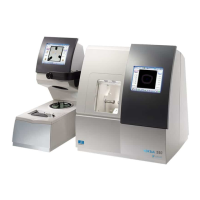
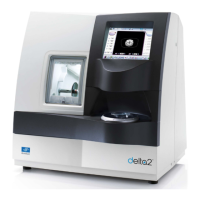
Make sure that the target centering marks line up with the lens centering marks.
To carry out lens blocking, refer to the section .Centering a lens > Blocking a lens (p.80)
7. Centering a lens for a high-base frame
At the end of a tracing, if a frame is considered as a high-base frame, this indicator is displayed in the information bar.
3D compensation
The PD and pupillary height measurements as well as the lens centering are done in two dimensions. Yet, the frame is treated in
three dimensions:
3D compensation takes into account all frame characteristics (x, y, z, curve, pantoscopic tilt, etc.) to ensure that the center of the
wearer's pupil is at the optical center of the lens. For an optimal job, the on-screen positioning of the centering indicators always
takes account of 3D compensation.
Match between frame base and lens base
To do a job involving a high-base frame, use lenses whose base matches that of the frame (maximum difference of 0.7 D).
Refer to the centering procedure for the particular type of lens:
Centering a single vision lens (p.42)
Centering a progressive lens (p.52)
Centering a bifocal lens (p.58)
Centering an executive lens (p.64)
Centering a mid-distance lens (p.69)
In automatic centering, centering using three focimeter dots, micro-engravings or manufacturer markings, two shapes appear in the
work area:
Initial shape (without 3D compensation)
Corrected shape (with 3D compensation)
Examples:
The lens is centered and ready to be blocked.>


 To Next Page
 Loading...