TR-4800E
Tally Router
Revision 1.1 Page - 13
3.6 WET POWER
The TR-4800E has a dedicated wet power source that can be used to provide voltage to GPIs and
GPOs. This allows the GPIO to be either powered or unpowered depending on the requirements of the
equipment that needs to be interfaced to (see section 2.7). This wet power source is provided to all of
the rear 37-pin D-Sub connectors as +WET and –WET. It is also used to power the front panel binding
post GPIOs (+BP16 option only).
The tally router’s wet power is software-selectable between several sources, and can also be turned off
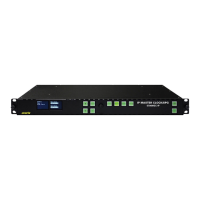
completely. The front panel has three green LEDs that indicate the currently selected wet power
source. There is also a red “On” LED that indicates if power is present on the selected source. This
LED will be illuminated when power is present, and off when power is not present or a current fault has
occurred (polyfuse tripped).
None
Wet power +WET and –WET will be disconnected (no voltage). All of the
front panel LEDs will be off.
+5V
The internal +5V power will be connected to +WET and –WET will be
connected to chassis ground. The front panel will have the “+5V” LED
+12V
The internal +12V power will be connected to +WET and –WET will be
connected to chassis ground. The
front panel will have the “+12V” LED
illuminated.
External
The WET PWR binding posts on the rear of the unit (front panel for +BP16
option) will be used as the source for wet power. The red binding post will be
connected to +WET and the black binding post will be connected to –WET
(isolated from chassis ground). The front panel will have the “EXT” LED
illuminated.
Table 2-11: Wet Power Source Selections
The wet power source +WET is protected by a 1.5 Amp polyfuse, no matter which source is selected.
This means that if an external wet voltage source is selected that is capable of supplying more than 1.5
Amps, the current through the tally router will still be limited to 1.5 Amps. Care must be taken to limit
the cumulative +WET current draw of all powered GPIO to 1.5 Amps or less.
If more current than the maximum is applied to the GPO the polyfuse will heat up and open. This
process happens very quickly if the current is high, but may take hours if the current is only a little
above the maximum. When the polyfuse opens, the front panel “On” LED will turn off. The polyfuse will
then begin to cool and will eventually reset on its own. If the overcurrent fault is not removed, the
process will repeat itself any may cause a “strobing” effect with the “On” LED.


 To Next Page