
 Need help?
Do you have a question about the EWM Tetrix 350 and is the answer not in the manual?
Explains the meaning and usage of DANGER, WARNING, CAUTION, and NOTE safety symbols.
Covers hazards from electromagnetic fields, electric shock, radiation, heat, explosions, and unauthorized repairs.
Addresses hazards from smoke, gases, fire, noise, and risks associated with coupling multiple power sources.
Details operator obligations, risks from non-genuine parts, stray currents, and mains connection requirements.
Covers safe handling of gas cylinders, transport risks, tipping, and disconnection of supply lines.
Specifies requirements for installation sites and ambient conditions for operation and storage.
Details the intended use and describes various welding applications including Plasma, TIG, and MMA.
Introduction to the machine's control panel and its primary operating elements.
Rotary transducer for setting welding parameters like current, thickness, and gas pre-flow.
Setting the main current for TIG welding and pulse current.
Instructions for switching the activArc function on/off and adjusting its characteristic.
General safety warnings regarding electric shock, burns, and the use of protective dust caps.
Details safety precautions for installation, site requirements, and avoiding damage from incorrect connections.
Precautions for optimal duty cycle related to machine cooling and ventilation.
Highlights risks of burns and fires from incorrect workpiece lead connections and stray currents.
Details hazards associated with improper mains connection and necessary safety precautions.
Details the connections for the welding torch cooling system and required precautions.
Diagram and notes for connecting the plasma welding torch using a gas metering unit (GMU).
Lists and describes the components and steps for connecting the plasma torch with a GMU.
Diagram and notes for connecting the plasma welding torch without a gas metering unit (GMU).
Safety warnings for handling gas cylinders and precautions for gas supply faults.
Diagram and steps for connecting the shielding gas supply, including pressure regulator setup.
Guidance on setting the shielding gas quantity, including a rule of thumb and potential issues.
Explains how to select welding tasks (JOBs) and lists factory-set JOB configurations.
Step-by-step guide for loading an existing JOB from the machine's memory.
Explains how welding parameters are set and displayed, including symbols used.
Details the pilot arc activation and deactivation, including safety measures for tungsten electrodes.
Safety precautions and detailed steps for connecting the TIG welding torch and workpiece lead.
Safety warnings for gas cylinders and precautions regarding shielding gas supply issues.
Diagram and steps for connecting the shielding gas supply, including pressure regulator setup.
Introduces the TIG Synergic operating principle and its three basic parameters for task selection.
Explains automatic parameter adjustment in the functional sequence during synergic operation.
Instructions on how to set the welding machine to synergic or conventional operating principle.
Guide to selecting welding tasks using machine control buttons and signal lights.
Details two methods for setting the welding current: via sheet metal thickness or directly.
Detailed steps for starting the arc using HF ignition without workpiece contact.
Detailed steps for starting the arc by contact ignition (Liftarc).
Rotary transducer for setting TIG welding parameters like current, thickness, and gas pre-flow.
Details the TIG non-latched operating mode, including its 1st and 2nd cycle processes.
Details the TIG latched operating mode, explaining the steps for welding and termination.
Explains the TIG spotArc process, its operating modes (long/short interval), and spot time setting.
Details the TIG Spotmatic process, including its unique ignition and activation methods.
Explains the activArc process for constant power and how to adjust its parameter.
Safety precautions for MMA welding, including handling electrodes and shielding gas connection.
Details safety for connecting the electrode holder and workpiece lead for MMA welding.
Introduction to the welding machine's 16 welding programs and how parameter changes affect them.
Guide to selecting and adjusting welding programs using the machine control.
Introduces the JOB Manager mode for loading, copying, and saving welding tasks (JOBs).
Details the process of copying pre-defined welding tasks (JOBs) to the free memory.
Step-by-step guide for loading an existing JOB from the machine's free memory.
Explains how to use the key switch to protect welding parameters from unauthorized adjustment.
Introduces simultaneous welding on both sides and the importance of synchronization.
Details the pins, signals, and designations for the TIG interface used in mechanised welding.
Details configuration steps for TIG potentiometer torch connection, including safety and jumper settings.
Resets settings to factory defaults: off (aus), CFG (machine config), CPL (complete).
Details maintenance tasks and their recommended intervals (daily, monthly, annual).
Emphasizes safety during maintenance work and prohibits unauthorized repairs or modifications.
Provides a checklist for diagnosing and rectifying common functional errors and connection problems.
Addresses issues causing no arc ignition and their remedies, like incorrect ignition type settings.
Diagnoses causes of bad arc ignition, such as material inclusions or poor current transfer.
Identifies causes of unstable arcs, including material inclusions and incompatible parameters.
Diagnoses pore formation causes like inadequate gas shielding, torch issues, or condensation.
Lists machine error messages, possible causes, and remedies for common faults like Err 3 to Err 19.
Addresses coolant flow and temperature errors (Err 20, Err 22) and their solutions.
Diagnoses HF choke excess temperature errors (Err 23) and provides remedies.
Covers various electronics errors (Err 32-39) and their troubleshooting steps.
Addresses ignition errors (Err 48) and emergency stop circuit errors (Err 51).
Addresses arc interruption faults (Err 49) and advises contacting service.
Step-by-step guide for resetting all customized welding parameters to factory settings.
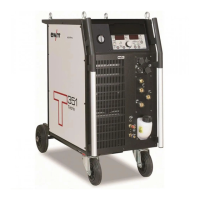
Provides detailed technical specifications for the Tetrix 350 AC/DC Plasma welding machine.
 General
| Brand | EWM |
|---|---|
| Model | Tetrix 350 |
| Category | Welding System |
| Language | English |


 To Next Page