Video
X is retrigger CV
Y is V/octave pitch CV
Z selects the sample
A is left audio output
B is right audio output
Z press retriggers sample
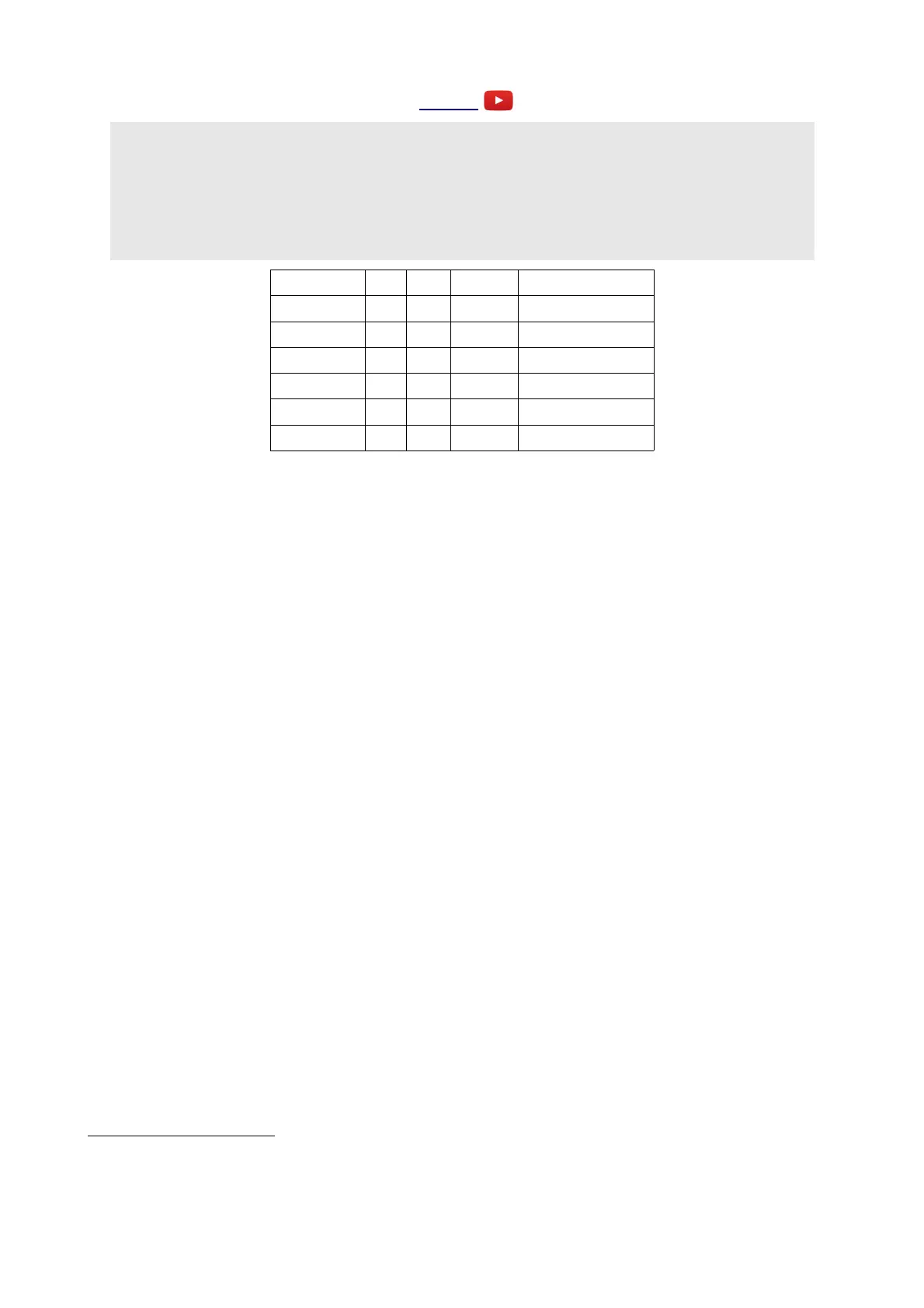
Parameter Min Max Default Description
0 0 99 0 Folder.
1 -8 8 0 Octave shift.
2 0 99 0 Envelope time.
3 -1 4 -1 MIDI mode.
4 0 24 2 Pitch bend depth.
5 0 127 0 Start offset.
This algorithm is much the same as 'I-1 Audio Playback', except that it forgoes the sample start
position input and instead has a pitch input.
Y is the pitch input, using the 1V/octave standard. 0V corresponds to the sample playing at its
natural pitch. Positive voltages speed up playback; negative voltages slow it down.
Parameter 1 shifts the pitch up or down in octave increments.
Note that there is a limit to how fast data can be streamed from the SD card. If you speed playback
up by a large factor, you may get dropouts.
Parameters 0 & 2 are the standard sample folder and envelope time parameters, described above.
Parameter 5 offsets the sample start point. A parameter value of 96 corresponds to the full length of
the file; values above 96 are treated as 96. The reason for this scaling is that when automating the
parameter via MIDI it is straightforward to exactly dial in useful fractions of the length e.g. 48 for
half way, 32 for a third of the way through etc.
MIDI Input: MIDI note on & off messages are handled equivalently to a trigger or gate on the X
input – that is, a note on retriggers the sample, and if the envelope time is non-zero, a note off will
stop the playback. Additionally, the pitch of the note on message is used instead of the Y input CV,
so you can effectively play the disting like a sampler from a MIDI keyboard. MIDI note 48 (C3)
corresponds to a 0V input i.e. playing the sample at its natural pitch. MIDI pitch bend is supported;
parameter 4 sets the bend depth in semitones.
Parameter 3 'MIDI mode' allows for polyphonic operation, using multiple disting mk4 modules. If
the parameter is -1 or 0, the module responds to MIDI like a monophonic synthesizer
13
. Otherwise,
the parameter is a 'voice ID' in a polyphonic setup. By giving different voice IDs to multiple
distings, and feeding them the same MIDI, you can create a polyphonic sample player where each
disting takes a different note of a held chord.
(Recall that the Select Bus provides a convenient way to send the same MIDI to multiple distings
without extra cabling - see above.)
By default the polyphonic operation uses a 'lowest voice' allocation scheme – each new note is
allocated to the voice with the lowest ID that is not currently playing a note. It is also possible to
13 It is the intention that in future MIDI modes -1 and 0 might differ, for example in reusing the CV inputs that are
likely not used if you're controlling the module via MIDI, but currently they are the same.
Page 77


 To Next Page