7381
User’s Guide
14
:WWarning
To prevent personal injury, prepare a place for extracted probes. Probes can be
extremely hot when removed from the Bath. The Bath generates extreme
temperatures.
Carefully place probes on a heat/cold resistant surface or rack until they are at room
temperature. Wipe the probe with a clean soft cloth or paper towel before you insert the probe
into another bath. This prevents the mixing of fluids from one bath to another. If the probe was
calibrated in liquid salt, carefully wash the probe in warm water and dry completely before you
transfer it to another fluid. Make sure that the probe is completely dry before you insert it into hot
fluid.
Comparison Calibration
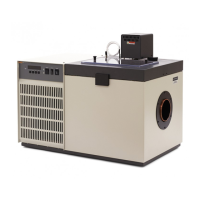
Comparison calibration tests a probe to be calibrated (device under test, DUT) against a
reference probe. After you insert the DUT into the Bath, allow sufficient time for the probes to
settle and the Bath temperature to stabilize.
A significant benefit of bath use, instead of a dry-well, to calibrate multiple probes is that the
probes do not need to be identically constructed. The bath fluid lets you calibrate different probe
types simultaneously. However, stem effect from different probe types is not totally eliminated.
Even though all baths have horizontal and vertical gradients, these gradients are minimized
inside the Bath work area. Nevertheless, insert the probes to the same depth in the bath fluid.
Make sure to insert all probes deep enough to prevent stem effect. Fluke Calibration
recommends a general rule for immersion depth to reduce the stem effect to a minimum: 20 x the
diameter of the DUT + the sensor length. Do not submerge the probe handles. If the probe
handles get too warm during calibration at high temperatures, use a heat shield just below the
probe handle. This heat shield can be as simple as aluminum foil slid over the probe before you
insert it into the Bath. It can be as complicated as a specially-designed reflective metal
apparatus.
For best results, when you calibrate over a wide temperature range, start at the highest
temperature and progress down to the lowest temperature.
To hold the probes in place in the Bath, use probe clamps or drill holes in the access cover.
Design other fixtures to hold the probes when necessary. Keep the reference probe and the DUT
probe(s) as closely grouped as possible in the Bath work area. Bath stability is maximized when
the Bath work area is kept covered.
To prepare for calibration:
• Place the reference probe in the Bath work area.
• Place the DUT in the Bath work area as close as possible to the reference probe. Do not
touch the probe to the Bath tank surface areas.


 To Next Page