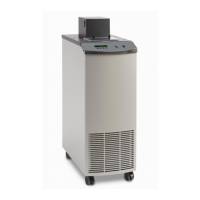
Calibration Bath
General Operation
15
Calibrate Multiple Probes
Fully loading the Bath with probes increases the temperature stabilization time after you insert
the probes. Use the reference probe as the guide and make sure that the temperature is stable
before you start calibration.
General Operation
The information in this section is for general information only. Do not use this section as the basis
for calibration laboratory procedures. Each laboratory must write their specific procedures.
Heat Transfer Fluid
Many fluids work with the Bath. When you choose a fluid, consider the characteristics of the fluid.
Temperature Range
One of the most important characteristic considerations is the fluid temperature range. Few fluids
work well throughout the entire bath temperature range. Bath temperature must be within the
safe and useful temperature range of the fluid. The lower temperature range of the fluid is
determined by the fluid freeze point or by the temperature at which the viscosity is too great. The
upper temperature is usually limited by vaporization, flammability, or chemical breakdown of the
fluid. Fluid vaporization at higher temperatures can adversely affect temperature stability
because of cool condensed fluid that drips into the Bath from the lid.
To limit Bath temperature, set the safety cutout so that the temperature cannot exceed the safe
operating temperature limit of the fluid, see Cutout Set-point.
Viscosity
Viscosity is a measure of the fluid thickness or how easily the fluid can be poured and mixed.
Viscosity affects the temperature uniformity and Bath stability. With lower-viscosity fluid, mixing is
better and creates a more uniform Bath temperature. This improves bath response time so the
Bath maintains a more constant temperature. For good control, the viscosity should be
<10 centistokes. 50 centistokes is about the practical upper limit of allowable viscosity. Viscosity
greater than this causes poor control stability because of poor stirring and can overheat or
damage the stirring motor.
Viscosity can vary greatly with temperature, especially with oils. Viscosity increases as
temperature decreases. When fluid viscosity increases, stability performance of the Bath can
decrease.
Make sure stirring occurs at all temperatures. When you use higher-viscosity fluids, the controller
proportional band (see Proportional Band) may need to be increased to compensate for the
reduced response time. Otherwise, the temperature can oscillate.
Specific Heat
Specific heat is the measure of the heat storage ability of the fluid. Specific heat, to a small
degree, affects the control stability and heating/cooling rates. Generally, a lower specific heat
means quicker heating and cooling. The proportional band can require adjustment depending on
the specific heat of the fluid.


 To Next Page