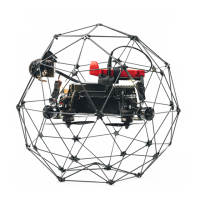
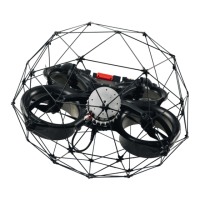
Read carefully and understand these important safety instructions before flying to
prevent any risk of accident and serious injuries.
§ The pilot should always act accordingly to his or her best judgment, focusing on the safety of the
people and the environment he or she is flying in.
§ Any flying robot must be operated according to the laws of the country they are used in. It is the
sole responsibility of the pilot to be informed of the applicable restrictions.
§ The pilot MUST always go through the checklists before, during and after each flights.
§ It is strongly recommended to avoid any operation inside the robot’s cage when the battery is
plugged in, except turning off the robot (unplugging the battery).
§ Under no circumstances, objects, fingers or any other body parts may enter inside the cage
while the robot is armed or while the propellers are spinning. It may result in serious injuries for
the person and damage the robot.
§ Using other devices in combination with Elios other than approved by Flyability (e.g. batteries,
battery chargers, etc.) is prohibited. Any unapproved modification of the drone is prohibited.
§ Elios, like any comparable aircraft, can in rare cases suffer electrical, mechanical and/or other
failures, which may lead to a partial or complete loss of its flying capability. To minimize the risks
or personal injury in the event of loss of flight control, the pilot is responsible for briefing every
attendant of the operation and for conducting all flights at a safe distance from people, moving
vehicles, flammable equipment etc.
§ It is not recommended to operate the aircraft close to power lines, power transformers or other
areas with high electromagnetic disturbances or in urban canyons as these may cause severe
effects on the sensors, impacting the robot’s stability and flying capability. Therefore, a pilot
must have the training and ability to fly the system in Manual Altitude mode in any situation. It is
recommended to avoid these problematic environments.
§ Always give way to other aircraft! Watch out for low flying helicopters!
§ Flight training is mandatory for any pilot.
§ Only use transport cases approved by Flyability.
§ The flight environment should always be compliant with the limitations dictated in
“Environmental Awareness” below.


 To Next Page