26
and lift your leg over the E-bike. Firmly
hold the handle bars with both hands, as
you would do with a bicycle. Always re-
member to fold in the prop stand before
riding
o.
Modern brakes have a substantially
higher braking performance than con-
ventional brakes. Carefully practise us-
ing your brakes.
Note
that when riding in wet conditions
and on slippery roads, your bike’s brak-
ing power, particularly the rim brakes,
can
be severely weakened. Expect a
longer braking distance if you are rid-
ing in wet conditions. Look ahead while
riding and familia
rise yourself with the
brakes’ response time.
If your pedals are produced with a rub-
ber
or plastic coating, rst carefully fa-
miliarise yourself with the grip of the
pedals.
The pedals may be very slippery
under wet conditions. Use safe terrain
withouttractofamiliariseyourselfwith
system pedals or clipless pedals.
Please note that the weight distribution
of the E-bike is signicantly dierent
from that of a bicycle without electrical
drive. The weight of an E-bike makes
parking, lifting, carrying or pushing up-
hillmoredicult.
Take note that your FLYER must be
equipped according to the legal require-
ments if it is to be used in public road traf-
c.
check what wheels the brakes are connected to
since this standard isn’t always followed.
Before each ride, and anytime your bike has
been left unattended for a short period of time,
make sure to check if each screw, quick-release
lever, thru axel or other important components
are properly secured where they belong. A table
listing the most important screw connections and
the prescribed fastening torques is provided in the
separate “Technical Data” operating instructions
document, while notes on the correct use of quick
release fasteners and quick release axles are
provided in Chapter 11.1.
When you are driving with clipless/step-in pedals:
Functional testing is required. The pedals should
release easily and smoothly.
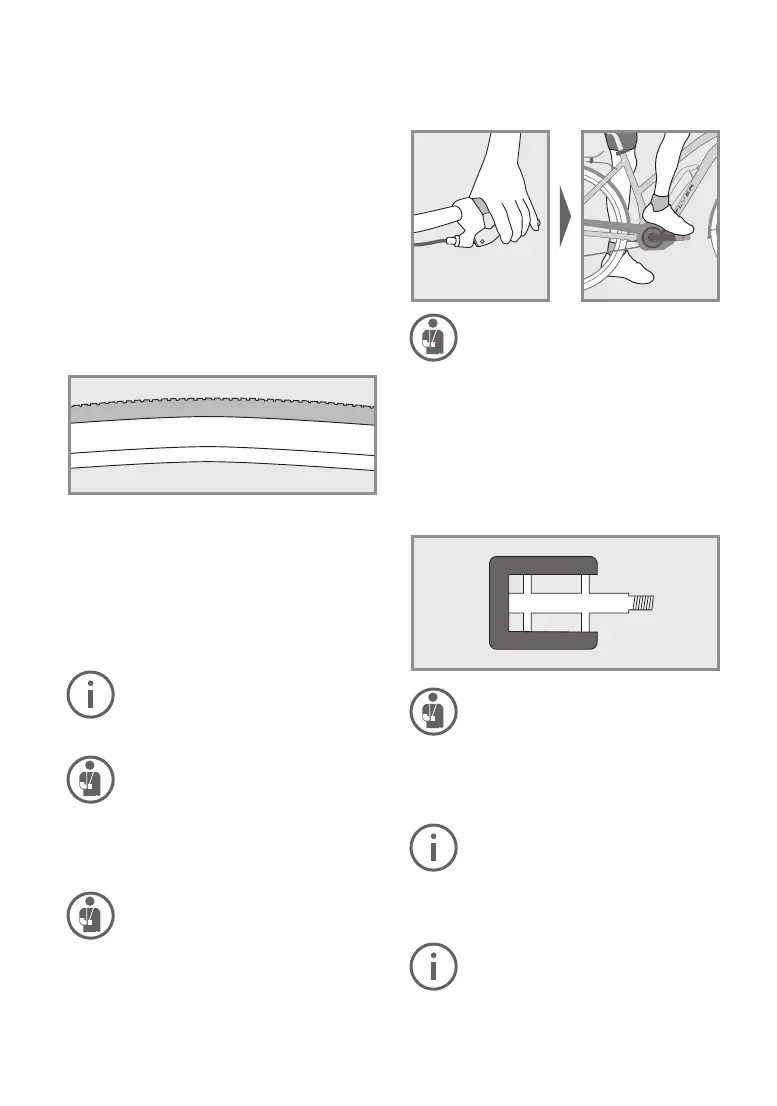
Check the tyre pressure. The manufacturer guide
-
lines
whichmaynotbeexceededorundercutare
printed on the side of the tyres.
It is also necessary for you to check the following
components of your E-bike:
• Please check that the battery is secure.
• Check the charging state of the battery to ensure
thatthechargeissucientforthedriveplanned.
• Familiarise yourself with the functions of the
on-board computer.
Familiarize yourself with your
new FLYER E-bike’s riding and handling
performance by testing its features out in
a safe and quiet area.
Only use a FLYER with a frame size that
suits you. Ensure that your legs have
enough room to manoeuvre. You must
be able to dismount quickly without
touching the frame. Insucient clear
-
ance or room to manoeuvre may lead to
severe injuries.
Please note that while preparing to
mount your FLYER that it will immediate-
ly start moving as soon as you put your
foot onto the pedal when the support
mode
is switched on. Do not place your
foot on the pedal when mounting. Hold
the brake, as the unfamiliar thrust may
otherwise lead to falls or other acci
-
dents. Stand to one side of the FLYER
30 - 80 PSI (2.5-5.5 BAR)
Exampleoftyrepressureinformation


 To Next Page