
 Need help?
Do you have a question about the Friedrich Breeze Series and is the answer not in the manual?
Key safety guidelines for operation and maintenance of the unit.
Explains how to interpret the model number for product identification.
Details the format and meaning of the serial number for tracking.
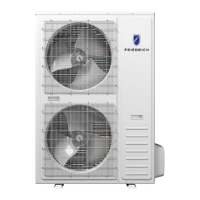
Detailed technical data and parameters for the outdoor unit.
Table to select the appropriate electric heater kit based on unit model and power requirements.
Noise level specifications for outdoor units across different frequency bands.
Noise level specifications for indoor units across different frequency bands.
Information on airflow performance and static pressure for indoor units.
Visual representation and measurements of the 24k outdoor unit's physical size.
Visual representation and measurements of the 36k outdoor unit's physical size.
Visual representation and measurements of the 48-60k outdoor unit's physical size.
Visual representation and measurements of the 24-36k indoor unit's physical size.
Visual representation and measurements of the 48-60k indoor unit's physical size.
Charts providing cooling/heating capacities based on operating conditions.
Charts providing cooling/heating capacities based on operating conditions.
Details how heating capacity is adjusted for defrosting periods.
Critical safety warnings and guidelines to follow before and during installation.
List of necessary tools and instruments required for installation procedures.
Step-by-step visual guide outlining the installation process sequence.
Schematic illustrating the path of refrigerant through the system components.
Diagram showing electrical connections for a matched indoor and outdoor unit system.
Specific warnings and precautions related to the indoor unit's installation and operation.
Identifies and labels the various parts and connections of the indoor unit.
Guidance on identifying and resolving common issues with the indoor unit.
Instructions for replacing or cleaning the air filter for the indoor unit.
Additional safety notices for indoor unit installation and maintenance.
Guidelines for selecting the proper installation site and required clearances for the indoor unit.
Procedures for physically mounting and installing the indoor unit.
Instructions and requirements for connecting the refrigerant piping for the indoor unit.
Guidelines for installing the condensate drain piping for proper water removal.
Instructions for making electrical connections to the indoor unit according to code.
How to adjust static pressure settings using DIP switches on the indoor unit PCB.
Guidance on safely handling the outdoor unit and choosing its installation site.
Steps for installing the drainage elbow and hose for the outdoor unit.
Procedures for securing the outdoor unit to its foundation or base.
Instructions for performing electrical wiring connections for the outdoor unit.
Electrical data and notes for outdoor unit wiring connections.
Requirements for pipe material, diameter, and maximum length for refrigerant lines.
Steps for cutting, brazing, and insulating refrigerant pipes.
Procedure for performing triple evacuation to ensure system integrity.
Final checks and procedures after installation to ensure proper operation.
Overview of the unit's built-in protective and operational control features.
Explanation of how the indoor and outdoor units communicate and operate.
Diagram showing the refrigerant flow between matched outdoor and indoor units.
Wiring diagram for matched outdoor and indoor units, including signal wires.
Specific refrigerant cycle diagram for the 24k BTU model.
Specific refrigerant cycle diagram for the 36k BTU model.
Specific refrigerant cycle diagram for the 48k to 60k BTU models.
Instructions for configuring outdoor unit settings using DIP switches.
How to query running parameters using the 7-segment display.
Table detailing parameter codes and their descriptions for checking operational data.
Configuration options for indoor unit static pressure using DIP switches.
Common issues, their possible causes, and recommended solutions.
Table listing fault codes, descriptions, reasons, and troubleshooting steps for outdoor units.
Identifies causes and corrective measures for overload conditions during cooling.
Identifies causes and corrective measures for overload conditions during heating.
Troubleshooting codes related to drive faults for 24-36k BTU units.
Troubleshooting codes related to drive faults for 48-60k BTU units.
Lists specific diagnostic codes and their troubleshooting steps for outdoor unit faults.
A flowchart guiding through the process of testing the refrigeration system in cooling mode.
A flowchart guiding through the process of testing the refrigeration system in heating mode.
Information on testing the compressor, including resistance tests and common fault signs.
Testing procedures for the EEV stepper coil, including resistance checks and visual inspection.
Details on testing the outdoor unit's DC fan motor, including wiring and voltage checks.
Procedures for testing the indoor unit's fan motor, including voltage and speed checks.
Identification of components and connections on the logic PCB for 24-36k BTU outdoor units.
Identification of components on the display PCB for 24-36k BTU outdoor units.
Identification of components and connections on the logic PCB for 48-60k BTU outdoor units.
Identification of components on the driver PCB for 48-60k BTU outdoor units.
Identification of components and connections on the outdoor unit filter board.
Identification of components and connections on the indoor unit logic PCB.
Step-by-step guide to disassembling the 24k outdoor unit's compressor and motor.
Step-by-step guide to disassembling the 36k outdoor unit's compressor and motor.
Step-by-step guide to disassembling the 48-60k outdoor unit's compressor and motor.
Steps for disassembling the indoor unit's fan and motor components.
Essential information about R-410A systems, including safety warnings and refrigerant properties.
Detailed procedures and safety precautions for replacing a compressor.
Specific steps for compressor replacement when a burnout has occurred.
Instructions for safely replacing the reversing valve in the R-410A system.
Step-by-step guide for replacing the Thermostatic Expansion Valve (TXV).
Detailed process for performing a triple evacuation to ensure system dryness and tightness.
Procedures for weighing in refrigerant and calculating additional charge based on piping length.
Wiring diagram for indoor units, including thermostat connections and optional components.
Wiring diagram specific to the 24k-36k BTU outdoor units.
Wiring diagram specific to the 48k-60k BTU outdoor units.
Conversion table between Celsius and Fahrenheit temperature scales.
Table showing resistance values for the compressor discharge sensor at various temperatures.
Table showing resistance values for other sensors at various temperatures.
Warranty coverage details for the first seven years, covering parts and labor.
Warranty coverage for the sealed refrigeration system from the eighth to tenth year.
General terms and conditions applicable to the Friedrich Breeze Heat Pumps limited warranty.


 To Next Page
 General