Need help?
Do you have a question about the Godex GS220 and is the answer not in the manual?
Explains the Single-Code and Multi-Code methods for configuring scanner features.
Details on enabling or disabling features using the Single-Code configuration method.
Details on enabling or disabling all features using the Multi-Code configuration method.
Instructions for resetting scanner settings to factory defaults using a barcode.
Options for enabling/disabling UPC/EAN barcode symbologies and their variants.
Configuration options for Code 128, including formatting and extended ASCII characters.
Configuration options for Code 39, including check digits and ASCII formats.
Options for Interleaved 2 of 5, Standard 2 of 5, Matrix 2 of 5, and Airline 2 of 5 symbologies.
Options for enabling/disabling Codabar and its dual-field variants.
Options for enabling/disabling Code 93 symbology.
Options for enabling/disabling Code 11 symbology.
Options for enabling/disabling Telepen and its ALPHA variant.
Options for enabling/disabling Plessey codes, including MSI and check digit settings.
Features like border requirements, intercharacter space, and small border settings.
Procedure for setting specific code lengths and type locks for barcode configuration.
Options for enabling/disabling two-digit and five-digit supplements and redundancies.
Configuration options for GS1 Databar 14, including check digits and application IDs.
Options for GS1 Databar Limited, including check digits and application IDs.
Options for GS1 Databar Expanded, including symbol ID transmission.
Options for enabling ISBT Code 128, special transmit modes, and data identifiers.
Settings for time requirements to find the second barcode in ISBT concatenation sequences.
Enabling/disabling and selecting specific pre-defined ISBT concatenation sequences.
Enabling/disabling and defining custom ISBT concatenation sequences using identifiers.
Options for light pen, RS232, keyboard wedge, OCIA, and IBM 46xx communication modes.
Settings for when the scanner can enter configuration mode.
Options for how many barcodes the scanner can buffer simultaneously.
Settings to require multiple decodes of the same barcode for a good scan.
Features like same symbol check and different character checks between barcodes.
Configuration of LED behavior for different scanner states.
Settings for beep tones, supplements, and fast beep modes.
Options to set intercharacter delays and inter-record delays to prevent buffer overflow.
Settings for communication timeouts, beeps, and tone options during timeouts.
Commands to enable/disable D/E, Z/R, F/L, and DTR scan functions, and DC2 activation.
How to configure up to ten user-defined prefix characters for data transmission.
Assigning specific ID characters to barcode types like UPC-A, Code 39, and Code 128.
Options for transmitting STX, Rochford-Thomson, AIM ID, UPC, and NCR prefixes.
Options for CR, LF, Tab, ETX suffixes, and UPC/NCR suffix IDs.
Procedure for replacing specific characters with others using configuration barcodes.
How to configure up to ten user-defined suffix characters for data transmission.
Options for SINEKO mode, Newcode formatting, leading zero removal, and CAPS lock.
Options for UPC-A/E check digits, expansion, number system, and GTIN formatting.
Options for transmitting Codabar start/stop characters, CLSI editing, and Mod-16/7-Check digits.
Options for Mod 43 check digit, stop/start characters, and Italian Pharmaceutical prefixes for Code 39.
Options for transmitting Code 11 check digits.
Options for converting Telepen ^L to E.
Options for UK Plessey check digits, special formats, and MSI Plessey check digits.
Options for ITF Mod 10 check digit and Matrix 2 of 5 check digit.
Configuration of parity bits (None, Odd, Even, Space, Mark) for RS232 communication.
Settings for various RS232 baud rates (e.g., 115200, 57600, 38400).
Configuration of data bits (7 or 8) and stop bits (1 or 2) for RS232.
Options for enabling/disabling RTS/CTS hardware handshaking.
Options for ACK/NAK, BEL/CAN, NAK retries, and XON/XOFF handshaking.
Options for French PC Term and NCR scanner modes.
Options for loading keyboard defaults, enabling stand-alone, and wedge emulation modes.
Selecting the appropriate keyboard layout and scan code table for different countries.
Options for AT, XT, PS/2, and Terminal keyboard emulation types.
Settings for IBM terminal keyboards, reserved terminal keyboards, and lowercase lock.
Options for transmit make code, FOH break code, cleanup bit, and Alt-Mode.
Settings for inter-scan code delays (800ms, 7.5ms, 15ms) and variable delays.
Enabling/disabling control sets for translating extended keys into ASCII control characters.
Table mapping HEX/Decimal values to ASCII characters and keyboard equivalents.
Table mapping keys to scan codes, 3151 codes, and prefix/suffix values.
Options for enabling OCIA mode and loading OCIA defaults, DTS/Siemens, Nixdorf, NCR-S/F modes.
Options for enabling light pen mode, bars/spaces high, transmit as Code 39/scanned, and polling.
Settings for narrow element width (10x, 50x border, 1ms, 60us, 100us, 500us, variable).
Options for enabling IBM 46xx communication, loading defaults, and specific IBM ports.
Options for enabling USB interface, low speed defaults, and loading integrated USB emulation defaults.
Explanation of code bytes and their use in configuration, with examples.
Options for enabling/disabling reserved codes.
Table mapping code bytes to barcode types (UPC-A, Code 39, etc.).
Options for enabling factory defaults and loading specific defaults (Ruby, RCH, Sanyo, Gilbarco, ALT, LaCaixa, ABACAB).
Procedure for entering and exiting serial program mode and recalling defaults.
Contact details for Godex International, Americas, China, and Europe.
 General
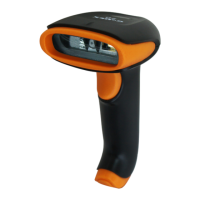
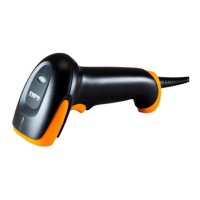
| Type | Handheld bar code reader |
|---|---|
| Wavelength | 650 nm |
| Sensor type | Laser |
| Scanner type | 1D |
| Read rate (max) | 72 reads/s |
| Linear (1D) barcodes supported | Codabar, Code 11, Code 128, Code 93, EAN-13, GS1-128 (UCC/EAN-128), JAN, U.P.C. |
| 2D (matrix & stacked) barcodes supported | Not supported |
| USB version | 2.0 |
| Standard interfaces | USB |
| Connectivity technology | Wired |
| Certification | CE, FCC, BSMI |
| Product color | Black, Orange |
| Housing material | - |
| Input voltage | 5 V |
| Power consumption (standby) | 0.675 W |
| Power consumption (typical) | 1 W |
| Storage temperature (T-T) | -40 - 60 °C |
| Operating temperature (T-T) | 0 - 40 °C |
| Operating relative humidity (H-H) | 5 - 95 % |
 Weight and Dimensions
| Depth | 110 mm |
|---|---|
| Width | 70 mm |
| Height | 153 mm |
| Weight | 120 g |

 To Next Page