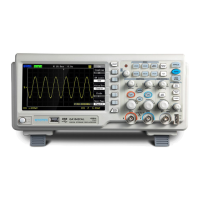
Operation description:
As shown in figure 2-35, the following steps can be carried out for simultaneously
observing unrelated signals in two channels:
1. Access two unrelated signals to channel 1 and channel 2.
2. Press [AUTO].
3. Press [TRIG MENU] to skip to “TRIGGER” menu.
4. Select the trigger “Type” as “Alternation”.
5. Select the “Signal source” as “CH1”.
6. Press “Trigger mode” to select “Edge”, “Pulse”, “Slope” or “Video”.
7. Perform setup to realize stable trigger.
8. Select the “Signal source” as “CH2”.
9. Repeat step 6, press “Trigger mode” to select “Edge”, “Pulse” or “Video”.
10. Repeat step 7.
2.7.3 Coupling
The “Coupling” option is used to determine which part of signal passes through the
trigger circuit. It is conductive to stably display the waveform. Press [TRIG MENU] to
use trigger coupling. Select the “Coupling” option in the “Setup” menu after selecting
the trigger type, including DC coupling, AC coupling, HF rejection and LF rejection. The
functions of all the options are specifically shown in table 2-14.
2.7.4 Trigger hold-off
The trigger hold-off function is used for stably displaying complex waveform. The
hold-off time represents a time interval between twice trigger detected by the
oscilloscope. During the hold-off period, the oscilloscope performs no trigger. As
shown in figure 2-36 below, regulate the hold-off time according to one pulse
sequence so that the oscilloscope only triggers at the first pulse in the row.



 To Next Page