S321 User Guide Chapter 1 - Introduction
Page 3 of 65
Atlas L-band
Atlas L‐band corrections are available worldwide. With Atlas, the positioning accuracy does not
degrade as a function of distance to a base station, as the data content is not composed of a
single base station’s information, but an entire network’s information.
Atlas L‐band is Hemisphere's industry leading correction service, which can be added as a
subscription. Atlas L‐ band has the following benefits:
Positioning accuracy ‐ Competitive positioning accuracies down to 2 cm rms in
certain applications
Positioning sustainability ‐ Cutting edge position quality maintenance in the absence
of correction signals, using Hemisphere’s patented technology
Scalable service levels ‐ Capable of providing virtually any accuracy, precision and
repeatability level in the 2 to 100 cm range
Convergence time ‐ Industry‐leading convergence times of 10‐40 minutes
S321 is supported by our easy‐to‐use Atlas Portal (www.atlasgnss.com), which empowers you to
update firmware and enable functionality, including Atlas subscriptions for accuracies from meter
to sub‐decimeter levels.
For more information about Athena RTK, see:https://hemispheregnss.com/Technology For more
information about Atlas L‐band, see: https://hemispheregnss.com/atlas
aRTK Position Aiding
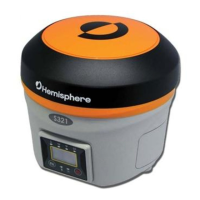
aRTK is an innovative feature available in Hemisphere’s S321 smart antenna that greatly
mitigates the impact of land‐based communication instability. Powered by Hemisphere’s Atlas L‐
band system service, aRTK provides an additional layer of communication redundancy to RTK
users, assuring that productivity is not impacted by intermittent data connectivity.
S321 receives the aRTK augmentation correction data over satellite, while also receiving the
land‐ based RTK correction data. With this, the receiver internally operates with two sources of
RTK correction, creating one additional layer of correction redundancy as compared to typical
RTK systems.
Once that process is established (less than a few seconds), the receiver can operate in the
absence of either correction source, or in other words, the receiver is able to continue generating
RTK positions in case the land‐based RTK correction source becomes unavailable for a period of
time.
Note: To use aRTK, you are required to change the RTK timeout to: 2700 s. This can be
accomplished by following the WebUI directions outlined in the Setup and Configuration section
of this document.
If your S321 is equipped with a 400 MHz radio you may be required to obtain a
valid radio license for your jurisdiction.


 To Next Page