Need help?
Do you have a question about the Hemisphere GPS S321 and is the answer not in the manual?
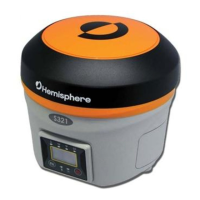
Provides a summary of the S321 smart antenna's design, capabilities, and intended use in surveying.
Explains the Athena RTK technology for real-time kinematic positioning, its benefits, and accuracy.
Details the Atlas L-band correction service for worldwide positioning accuracy without a base station.
Describes the aRTK feature mitigating communication instability with redundant correction sources.
Introduces the SureFix processor for providing high-fidelity quality indicators for RTK solutions.
Lists the various kits and supplementary products available for the S321.
Details the location and function of all ports and connectors on the S321 unit.
Guides the user through the process of installing the internal battery into the S321.
Explains how to connect the UHF and GSM antennas to the S321.
Describes mounting the S321 onto a tribrach or range pole.
Explains the two main power sources for the S321: internal battery and external power.
Covers connecting external devices via the 7-pin diagnostic port for troubleshooting.
Explains navigation using the device's FN and I keys.
Describes the procedure for powering the S321 receiver on and off.
Provides instructions for handling the MicroSD and SIM cards, including ESD precautions.
Details how to perform a reset on the S321 by locating and pressing the reset button.
Explains the S321's control panel, including display and indicator LEDs.
Guides base station and rover unit setup, including antenna connection.
Explains how to wirelessly communicate with the S321 using Bluetooth.
Describes accessing the WebUI via Wi-Fi for device control and management.
Details WebUI settings for system modes, data links, and UHF configuration.
Details WebUI settings for network, NTRIP, TCP/IP, and Bluetooth connectivity.
Covers firmware updates via WebUI or MicroSD card.
Explains how to download static data logs from the S321's internal memory or MicroSD card.
Guides the three-step calibration process for internal sensors (bubble, magnetic).
Lists specifications for various radio modes, including link rate, spacing, modulation, and FEC.
Provides resolutions for receiver power failures and issues with no data logging.
Addresses problems with the S321 not achieving RTK Fixed status and connectivity issues.
Details GNSS receiver type, channels, positioning modes, and performance accuracy metrics.
Lists satellite systems, communication ports, WebUI, and wireless specifications.
Provides radio, power, memory, environmental, and mechanical specifications for the S321.
 General
| Channels | 372 |
|---|---|
| Update Rate | Up to 10 Hz |
| Ingress Protection | IP67 |
| Humidity | 95% non-condensing |
| Connector | TNC |
| Type | Antenna |
| Frequency | GPS L1, L2, GLONASS L1, L2 |
| Signals Tracked | GPS, GLONASS, BeiDou, Galileo |
| Position Accuracy (RMS) | 1 cm + 1 ppm |
| Communications | RS-232, USB |
| Power | 5V DC |
| Operating Temperature | -40°C to +70°C |
| Axial Ratio | < 3 dB |

 To Next Page