64
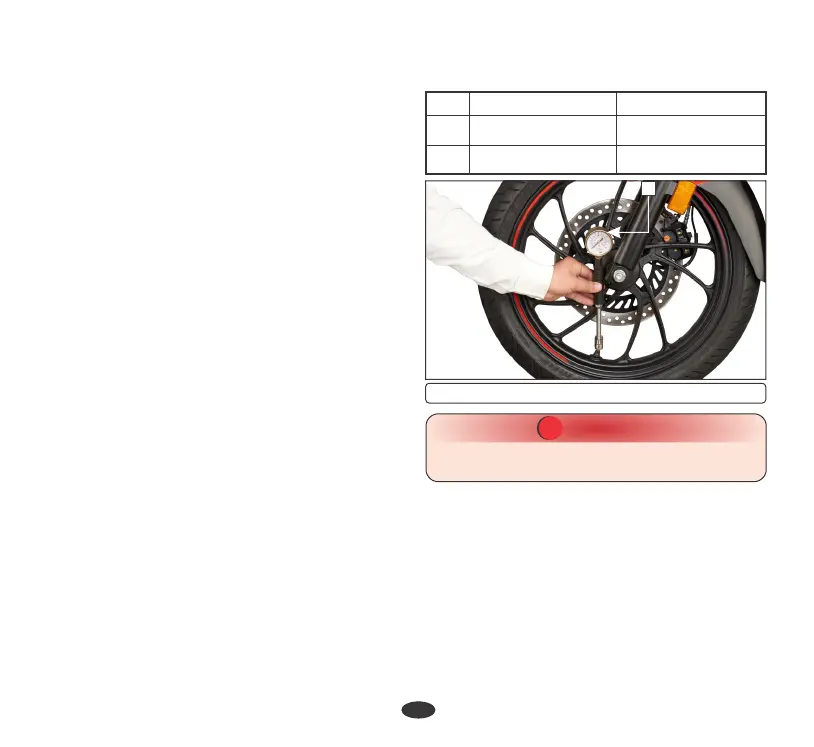
(1) Air pressure gauge
1
Air pressure
Keeping your tyres properly inflated provides
the best combination of handling, tread life
and riding comfort.
Generally, under-inflated tyres wear unevenly,
adversely affect handling and are more likely
to fail from being overheated.
Under inflated tyres can also cause wheel
damage in rocky terrain.
Over-inflated tyres make your vehicle ride
harshly, are more prone to damage from road
hazards, and wear unevenly.
We recommend that you visually check your
tyres before every ride and use a gauge to
measure air pressure at least once a month or
any time you think the tyres pressure might be
low. Tubeless tyres have some self-sealing
ability if they are punctured. However, because
leakage is often very slow, you should look
closely for punctures whenever a tyre is not
fully inflated.
Always check air pressure when your tyres are
"cold"-when the vehicle has been parked for
at least three hours. If you check air pressure
when your tyres are "warm"-when the vehicle
has been ridden for even a few km-the
readings will be higher than if the tyres were
"cold". This is normal, so do not let air out of
the tyres to match the recommended cold air
pressures given below. If you do, the tyres will
be under-inflated.
Front
Rear
2
1.75 kgf/cm (25 psi)
2
1.96 kgf/cm (28 psi)
2
1.75 kgf/cm (25 psi)
2
2.10 kgf/cm (30 psi)
Rider only Rider and Pillion
The recommended “cold” tyre pressures are:
Over inflation/Under inflation will affect the
performance.
CAUTION
!!
•
Cuts, splits or cracks in the tyre. Replace the
tyre if you can see fabric or cord.
Inspection
Whenever you check the tyre pressure, you
should also examine tyre treads & side walls
for wear, damage & foreign objects.
Look for:
•
Bumps or bulges in the side of the tyre or the
tread. Replace the tyre if you find any bumps
or bulges.



 To Next Page