Rev. 1.60 70 August 20, 2019 Rev. 1.60 71 August 20, 2019
BS66F340/BS66F350/BS66F360/BS66F370
Touch A/D Flash MCU with LED Driver
BS66F340/BS66F350/BS66F360/BS66F370
Touch A/D Flash MCU with LED Driver
LXT Oscillator Low Power Function
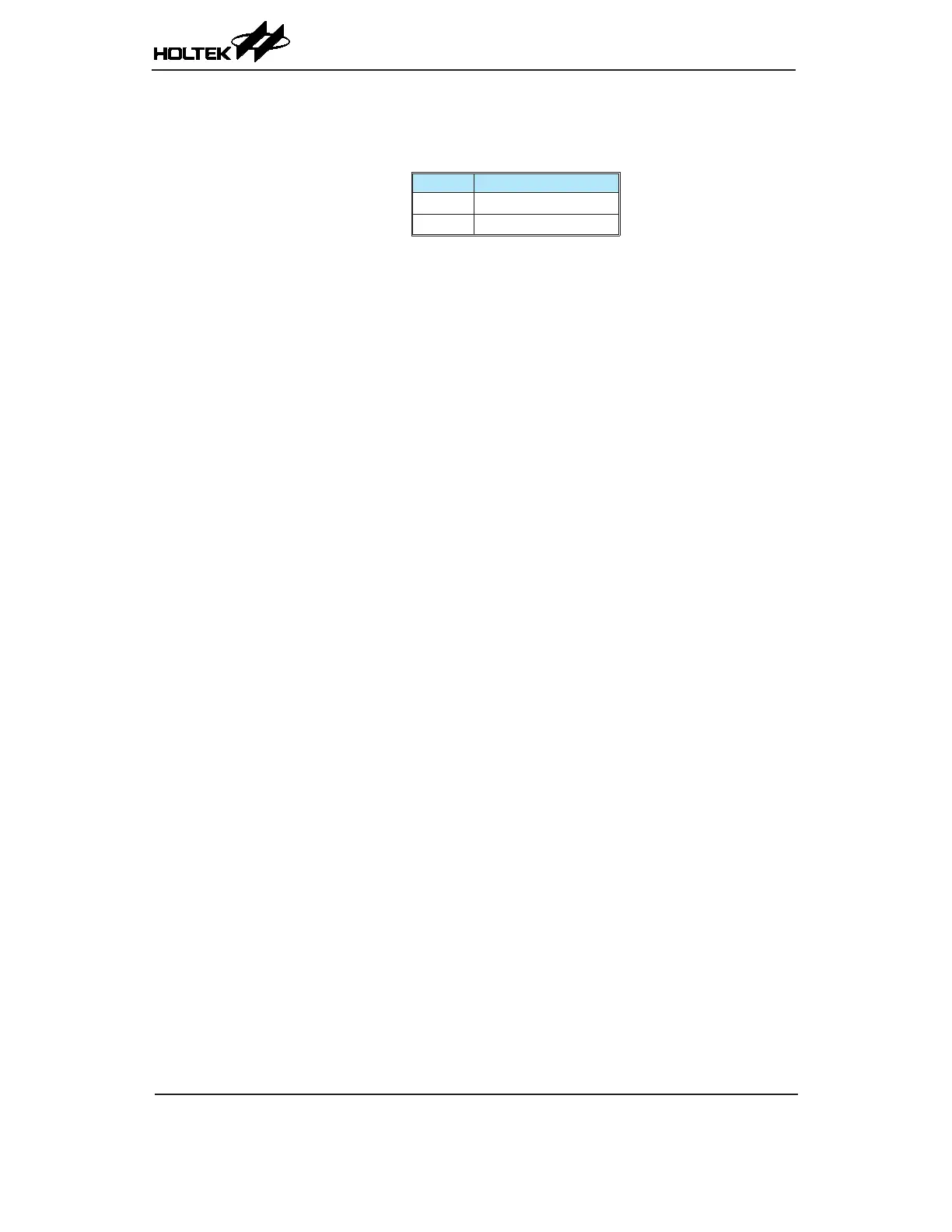
The LXT oscillator can function in one of two modes, the Speed-Up Mode and the Low-Power
Mode. The mode selection is executed using the LXTSP bit in the LXTC register.
LXTSP LXT Operating Mode
0 Low-Power
1 Speed-Up
When the LXTSP bit is set to high, the LXT Quick Start Mode will be enabled. In the Speed-Up
Mode the LXT oscillator will power up and stabilise quickly. However, after the LXT oscillator has
fully powered up, it can be placed into the Low-Power Mode by clearing the LXTSP bit to zero and
the oscillator will continue to run but with reduced current consumption. It is important to note that
the LXT operating mode switching must be properly controlled before the LXT oscillator clock is
selected as the system clock source. Once the LXT oscillator clock is selected as the system clock
source using the CKS bit eld and FSS bit in the SCC register, the LXT oscillator operating mode
can not be changed.
It should be note that no matter what condition the LXTSP is set to the LXT oscillator will always
function normally. The only difference is that it will take more time to start up if in the Low Power
Mode.
Internal 32kHz Oscillator – LIRC
The Internal 32 kHz System Oscillator is one of the low frequency oscillator choices, which is
selected via a software control bit, FSS. It is a fully integrated RC oscillator with a typical frequency
of 32 kHz at 5V, requiring no external components for its implementation. Device trimming during
the manufacturing process and the inclusion of internal frequency compensation circuits are used
to ensure that the inuence of the power supply voltage, temperature and process variations on the
oscillation frequency are minimised. As a result, at a power supply of 5V and at a temperature of
25˚C degrees, the xed oscillation frequency of 32 kHz will have a tolerance within 10%.
Operating Modes and System Clocks
Present day applications require that their microcontrollers have high performance but often still
demand that they consume as little power as possible, conicting requirements that are especially
true in battery powered portable applications. The fast clocks required for high performance will
by their nature increase current consumption and of course vice-versa, lower speed clocks reduce
current consumption. As Holtek has provided these devices with both high and low speed clock
sources and the means to switch between them dynamically, the user can optimise the operation of
their microcontroller to achieve the best performance/power ratio.
System Clocks
Each device has different clock sources for both the CPU and peripheral function operation. By
providing the user with a wide range of clock selections using register programming, a clock system
can be congured to obtain maximum application performance.
The main system clock, can come from either a high frequency, f
H
, or low frequency, f
SUB
, source,
and is selected using the CKS2~CKS0 bits in the SCC register. The high speed system clock is
sourced from an HXT or HIRC oscillator, selected via conguring the FHS bit in the SCC register.
The low speed system clock source can be sourced from the internal clock f
SUB
. If f
SUB
is selected
then it can be sourced by either the LXT or LIRC oscillators, selected via conguring the FSS bit in
the SCC register. The other choice, which is a divided version of the high speed system oscillator
has a range of f
H
/2~f
H
/64.



 To Next Page