2.18
If the saw is tted with a blade coarser than optimum (e.g.: 1.4/2.5 TPI) we can still use the graph, but we go to the 1.4/2.5
curve. As a result we nd that the FEED RATE is decreased to 1.3 in/min (133mm/min) for this blade. If however, the
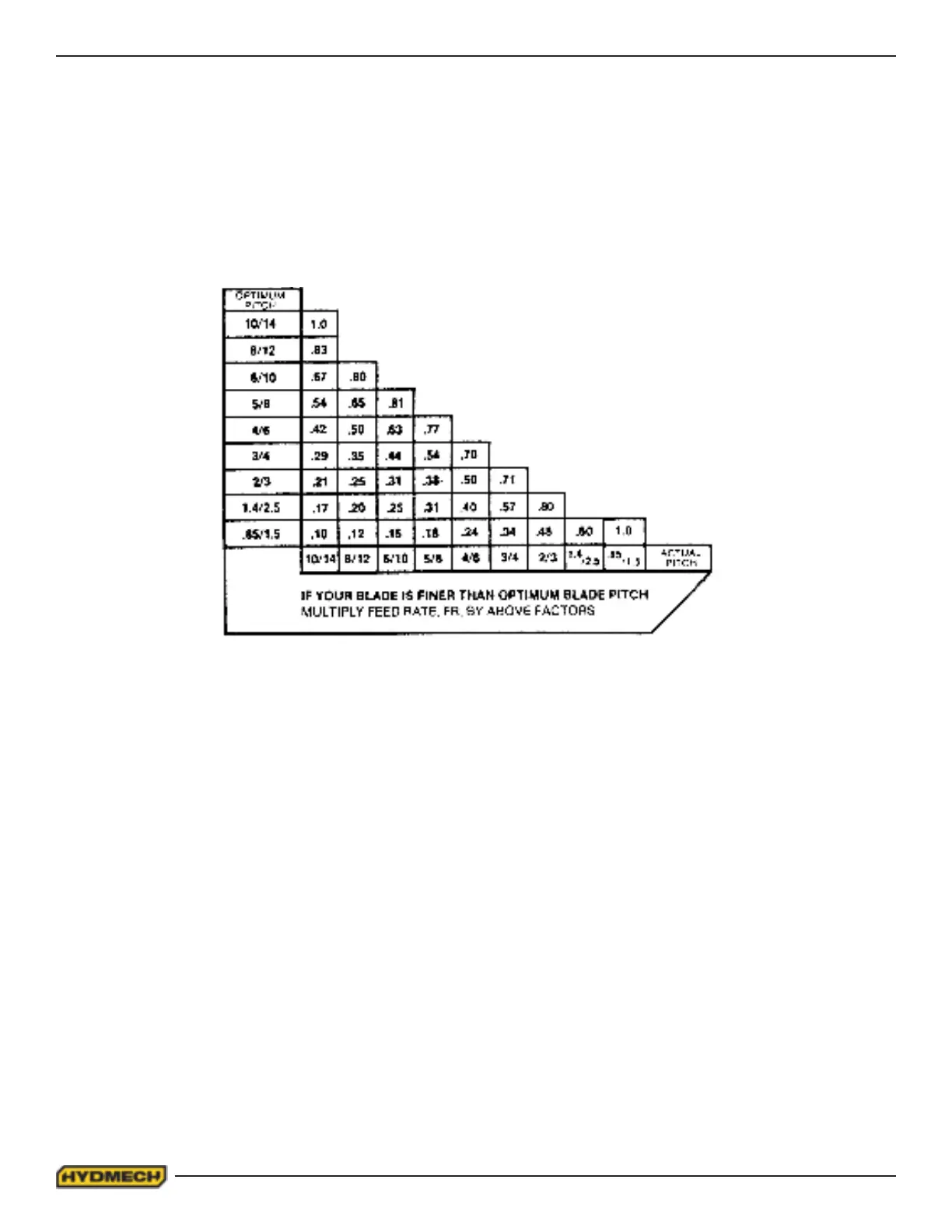
machine is tted with a ner than optimum blade (e.g. 3/4 TPI) we use the graph for the optimum blade as before, and
then use a multiplier given by the table below.
Optimum Vs Actual Blade Pitch
ADDITIONAL CUTTING SETUP EXAMPLES
EXAMPLE # 2
Material:
Round Steel Tube SAE 4320 - Hardened to 35 RC (325 Bhn )
Dimensions - 6” O.D. x 4” I.D. (150mm O.D. x 100mm I.D.)
Step 1 Effective Material Width: 4 1/2” (.75 X 6) 114mm (19 x 6)
Step 2 Feed Force limit setting for 6” Diameter material (Refer to Feed Force Limit, Setting in Step 2)
Step 3 Optimum blade pitch (TPI): 3/4 T. P. I.
Actual blade pitch on the saw: 4/6 T. P. I.
Step 4 Optimum blade speed for 4 1/2” effective 225 ft/min (70m/min) material width
Blade speed reduced by hardness factor: 225 ft/min X .60 = 135ft/min (70m/min x .60 = 42m/min)
Step 5 Feed Rate for 3/4 TPI blade: 1.8 in/min (45mm/min)
Feed Rate for 4/6 TPI blade: 1.8 in/min X .70 = 1.3in/min
(reduced by ner than optimum blade pitch factor) (45mm/min x .70= 31.5mm/min)
FEED RATE, continued


 To Next Page