3.7
HYDRAULIC MAINTENANCE
There are only FIVE items of routine maintenance associated with the hydraulic system.
1. OIL FILTER - Ten micron ltration of the hydraulic oil is provided by a spin on type lter mounted on the tank
return line. The element should be changed after the rst 50 Hours of operation and then every 500 working hours.
Suitable replacement elements are:
CANFLO RSE-30-10
GRESEN K-22001
PARKER 921999
ZINGA AE-10
2. OIL LEVEL & REPLACEMENT- The oil level should be maintained in the upper half of the level gauge. Normally
the rate of oil consumption will be very low and it should be unnecessary to add oil more often than at lter changes.
Add oil only to the top line on the gauge. To change the oil, it is necessary to drain the tank ( a drain plug is found on
the bottom of the tank) and ll it to 1/3 full level with the new oil, operate through several fully automatic cycles with the
index set to full stroke and the head to full rise. Drain the tank again, and nally ll the tank with the new oil. Hydraulic
tank capacity is approximately 11 US gallons.
Recommended replacement oils: Chevron AW Hydraulic Oil 46
Esso NUTO H46
Mobil Mobil DTE 25
Texaco Rando HD 46
Shell Tellus 46
3. HYDRAULIC OIL CHANGE - Oil visual inspection should be conducted with every lter change for the following
signs of degradation:
• Milky of hazy oil color
• Burnt smell
• Varnish or sludge formation
• Increased viscosity
If one of the above is observed, oil should be changed. It is recommended to change the oil after 6000 hours of
operation or every 2 years.
4. OIL TEMPERATURE - Oil temperature is indicated by a thermometer contained in the level gauge. Oil
temperature during steady operation should stabilize at about 50 - 55 F° (10-12°C) above room temperature. Thus in
a 70 F° (20°C) shop one might expect an oil temperature of about 120 F° (50°C) Oil temperature should never exceed
160 F° (70°C)
5. OIL PRESSURE - Oil pressure is factory set to 950 to 1000 PSI (6550 to 6895 kPa) and should not require
further attention except precautionary observation at start-up and every few days thereafter.
CLEANLINESS
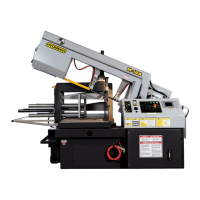
The M-16, M-20 heavy duty design should endure heavy operating conditions and provide the customer with awless
machine performance. To extend good performance some care is required especially as cleanliness is concerned.
The following areas should be kept clean:
- Control console free of dirt and grease.
- Door charts free of dirt and grease.
- Wheel boxes free of chips.
- Blade guides free of chips.
- Outfeed table free of chips.
- A large chip build-up should be avoided in the base of the saw.
NOTE: All parts must be cleaned before any repair service can be performed on them.


 To Next Page