106
If you run the furnace and refrigerator simultaneously, you will be using approximately
(12.0 + 3.0) 15.0 amps per hour. This does not include any 12-volt lights, or any other 12-
volt component. If the furnace and refrigerator in this example operated constantly, a 75
amp-hour battery would become fully discharged in 5 hours.
The auxiliary battery should be installed in parallel with the battery in your tow vehicle.
When the 7-way trailer plug is connected, both batteries power the RV. Do not allow it to
discharge your tow vehicle battery below the level required to start the engine. To prevent
this from occurring, disconnect the 7-way trailer plug or install a battery isolator. When the
tow vehicle engine is operating with the RV connected, the tow vehicle charging system will
charge both batteries.
Some equipment in your RV will draw small amounts of current even when turned OFF. To
prevent the auxiliary battery from being discharged when your RV is not connected to shore
line power, disconnect the auxiliary battery negative cable at the battery. During storage, it is
important to check the voltage monthly and recharge the auxiliary battery as needed. If you
remove the auxiliary battery from your RV, store it in a dry, cool area per the manufacturer’s
instructions.
Do not reverse the positive and negative battery cables (doing so will blow the reverse polar-
ity fuse(s) that protect the converter).
Please contact the battery manufacturer for additional information on the auxiliary batteries.
You may want to consider the installation of a battery isolator on your tow vehicle as a
convenience feature:
It receives current from the tow vehicle alternator and controls distribution of
energy to both the RV auxiliary battery and the tow vehicle battery.
It serves as a check valve to prevent energy from being drawn from your tow ve-
hicle chassis battery (so you can start your tow vehicle engine).
Your dealer can assist you with the selection, purchase and installation.
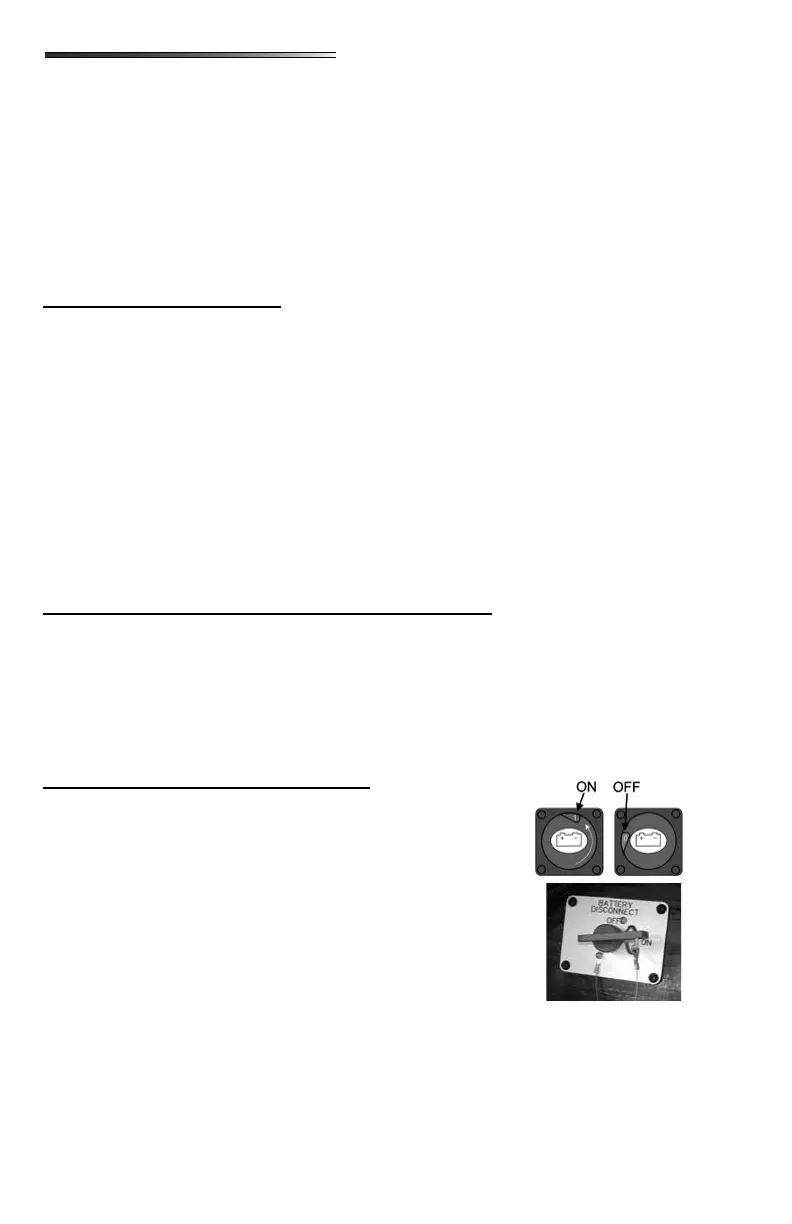
The Battery Disconnect switch is typically located in an en-
closed exterior compartment. The style of the disconnect
switch may vary per model. This switch does not shut o all
power, but only shuts o the 12VDC power to the main 12V
fuse panel, and the interior of the vehicle. Batteries can still be
trickle charged by the converter, and there will still be power
to some devices.
When this switch is ON, there will be a green area showing a
“1” along the top of the switch. To turn the switch OFF, turn it
counter-clockwise until you see the red area along the left side
of the switch showing a “0” (zero).
To operate this switch, turn the lever counter-clockwise to turn
o all 12VDC power to the fuse panel in the RV. The lever can be removed and is equipped
with a lanyard to keep the key from getting lost.





 To Next Page