(
41it'fi
:i
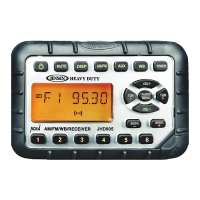
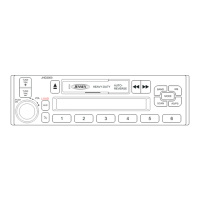
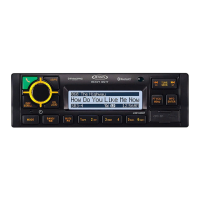
JHD36A
HEAVYDUTY
-----------------------------------------------------------------------------------------------------------
Weather
Band
Operation
What
is
the
NOAA
Weather Radio/ Weatheradio Canada?
NOAA
(National Oceanic and Atmospheric Administration) is a nationwide system that
broadcasts local weather emergency information 24 hours a day via the National Weather
Service (NWS) network. The U.S. network has more than 530 stations covering the 50 states as
well
as the adjacent coastal waters, Puerto Rico, the U.S. Virgin Islands
and the U.S. Pacific
Territories. Each local area has its own transmitting station and there are a total of seven
broadcasting frequencies used. A similar system is available in Canada under the Weatheradio
Canada service administered by Environment Canada.
Tuning
to
Weatherband
Press and hold the
BANDIWB
button (15) to access the Weatherband. The indication
"WB"
will
appear on the display panel, along with the current number and channel indication: "WB-1",
WB-2",
"WB-3", "WB-4", "WB-5", "WB-6"
or
"WB-7".
The seven frequencies are shown
In
the
following table:
WB
Frequencies
Frequency
(MHz)
Preset
162.400
2
162.425
4
162.450 5
162.475
3
162.500
6
162.525
-
162.550
1
The above table also shows which preset button
will
access the frequency. Note that one
frequency cannot be accessed using a preset button. The frequency can only be reached using
the tuning controls.
Use the TUNE/SEEK
I<<
or
>>I
buttons (18, 19) or the preset buttons to tune to each of the
seven channels until you find the weatherband station broadcasting in your area.
How
many
stations
can
I
expect
to receive?
Since the broadcasts are local weather and information, the transmission power is usually very
low (much less than standard AM or
FM
stations) so you will usually receive only one station
unless you are on the edge of two or more broadcast signals. The most you will receive
will be
two or three, and that
Is
rare.
Is
it
possible
I
won't
receive
any
stations?
Depending on where you are located, there is a possibility you will receive only a very weak
signal or none at
all.
Also, similar to AM and FM signals, weatherband signals are subject to
9
surrounding conditions, weather, obstructions of the signal by hills or mountains, etc.
NOAA
Weather
Alert
The Weather Alert function adds an additional level of user safety by automatically switching
from any of the available function modes to weather band for a minimum
of
60 seconds
If
a
NOAA
warning tone
(1050Hz)
Is
received/ detected.
If no additional warning
tone
Is
received for
60 seconds, the unit will switch back to the last known function mode.
See "System
Menu" on
page 6 to learn how to turn the
WB
Alert feature on.
SAME
Decoding
and
Filtering
Specific Area Message Encoding (SAME) data is also broadcast prior to alert broadcasts.
SAME data contains information about the geographic region affected by the alert, the type of
alert, and its effective time. The geographic region
Included in the SAME data is
called
the
Geographical Area code and has the form PSSCCC
where
"P"
represents a portion
of
the county,
"
SS"
is a two-digit state, territory, or offshore marine area identifier and
"CCC"
identifies the
county, province,
or
major metropolitan area within the state. This unit can be configured through
the system setting menu with up to seven Geographical Area codes to limit the automatic tuning
or power on functions described above.
SAME data also includes the type of alert being broadcast. This unit can be configured through
the System Setting Menu to limit the automatic tuning
or
power on functions based on the type
of alert.
SAME
Is
activated
by
programming a 6 digit code -
called
a
FIPS
code - into your radio. The
FIPS
code
or
Federal Information Processing System code
is
a six digit code that identifies the
states and counties (or parishes)
In
the United States. The first digit identifies the county
subdivision. The next two digits
Identify
the state or territory, and the last three identify the county.
The
FIPS
code for your area can be found by calling the
NWS
toll free number or visiting the
web site.
The phone number
Is
1-888-NWS-SAME (1-888-697-7263). Upon calling, an automated system
will
prompt you to enter your state and county. When you confirm the Information, the system will
provide your six digit
FIPS
code.
The web site
Is:
www.nws.noaa.gov/nwr/indexnw.htm. Upon selecting your state from the chart,
you
will
see a listing of all the counties in that state. For each county there is a listing of the
SAME#
(FIPS code), the location of the transmitter, the
WB
frequency, the call sign, the
transmitter power and miscellaneous remarks.
NOTE: Because
broadcast
areas overlap
you
may
want
to
set
more
than one
S.A.M.E.
location.
ff
you
live
near
the
border
between counties,
you
may
want
to receive alerts
from
more
than
one
tower.
Your radio Is capable of being programmed
with
up to 7 different FIPS location codes. The
default code has been programmed at the factory - 000000 - to respond to all messages within
your area.


 To Next Page