32
5.1-1
5 Operation.
This chapter describes how to operate the unit in order
to balance a wheel.
The standard balancing runs will be described first. In
chapter 5.4 and up special modes and functions will
be described.
Be sure to be familiar with:
- possible dangers, refer to chapter 1
- the unit, refer to chapter 4.
5.1 Mounting the wheel.
• Clean the wheel thoroughly prior to mounting it to
the unit.
• No dirt (sand, stones, glass, stickers, etc.) should
be left on the rim or the tyre.
• Remove all weights from the rim.
• Always balance a “clean” wheel!
• Work safely. Wear safety glasses.
Use only clamping and centring devices that fit properly
on the unit and are designed to be used with it. In order
to keep pace with technical progress, the unit, clamping
and centring devices may undergo design revisions.
Always check for compatibility between the devices and
the unit. Refer to the supplied technical information.
The method used to mount a wheel depends on the
way the wheel is centered at the vehicle.
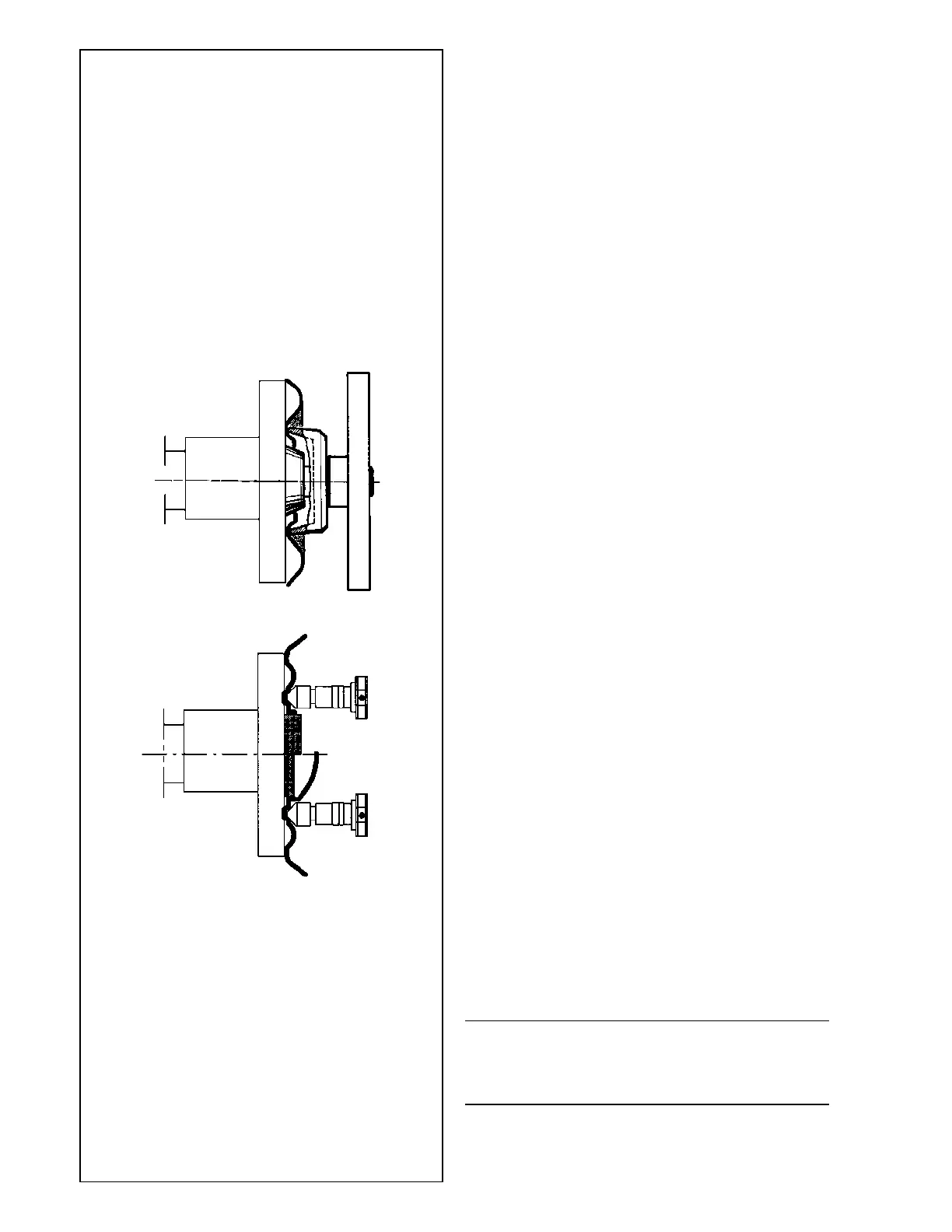
- When the rim has a true center hole, a hub centric
wheel, use a cone. Refer to Figure 5.1-1, top. This
is also the faster way to mount a wheel. If the correct
cone is not available, or if a wheel is very hard to
balance, using an adaptor plate may help.
- When the rim does not have a true hole and should
be centered on the mounting studs, a lug centric
wheel, use an adaptor plate. Refer to Figure 5.1-1,
bottom.
Cone Mounting
Cone mounting is the most common way to mount
automobile wheels. Choose the cone that fits best when
placed through the wheel center hole. Place the cone
and wheel on the shaft and ensure that the cone centres
the wheel when you tighten the handle.
• Hold the handle in place and rotate the wheel when
tightening.
WARNING: ENSURE THAT THE WHEEL IS FIRMLY
AGAINST THE MOUNTING FLANGE AND THE
HANDLE THREADS ENGAGE AT LEAST THREE
TURNS ON THE SHAFT.


 To Next Page