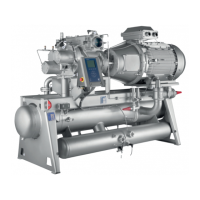
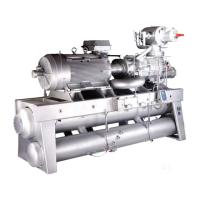
The SAB 355 (including ATEX) Screw Compressor Unit is a robust refrigeration compressor designed for high-pressure and booster operations. It is supplied as a ready-to-operate unit, requiring only connection to the plant system. The unit integrates several major subsystems, including a control system, compressor, lubrication system, oil separation system, hydraulic system, and oil cooling system, all mounted on a welded and painted steel base frame.
Function Description:
The core of the unit is a rotary screw compressor, manufactured by Frick, which uses mating asymmetrical profile helical rotors (4+6 lobe combination) to provide a continuous flow of refrigerant vapor. Oil is injected into the rotors for lubrication, cooling, and tightening, ensuring good volumetric and adiabatic efficiency even at high compression ratios. The compressor unit is designed to be self-lubricating, with oil supplied from the oil separator at system head pressure. During normal operation, the compressor essentially acts as its own oil pump. For applications with low oil differential pressure, a "demand pump" oil system can be used, which activates when the differential pressure between the compressor discharge and main oil injection port falls below 2.5 bar [35 psi].
The UniSAB III control and monitoring system is central to the unit's operation, providing safe control, monitoring, and optimization of compressor functions. It manages capacity regulation, monitors pressures and temperatures, calculates suction pressure vapor overheating, and tracks oil flow and filter differential pressure. The system stores shutdown situations for fault diagnosis and supports advanced control for up to 14 compressors via Profibus DP, Modbus TCP, or Comsab II.
The compressor hydraulic system moves the movable slide valve (MSV) for capacity control (100% down to approx. 10% of full load) and the movable slide stop (MSS) to adjust the compressor's volume ratio (Vi) from 2.2 to 5.0. This dual-purpose hydraulic cylinder is controlled by double-acting, four-way solenoid valves.
Oil cooling is crucial for maintaining optimal oil temperature (55-77°C [130-170°F] for liquid injection, 49-71°C [120-160°F] for external cooling). The unit can be equipped with single-port or dual-port liquid injection, refrigerant-cooled (thermosyphon), or water-cooled oil cooling systems, all automatically controlled.
A suction filter with a built-in non-return valve prevents impurities from damaging the compressor and stops reverse rotation during idle periods. The oil separation system, consisting of an oil separator and reservoir, efficiently separates oil mist from discharge gas, returning it to the compressor.
Important Technical Specifications:
- Compressor Models: SAB 355 S (SGC 3511), SAB 355 L (SGC 3515), SAB 355 E (SGC/SGX 3519), SAB 355 X (SGC/SGX 3524).
- Rotor Lobe Combination: 4+6 male rotor drive.
- Discharge Pressure Rating: Bearing and casing designed for 28 bar [400 psi].
- Volume Ratio (Vi) Control: Infinitely variable from 2.2 to 5.0.
- Capacity Control: Fully modulating from 100% to approx. 10% of full load.
- Oil Separator External Heat Surface: OHU 6041/5030 (13.9 m²), OHU 7650/6050 (22.8 m²).
- Oil Filter: 100 μm mesh width, protected against bursting by UniSAB III shutdown if pressure drop exceeds 1 bar.
- Oil Cooling Temperature Ranges: Liquid injection: 55-77°C [130-170°F]; External (thermosyphon/water-cooled): 49-71°C [120-160°F].
- Ambient Temperature/Humidity: 10-90% relative humidity (non-condensing), minimum 0°C (+32F), maximum +40°C (+104F).
- Motor Specifications: Schorch and Leroy-Somer, 3 x 400V 50 Hz or 3 x 440V 60 Hz, IP 22/23 or IP 54/55 protection class.
- UniSAB III Control System: Supply voltage 85-250 VAC, frequency 47-63 Hz, power 32 VA.
- Noise Data (SAB 355, 2950 rpm): SWL 112, SPL 89 (for R717/HCFC/HFC, TE -15°C, TC +35°C). Add +2 dBA for 60 Hz compressors.
- Vibration Data: Complies with ISO 10816, Part 6, Annex A, group 4, AB (reciprocating) and VDI 3836, Group 3 (screw compressors), with acceptable rms values up to 11.2 mm/s.
- Test Pressure Levels: Compressor block: 40.3 bar [566 psi] (strength), 28 bar [377 psi] (leak); Entire unit: 7 bar [102 psi] (leak).
- ATEX Compliance: Available for potentially explosive atmospheres, with specific temperature classes (T1-T6) and requirements for electrically conductive parts and limited light metals. Special non-sparking tools are required for maintenance.
Usage Features:
- Easy Operation: UniSAB III provides a user-friendly interface with a distinct display for operational data, status, and menu navigation.
- Safety Monitoring: Comprehensive safety features with shutdown and alarm settings for all measuring points, indicating issues with flashing diodes and display texts.
- Multilingual System: UniSAB III supports 19 languages, including English.
- VSD Compatibility: The compressor can be driven by a Variable Speed Drive (VSD) for energy efficiency, but factory-built and tested packages are recommended to ensure reliability and warranty coverage due to potential vibrational issues.
- Marine Application: Designed to meet classification company requirements for ship installations, considering inclination (static 15° axial, 5° transversal; dynamic ±22.5° axial, ±7.5° transversal).
- Cold-Start System: Ensures rapid oil pressure development for lubrication, even in cold ambient temperatures, without an oil pump.
Maintenance Features:
- Daily Maintenance (minimum twice a week): Visual inspections for noise, vibrations, oil level, refrigerant charge, leaks, mechanical seal oil draining, and control system alarms.
- Periodic Maintenance: Motor lubrication and other routine tasks based on running time, with intervals specified in the maintenance table (e.g., oil filter changes, coalescer changes, check and clean suction screen, check alignment, electrical connections, sensor calibration, vibration analysis, shaft seal replacement).
- Major Overhaul: Contact local service provider for major maintenance tasks.
- Oil Analysis: Recommended at regular intervals to assess oil quality and detect potential wear in compressor components. Johnson Controls Denmark offers an analytical concept for uniform reporting.
- Oil Charging: Carried out using a portable oil charging pump when unit pressure is below 6 bar. Oil level must be visible in the sight glass, and approximately 25% extra oil should be available for first start-up.
- Long-Term Storage: Requires protective gas (N2) overpressure, level foundation, protection from vibrations, dust, and corrosive vapors. Compressor rotors should be rotated every three months to prevent oil drying out.
- Dismantling and Disposal: Requires competent refrigeration personnel, proper draining of refrigerant and oil into suitable containers, disconnection of electrical connections, and sorting of machine parts for approved disposal according to national rules. Special care is needed when using cutting tools due to oil residue and refrigerant.

 Need help?
 General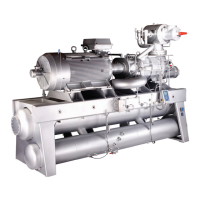


 To Next Page