Need help?
Do you have a question about the KBR multicomp F144-NC-1V1C6DO6RO-2 and is the answer not in the manual?
Provides critical safety instructions for installation, operation, and handling to prevent hazards.
Details warranty conditions and liability for the purchased product.
Instructions for the proper disposal of defective or outdated devices.
Defines setting parameters for thyristor and contactor stages, including switching intervals and discharge times.
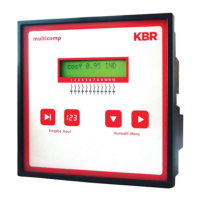
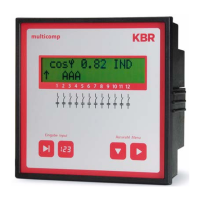
Identifies and describes the controller's LCD display, output lines, and sensor buttons.
Explains sensor button functions and lists default controller settings for commissioning and performance.
Details settings available in the Extras menu and other configurations like user language and THD limits.
Provides crucial safety and regulatory information for device installation, including VDE regulations.
Guides on connecting current transformers and measuring voltage for accurate system operation.
Discusses dimensioning current transformers based on consumer and capacitor current requirements.
Illustrates the wiring diagram for measuring voltage between Phase and Neutral.
Presents the wiring diagram for measuring voltage between two phases of the system.
Essential checks and initial steps for powering up the compensation system.
Details programming and checks for target CosPhi, currents, and voltage transformer data.
Visual guide illustrating the device's menu structure and navigation paths between different functions.
Describes the Initialization and Start menus, showing current values and system status.
Explains the display windows for stage status, service options, and deletion capabilities.
Details the Commissioning, Switching Performance, Error Message, and Extras menu displays.
Explains the Initialization window displayed immediately after connecting the supply voltage.
Describes the Commissioning menu used for initial controller setup and parameter configuration.
Covers password security features and the correct configuration of current transformer values.
Details setting the target CosPhi and configuring voltage transformer parameters for accurate measurement.
Explains setting discharge time and configuring capacitor stages manually or via auto-mode.
Outlines the steps for conducting a function test after all parameters have been programmed.
Explains the start menu display, including measured values, CosPhi, and stage status indicators.
Describes how to view and change the operating state of capacitor stages (Auto, Off, On).
Explains the Service window for viewing operating cycles and handling specific error conditions.
Provides in-depth commissioning information, including password and transformer setup.
Details setting discharge time and maximum stage power for optimal switching operations.
Explains manual and auto configuration modes for capacitor stages, including learning mode.
Details settings for hysteresis and alarm delay to influence the system's switching performance.
Covers idle time, switching interval, alarm CosPhi, and attenuation settings for fine-tuning.
Explains how to configure error messages and their corresponding actions (Message, Alarm Relay, Off).
Details user language selection, THD limit, and operating cycle limit settings.
Covers sampling rate, stage power monitoring, reset options, and contrast settings.
Addresses common issues like undercompensation, overcompensation, and frequent switching.
Outlines essential checks for system components and safety devices to ensure proper function.
Provides a comprehensive list of configurable parameters and their adjustable ranges.
Lists further configurable parameters and settings for error message dialogs.
Details the technical specifications of measured quantities like voltage, current, frequency, and power.
Specifies accuracy, measuring principle, device memory, operational limits, and power supply requirements.
Details hardware inputs/outputs, switching capacities, and electrical connection specifications.
Covers mechanical dimensions, protection types, environmental conditions, and relevant standards.
Offers a table to assist in selecting appropriate supply lines and fuses based on power requirements.
 General
| Brand | KBR |
|---|---|
| Model | multicomp F144-NC-1V1C6DO6RO-2 |
| Category | Controller |
| Language | English |

 To Next Page