PAS SERIES Before Using the Unit 2-5
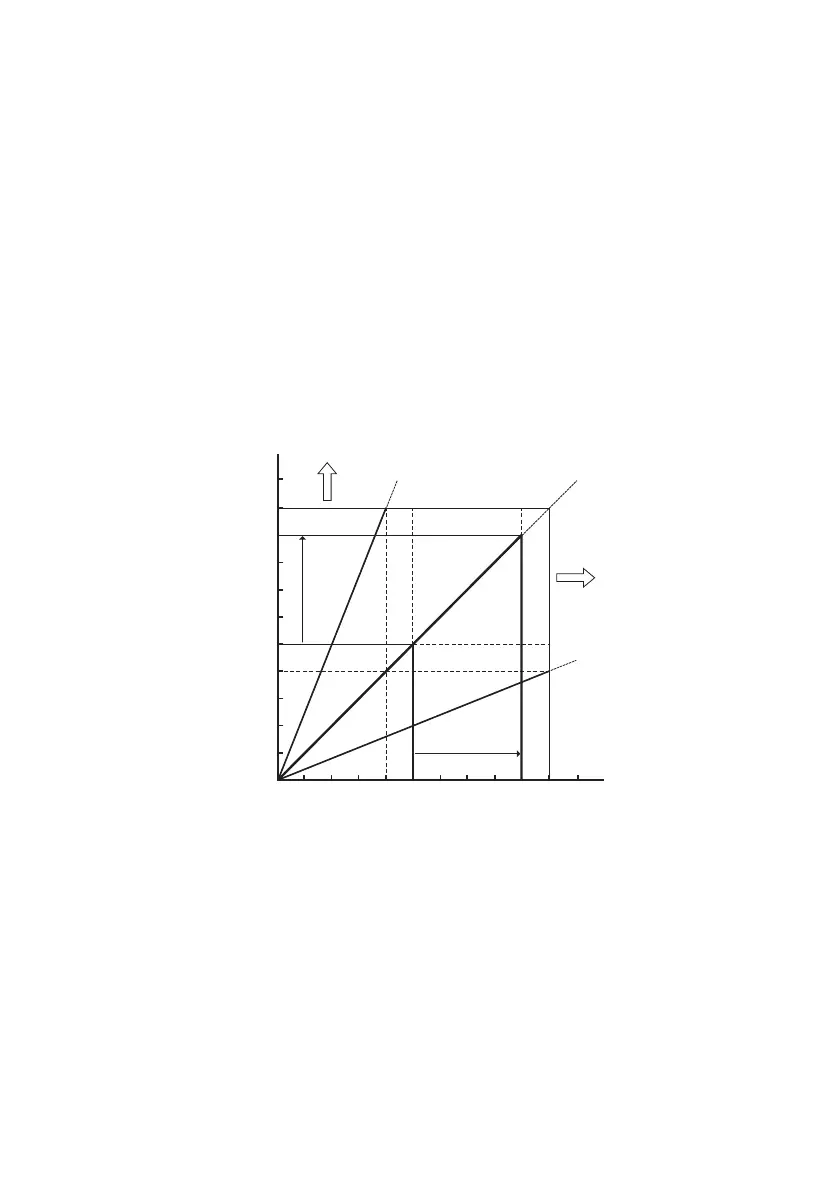
output current increases as the output voltage increases. When the
output voltage reaches 50 V (that is, the output current has reached
5 A), the output voltage no longer increases even if you attempt to
raise it. This is because the output current is limited to 5 A specified
initially, causing the power supply to switch to the constant current
(CC) operation mode. In this way, the power supply automatically
switches from the constant voltage to constant current operation to
prevent an overcurrent from flowing. (The point at which the opera-
tion mode switches is called the "crossover point".) If the current
limit is raised in this condition, the power supply returns to the previ-
ous constant voltage operation, allowing you to increase the output
voltage further. If the current limit is increased from 5 A to 9 A in
Fig.2-7, a voltage of up to 90 V can be output.
Fig.2-7 Constant voltage operation and constant current
o
per
at
ion
Next, let's assume the case in which a load resistance of 4 Ω is used.
The output current limit is considered to be the rated maximum out-
put current. If you increase the output voltage from 0 V, the output
current reaches the output current limit when the output voltage
reaches 40 V; the power supply cannot output a voltage above 40 V.
This is the limit even though the power supply is generating less than
half its output capacity in terms of power. If you wish to increase the
Load line of RL = 4 ȍ
Load line of RL = 10ȍ
Load line of RL = 25 ȍ
Area where current
capacity needs to be
increased
Area where voltage
needs to be increased
0 5 A 10 A9 A4 A
50 V
90 V
100 V
40 V
Output current Io



 To Next Page