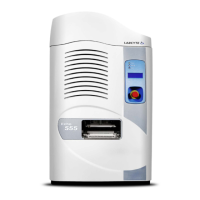
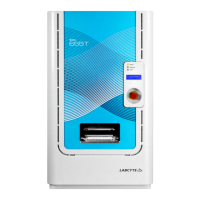
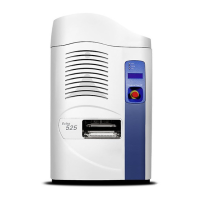
l The main body of the Echo Liquid Handler has a very small footprint: 53.9 cm wide and 68.3 cm deep (21.2 in x 26.9 in).
l Facilities requirements (power, temperature, ventilation, compressed air, vacuum, communications) are simple and straight
forward.
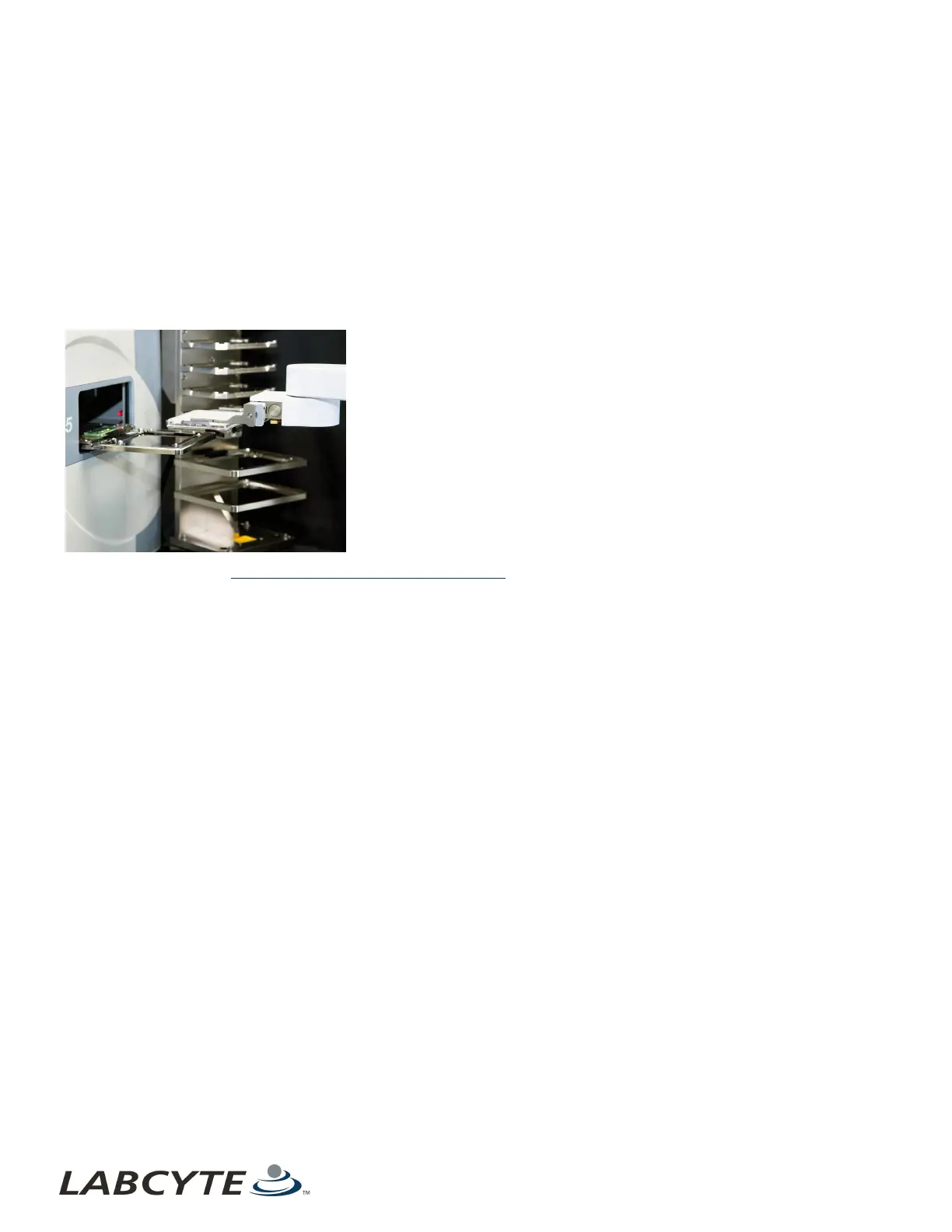
l Source and destination microplates are loaded onto stages presented outside the instrument and placed in a fixed location
for easy access by a robotic arm (see the following figure).
l Most barcode standards are supported. Barcodes can be located on the short or long side of a microplate.
l The control software supports manual operation “out of the box” device control, system monitoring, creation of destination
plates and protocol definitions, and protocol execution are available to the user.
l Customers choosing to develop their own Echo software applications are supported by a fully implemented ActiveX control
library.
Figure 3: Access™ Workstation Loading a Source Microplate
For more information, see What system configurations are supported?
Low Maintenance Requirements
Echo instrument up-time is high, not only because it is reliable, but also because very little maintenance is required.
l Routine operator maintenance takes only minutes each week— for coupling fluid maintenance.
l Field service maintenance is scheduled once per year for customers with service contracts.
l Echo technology means that there are no tips, no pins, and no washing.
l The acoustic transducer itself has no moving parts to wear out. It simply converts RF (radio frequency) energy to ultrasound
energy. The mechanisms that move it into position are designed for a long and serviceable life.
Cost Savings
The Echo Liquid Handler reduces operating costs by:
l Enabling the routine use of higher density, lower volume assays. Moving to smaller assay volumes reduces the costs of
reagents and solvents.
l The use of higher density microplates dramatically increases the number of assays that can be performed with a limited
amount of test reagent used.
l Minimizing the use of expendable supplies (for example, intermediate microplates, tips, pins, and wash solutions).
l Eliminating washing stations and their complex procedures and fluids.
l Eliminating the requirement to calibrate reduces upkeep time or delays in adopting new liquid handling procedures.
High Accuracy, Precision, and Speed
High throughput capabilities are maintained without degrading fluid transfer accuracy and precision.
Droplet-to-droplet volumetric precision exhibits a low CV (coefficient of variation) for all fluid types tested to date. This is attributed
to the elimination of sample contact with the ejection mechanism. The use of a single transfer mechanism within the Echo Liquid
Handler reduces the chance of imprecise transfer due to intraplate sample variability, as compared to tip-based and other
instruments that transfer samples in parallel.
What are the Echo Liquid Handler features? CHAPTER 2 | Introduction
18


 To Next Page