Multi-Client Considerations
Larger research labs may have many computers, instruments, controllers, and other devices interconnected on an Ethernet LAN
(local area network). Please review the following information and take appropriate measures to avoid conflicts caused by multiple
workstations controlling an Echo Liquid Handler inappropriately.
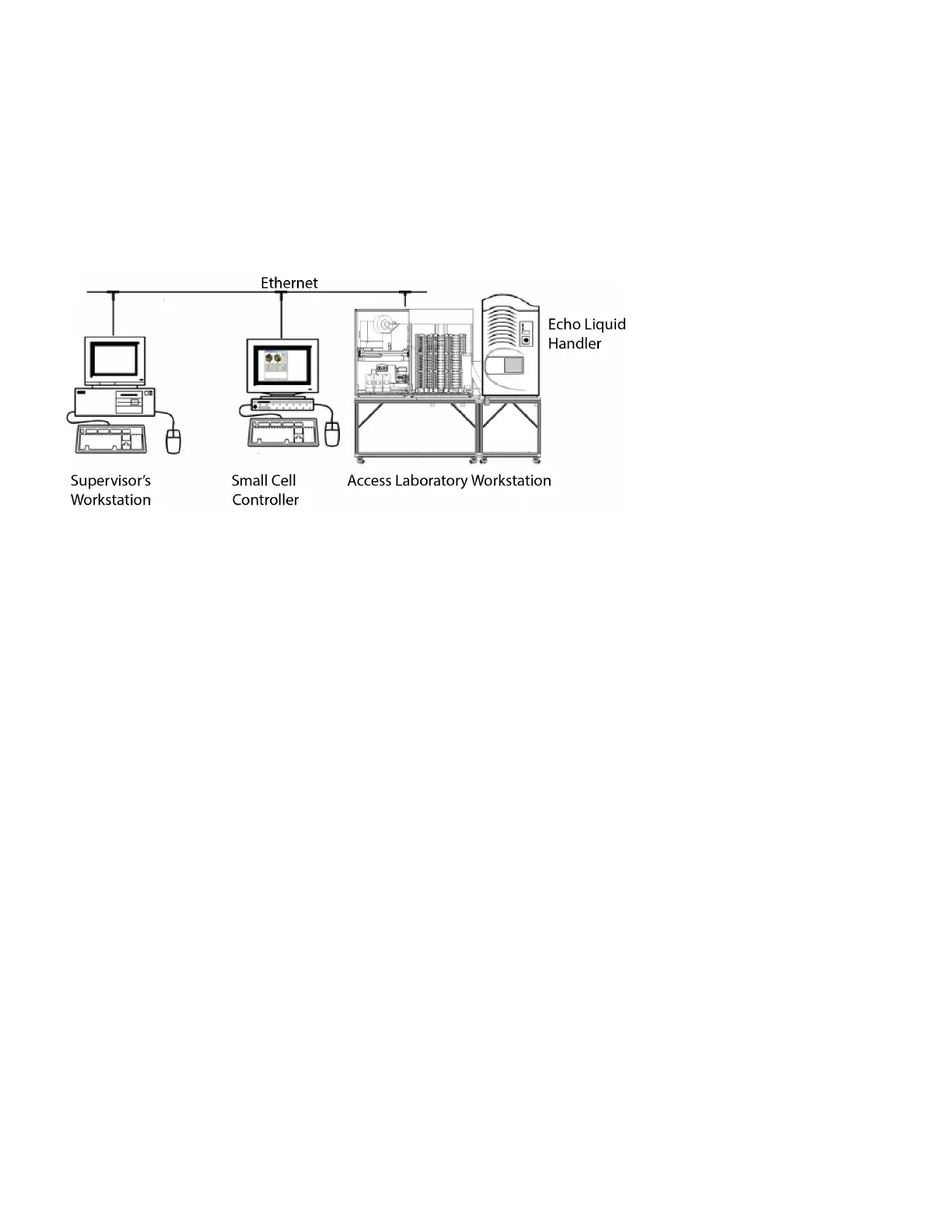
The Echo Liquid Handler can be connected to a network or to more than one workstation. This configuration allows one or more
users to control the Echo remotely, to download liquid transfer information directly to the network, or to connect more than one
Echo Liquid Handler to an automated filling operation.
Figure 9: Multiple Clients Talking to an Echo Liquid Handler
For example, a local workstation might be used to do the following:
l Monitor instrument status.
l Perform user maintenance.
l Execute troubleshooting procedures.
At the same time, a central system may be used to control all of the day-to-day work flow involving the instruments in the lab. In
relation to an Echo Liquid Handler, it might be involved in the following:
l Define fluid transfer protocols.
l Define destination microplates.
l Deliver source and destination microplates to the Echo Liquid Handler via conveyor belt and robot.
l Remove source and destination microplates.
l Execute fluid transfer protocols.
l Handle all of the data.
The Echo Liquid Handler is a client/server system. The client is the external workstation that contains the user interface software
to define plate and protocol information. The server is the controller that runs the instrument motors and sensors. Each subsystem
is independent, with its own system checks. This architecture allows the Echo Liquid Handler to be commanded by multiple
clients to run concurrent operations, yet ensure that each operation is safe with respect to each other.
For example, one user might command the Echo Liquid Handler to do a microplate survey, then a liquid transfer protocol. During
the source microplate survey, another user might command the Echo Liquid Handler to extend the source plate. The microplate
survey that is in progress will continue to completion, then extend the source microplate. Thus, while the Echo Liquid Handler
guarantees safe operation, it cannot prevent the commands of one user interfering with those of a second user. Therefore, it is the
responsibility of the users to coordinate their actions to ensure the proper fulfillment of a transfer protocol.
Also, if more than one user creates, edits, or deletes fluid transfer protocol definitions or destination microplate definitions, then
there must be communication between users to ensure that the definitions are consistent with the protocols.
Users should be aware of the following considerations with the client/server architecture:
l An Echo Liquid Handler is not limited to a single client. One or more clients can either monitor its status or command it to
execute its functions.
l Uncoordinated clients can cause out-of-order execution that interferes with other users' protocols. For example, client A
can delete or edit a protocol or destination microplate definition created by client B. An edited protocol definition can only
be detected if the original definition is stored on client B and compared to the definition in the database.
25 PN | 001-11665
USER GUIDE | Echo® 525 Liquid Handler User Guide What system configurations are supported?


 To Next Page