Version 3.3 125
Configuration Operator’s Manual
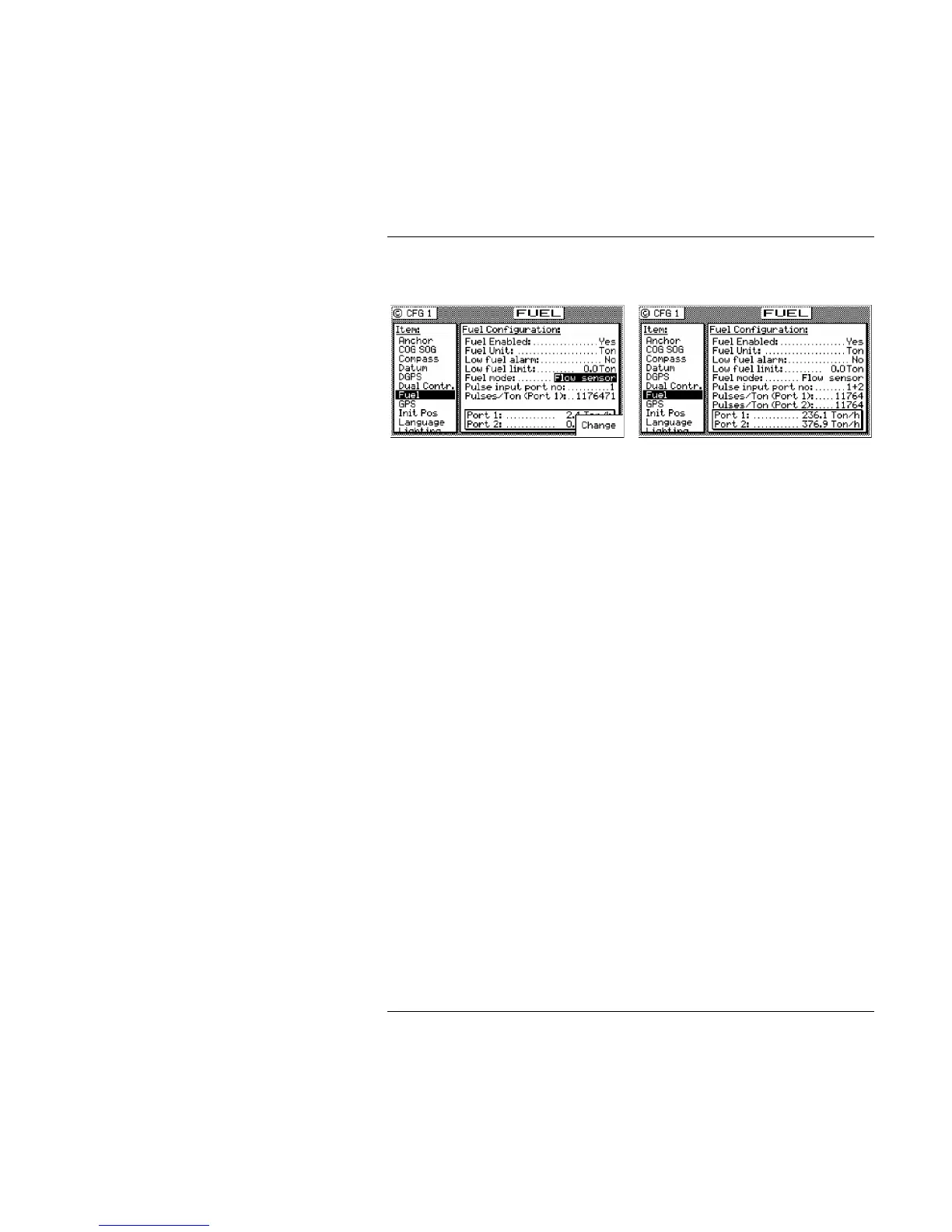
Consumption - is the value you program into the receiver to
estimate your actual usage upon.
Flow Sensor - is the calibrated input from a real time fuel sensor
connected to the Fuel input port.
Pulse Input Port No. - select between Pulse Input Port 1, Pulse
Input Port 2, or Pulse Input Port 1+2. You can provide a
single pulse input which is calibrated for all engines on
board, or provide two calibrated inputs for two input ports,
and the receiver will automatically make the necessary
calculations.
Pulse Input Port 1 is pin 18 of the 31 pin connector and
Pulse Input Port 2 in pin 21 of the 31 pin connector. Both
ports share pin 14 as a common ground. These are separate
from NMEA-0183 Input Ports 1 and 2.
Pulses/Ton (Port 1) - This is the calibrated pulses per fuel unit
value that you must get from the fuel monitoring system
manufacturer.
GPS - Elevation Mask & Antenna Offset Control
This screen controls the lowest elevation, or angle above the
horizon, that the receiver will attempt to track a satellite. Satellites
with an elevation below this number will be tracked if enough
channels are available, but will not be included in the position
solution. You can set the elevation limit to any value up to 45°. For
most marine applications, the default limit of 5° is appropriate.
However, there may be some applications where the receiver is
used where a higher elevation limit is desired. For example, if you
are trying to get the best possible position from the receiver and the
environment you are in has significant foliage which causes low
elevation satellites to “pop in and out”, you might choose to set the
elevation limit to 15° so that only satellites above the tree line are


 To Next Page