filter (-3dB at 80Hz and 400Hz) which is particularly useful for 150Hz cuetone
breakthrough measurement on cartridge recorders. It reduces tape noise contribution by
typically 10dB. Option 8 covers 2kHz to 20kHz (-3dB frequencies are 1.8kHz to 21kHz)
and can be used for 8kHz cuetone measurement. Crosstalk option 9 (-3dB at 11kHz and
22kHz) is useful for 15kHz crosstalk. Crosstalk at other frequencies can be measured
using the 22Hz-22kHz level measurement facility (on
), but this will
also be measuring noise.
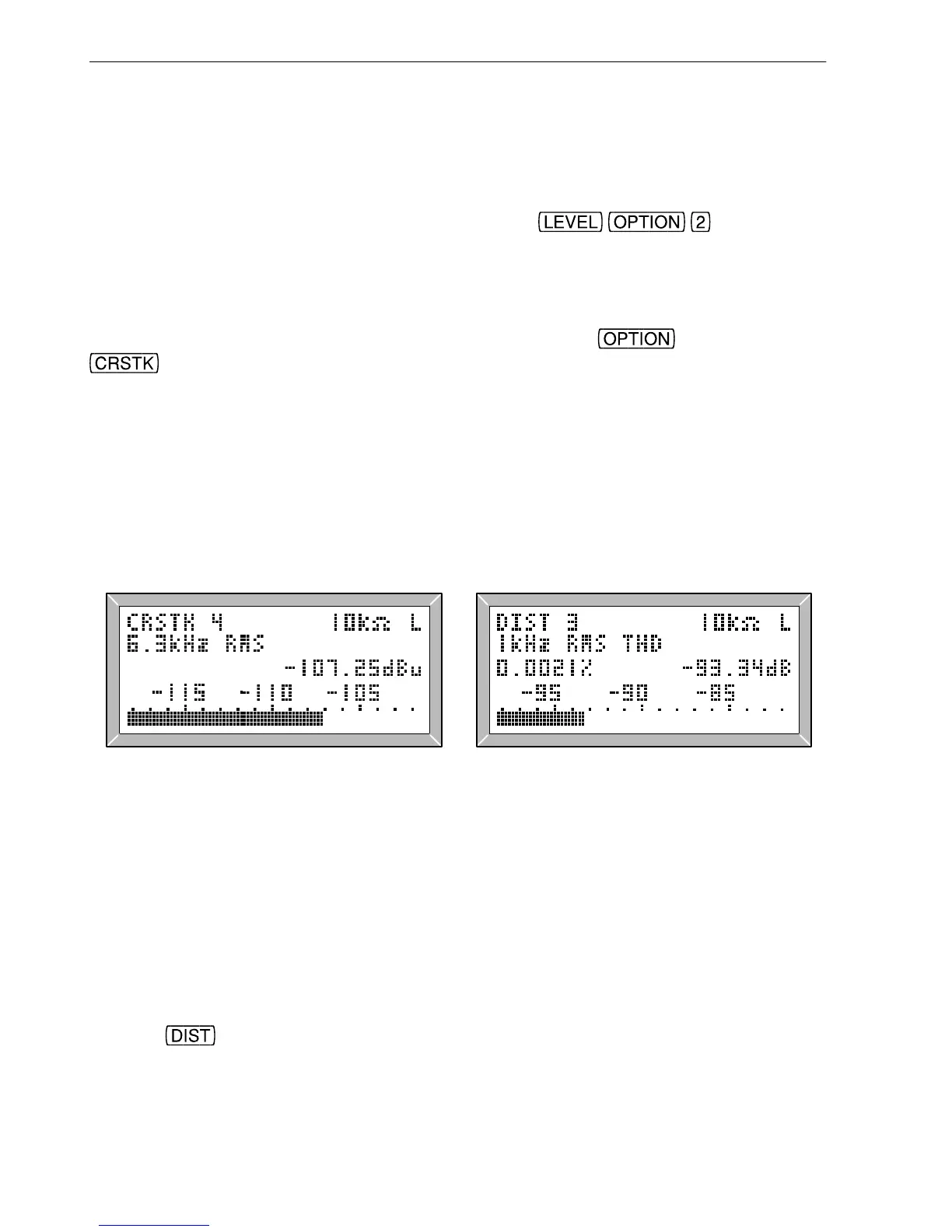
The crosstalk option is automatically selected if a suitable frequency (1kHz, 10kHz,
15kHz etc) is found on the other channel. In cases where there is no tone on the other
LA102 input the option may be set explicitly by pressing the
key after pressing
in the normal way (section 2.7). This manual selection may also be useful when
measuring crosstalk from noise or programme material. Note that a crosstalk reading
around 0dB usually indicates that the channels are transposed.
Note: The LA100 can measure crosstalk at levels of -100dB or lower and this is usually
good enough for all practical purposes. However, a few users have demanded even lower
residual crosstalk levels and Lindos has devised a way of reducing the LA102’s own
crosstalk with a simple board modification. Full details are given in Application Note 10
available from Lindos free on request.
Fig. 2.11 Crosstalk Measurement Fig. 2.12 Distortion Measurement
2.13 Distortion Measurement Distortion measurement
The LA102 can measure harmonic distortion at 6 spot frequencies (as for crosstalk)
selected as options 1-6. Five of these are ‘total harmonic distortion’ measurements, (or
strictly THD+noise, band-limited 2nd harmonic to 22kHz) but the 315Hz measurement
reads third harmonic only. This involves a band pass filter centred on 945Hz which
greatly reduces the contribution of wideband noise, particularly from tape.
Pressing
results in a fully automatic measurement, the LA102 measures the input
frequency and selects one of the six notch filters, the fundamental being measured
immediately after the key is pressed and stored automatically as the reference level (fig.
2.12). The measurement is very fast, taking only about half a second to settle. The
24
2. Manual Operation



 To Next Page