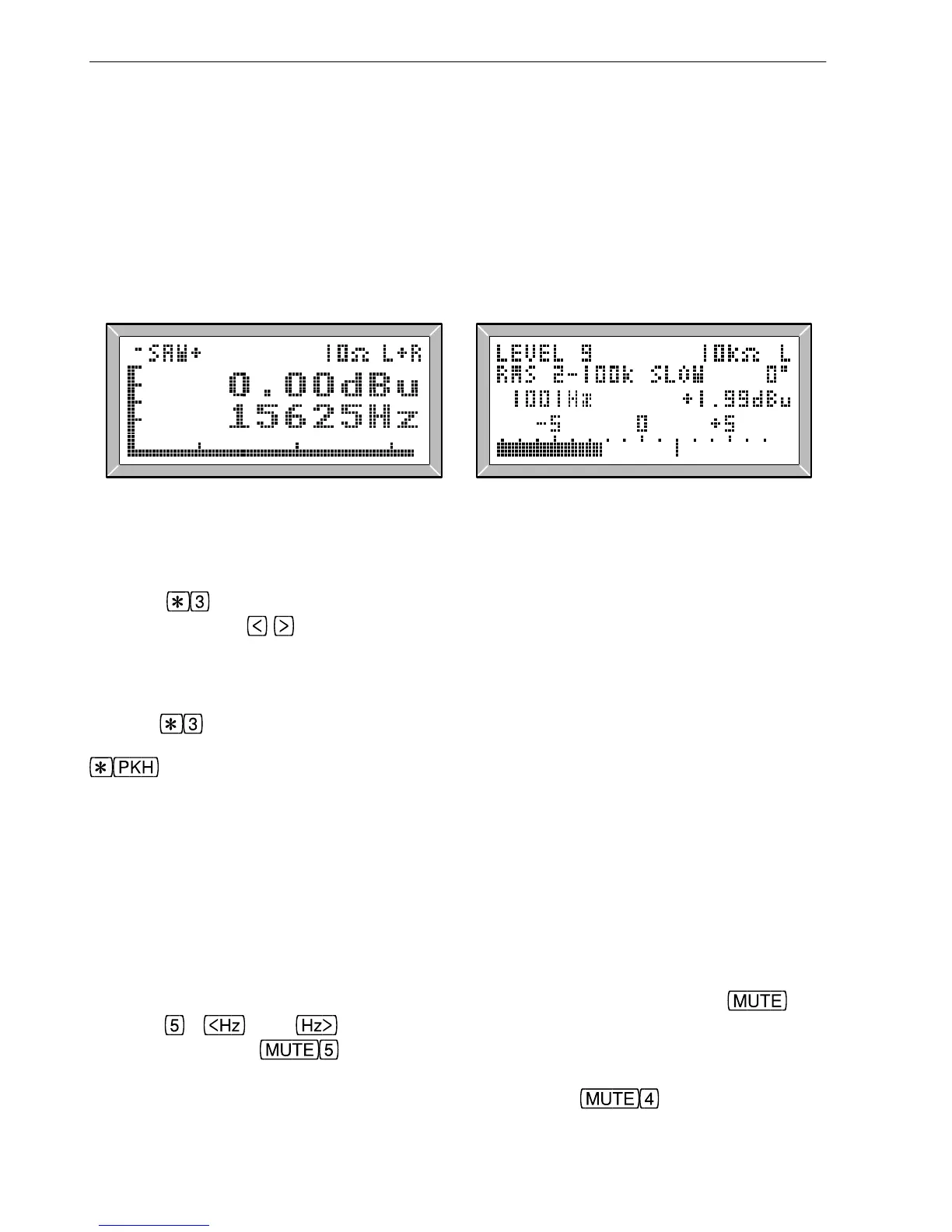
generated with the same rms level as sine waves (ie less peak to peak amplitude). The
peak to peak amplitude of sawtooth and triangular waveforms is the same as that for
sinusoids at the same level setting (so the rms level is 1.7dB lower). SAW+ and SAW-
provide sawtooth waveforms with positive and negative going slopes.
DOUBLE provides a double tone with 1011Hz centre frequency and 70Hz separation for
difference frequency distortion measurement (see section 2.16). No other double tone
frequencies can be generated and the bar graph shows the frequency which will be
generated when another waveform is selected.
Fig. 2.23 Sawtooth Waveforms Fig. 2.24 Peak Hold
2.25 Miscellaneous Features Inhibit autoranging Continuity detection Range setting Level range setting
Pressing on the LA102 inhibits autoranging and sets a fixed range which can be
changed using the
range keys. Selecting a new function changes the range to the
range last used for the newly selected function, and this can be useful on test tapes, where
autoranging on verbal announcements can be troublesome. Default values (after memory
clear) are 0dB, -30, -30, -30, -60dB for Level through to W&F. Autoranging returns on
the next
or reset. Manual range setting
toggles a peak hold function on the LA102. The numerical display is held
briefly and a marker appears on the bar graph (fig. 2.24). This is always switched in
automatically on W&F.
Sometimes, on noisy or low frequency signals the rms bar graph can jump around making
it difficult to read. Level option 9 overcomes this problem by providing a slow average of
the rms rectifier which is much more stable (although slower at settling), even down to
10Hz. The averaging is performed in software using a first order digital filter.
The LA101 can generate 22.5kHz sine waves for pilot tone continuity detectors. The
frequency actually generated is 22.4905kHz and is selected by holding
and
pressing
. and keys can be used to go to adjacent frequencies (22321Hz
and 22727Hz), but
must be used to return to this special frequency. This
frequency can also be used in ! tone segment definitions (section 4.16) and from remote
mode (see section 9.11). Also provided is 19.003kHz on
for FM stereo pilot
34
2. Manual Operation



 To Next Page