The LA102 will now measure the filter’s gain correctly and choose a range which will be
sufficient to handle the peak level. For example, when testing a 6.3kHz narrow band-pass
filter the sequence
!T6300,1000,0U should be used, and full details are given in section
4.16.
Repeating sweeps (as used in sequences 15 and 10) use the same rules for the first sweep,
but will autorange between successive sweeps to ensure that the optimum range is
selected, so it does not matter which segment is used − the results will always be accurate
after two or three sweeps. Note that this allows sweeps at low levels to be run and
accurately plotted.
An example for experienced users:
(the following assumes sequence 6 contains the Lindos default sequence)
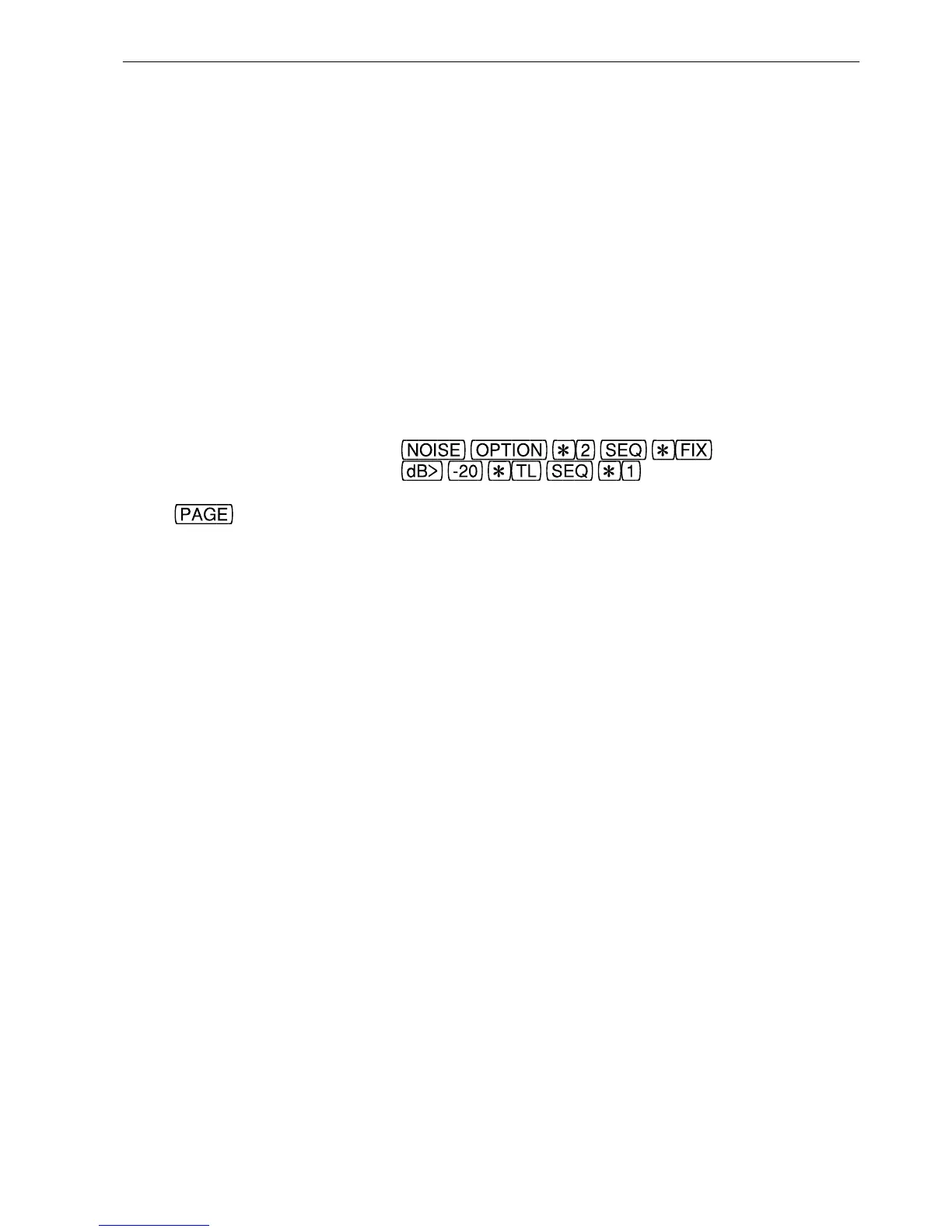
Try sweeping the CCIR weighting filter in the LA102 (at -20dBu):
LA102:
LA101:
Press
and move the cursor to 6300Hz where the the CCIR filter peaks. The
LA102 will display
RANGE? to indicate that an overload occurred (fig. 3.21). To correct
this change sequence 6 in the LA101 to one of the following and repeat the test
(remembering to set the -20dBu test level before running the sequence):
T+10 U Run segment T 10dB higher
!T6300,1000,0 U Run segment T at frequency where peak occurs
TU< LA102 changes range between repeating sweeps
3.15 Peak Programme Meter (PPM) Testing Tone bursts Meter testing Testing meters
The PPM test sequence generates a series of tone-bursts and reference levels for testing
the meter ballistics and level accuracy of a Peak Programme Meter, as required by the
relevant standards. With practice it is possible to verify correct PPM operation in a single
run, looking for the peak excursions on tone bursts. For development work the individual
tone bursts can be run over and over again using single segment operation (section 3.23).
Five tone bursts are used to test the meter ballistics and in each case the expected target
which the PPM should reach is shown on the LA101 display after the tone burst. A 5s
delay follows each tone burst to prevent retriggering before the meter has settled properly.
After the tone bursts seven levels are generated for 4s each ranging from PPM7 down to
PPM1 to enable the level accuracy to be checked.
Ballistics
55
3. Sequence Testing



 To Next Page