2.16 Difference Frequency Distortion Measurement
Several other miscellaneous measurements are provided on the key, and one of
these is 2nd order difference frequency distortion. This is a form of intermodulation
distortion (IMD) similar to the CCIF IMD measurement which has now been superseded
by the IEC268-3 standard. The term difference frequency distortion is used to distinguish
it from other forms of IMD which are now known as modulation distortion (previously
called SMPTE IMD), dynamic intermodulation distortion (DIM) and total difference
frequency distortion (based on the Thiele method).
Thiele IMD measurement
To measure difference frequency distortion, a test signal is used comprising two
frequencies, f
1
and f
2
, with a difference frequency of 70Hz. Each tone should have an
amplitude of -6dB relative to the nominal test level, so the rms value of the test signal will
be -3dB and the peak to peak amplitude of the test signal will be the same as that of a 0dB
sine wave. The typical intermodulation distortion products for this test signal are shown
in fig. 2.15.
The level of the 2nd order difference frequency distortion at the system’s output is
measured using a 70Hz narrow bandwidth filter. In accordance with the IEC268-3
standard, the distortion is referred to a reference level which is twice the amplitude of
the f
2
tone. This is different from many older IMD measurements, including that
provided in earlier L102 software (prior to V5.6), which simply measured the distortion
level relative to rms level of the double tone. This new IEC268 method will therefore
give a figure 3dB lower than the old IMD measurement. In practice the LA102 cannot
measure the level of the f
2
tone by itself as it is so close to f
1
, so it actually measures the
rms level and assumes that the f
2
tone is 3dB below that (hence the reference level is 3dB
above it).
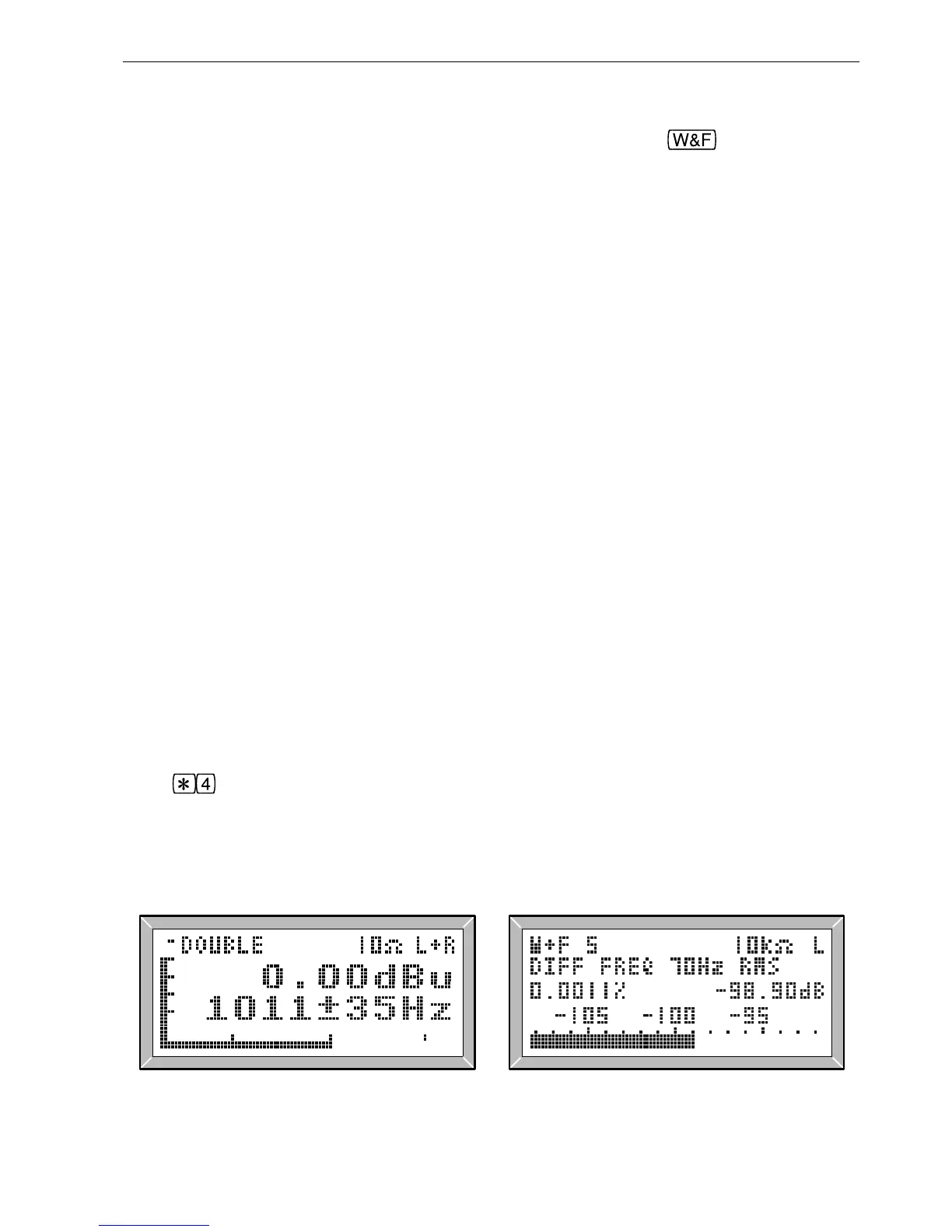
The LA101 can generate the necessary double tone, but only around 1kHz (see fig. 2.16).
Press
on the LA101 until the display shows DOUBLE (see fig. 2.17) and set 0dB.
The LA101 actually generates 976.56Hz and 1046.3Hz (69.754Hz separation) with each
tone having an rms level of -6dB relative to the displayed output level, and the resulting
waveform having an rms level of -3dB, as required by the standard. The peak to peak
level is therefore the same as that of a 0dB sine wave.
Fig. 2.17 Generating a Double Tone Fig. 2.18 Difference Freq. Distortion
27
2. Manual Operation



 To Next Page