register 1 (perhaps from a reference tape, or from a device which is known to be good).
3.13 FSK Failure − Error Codes FSK failure Sequence error Sequence failure FSK speed tolerance
The FSK system used is very effective in coping with speed errors on tape replay, because
of the repeated resynchronising that it provides (the FSK itself will tolerate speed errors
up to ±4%). For optimum FSK operation a signal level of 0dBu into the LA102 is
preferred, but levels between -30dB and +20dB are normally satisfactory, permitting use
on most professional and domestic equipment. Loudspeaker measurements have proved
very successful, using a microphone and pre-amplifier and relying on FSK operation, but
careful microphone positioning is sometimes required as room reflections can cause
delayed interference with the FSK. Similarly systems that ‘ring’ badly, have extreme
group delay or do not pass the FSK frequencies (1650Hz and 1850Hz) may cause FSK
failure, which is indicated by an error message. In many such cases triggering can be
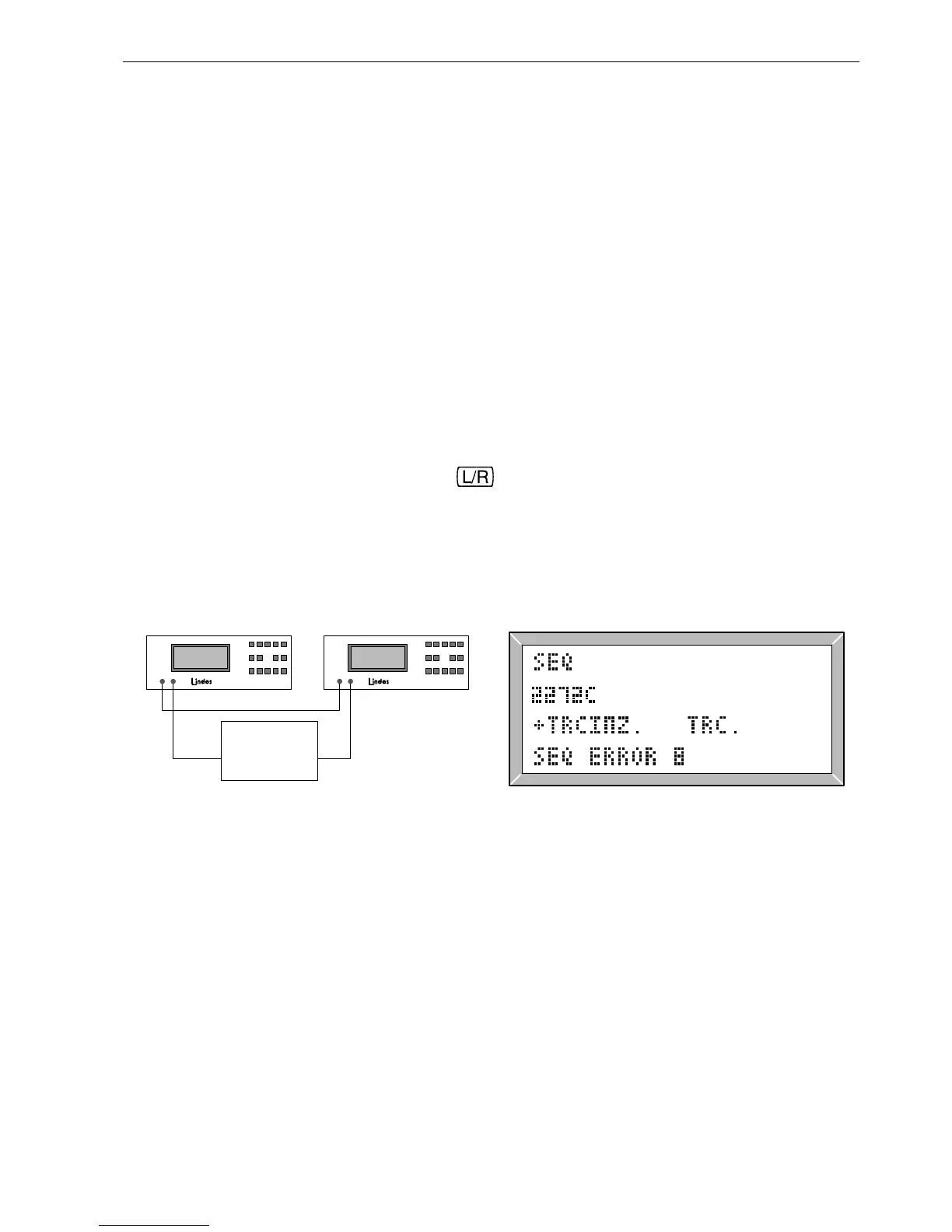
guaranteed by a direct connection between the units on the L channel, with the input to be
measured applied to the R channel, as shown in fig. 3.16. The R channel should now be
selected on the LA101 by pressing the
key when in sequence mode (note that the
FSK is still transmitted and decoded on the L channel even though the LA102 will now
take measurements on the R channel). ‘
SEQ ERRORS’ 1 to 8 usually indicate FSK
failure (as shown in fig. 3.20) and a full list of error messages, together with explanations,
is given in appendix E.
DEVICE
UNDER
TEST
LA101
LA101 AUDIO OSCILLATOR
LA102
LA102 AUDIO MEASURING SET
Fig. 3.19 A Separate FSK Path Fig. 3.20 FSK Failure Message
3.14 Sweep Headroom Sweep headroom Sweep failure Sequence failure Testing filters Sweep overload
Since the LA102 cannot be allowed to autorange during a sweep, and has no way of
knowing how high the signal will go in advance of the sweep, it is necessary to allow a
certain amount of headroom in the measuring set. Generally, the default sequences
provide sufficient headroom for most applications without losing too much resolution and
the user need take no action except where high accuracy is required, or where a signal
path has a large peak.
When testing systems with large peaks in the frequency response (such as one band of an
53
3. Sequence Testing



 To Next Page