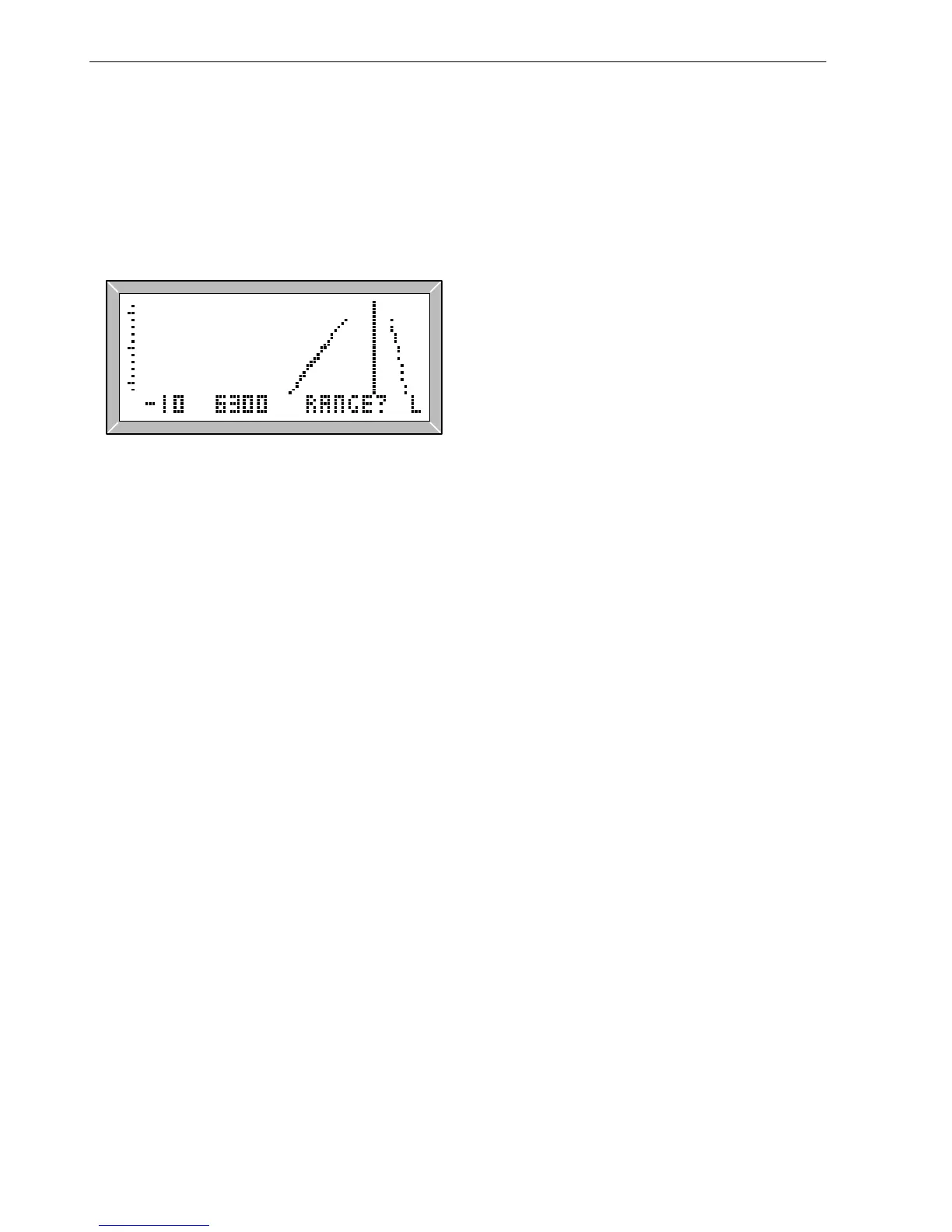
equaliser) more headroom may be required. An overload during frequency sweep
measurement is detected and the message
RANGE? is displayed in place of the level on
both the screen and the printout where an overload has occurred (see fig. 3.21). Since the
LA102 chooses its level based on the measured test level, a system which does not pass
the 1kHz test level tone may cause a similar problem. The following notes should give
sufficient information for most situations, but section 4.25 describes a technique for
setting sweep headroom for systems with very large peaks in frequency response.
Fig. 3.21 Overload During Sweep
When receiving segment U the LA102 assumes that a 0dB frequency sweep will be
received at a level similar to the measured test level and therefore uses the same range as
it used for measuring the test level (which itself was determined by autoranging on the
test level tone). If the sweep segment has a measurement level (see section 4.5) other
than 0dB then this is taken into account. Sweep segment U at 0dB therefore has 9dB of
nominal headroom, while all of the other sweep segments all provide an extra 10dB,
giving 19dB of headroom, but slightly less resolution.
When testing very flat systems segment U should be used to achieve the best resolution
and accuracy (when measuring a 0dB signal on the 0dB range the resolution is around
0.01dB, but when measuring a -20dB signal on this range it is around 0.05dB). If
necessary segment U can be used at a level other than 0dB by giving it a measurement
level (see section 4.5).
When testing a system with a large peak in the frequency response it is best to use a
segment other than segment U (if a 0dB sweep is required this can be achieved by giving
the sweep segment a measurement level of 0dB, see section 4.5). If an overload still
occurs, then the test level segment can be run at a higher level to make the LA102 use a
higher range for the frequency sweep (ie change
TR0 to T+10R0). Alternatively, a
repeating sweep (as found on sequences 15 and 20) can be used.
When testing a filter with a narrow pass band it is best to run the test level segment at the
filter centre frequency. This also means that the test level result will indicate the gain of
the filter at its centre frequency which is generally more useful than at the 1kHz default.
54
3. Sequence Testing


 To Next Page
 Loading...