sequence, and the weighting name will appear at the top of the screen (in manual and
sequence modes). As the LA101 can only apply weightings to third octave frequencies,
some segments cannot be used. In particular, segments
O, S, X, Y, Z, !, c, d, o, r, u, x and
z are not allowed and will generate a CANNOT USE WEIGHTING error message if used.
Weighted frequency sweeps are possible using segments P, Q, R or U. A third octave
frequency sweep will be generated by these segments with fewer frequency steps than the
fine sweeps normally used. It is important to remember that the sweep only contains third
octave frequencies and the result will therefore be a stepped frequency response graph,
but this is quite satisfactory for most purposes. This feature allows filters to be tested by
using an inverse weighting curve to obtain a flat frequency response (providing the curve
is not too steep and covers a suitable level range).
As an example, we can test the CCIR weighting filter in the LA102. First of all, try
testing it with a normal, flat frequency sweep:
LA102:
Select CCIR RMS measurement
Enter sequence mode
Test the LA102 CCIR filter
LA101:
Set a test level of -40dB
Run sequence 10 (repeating sweep)
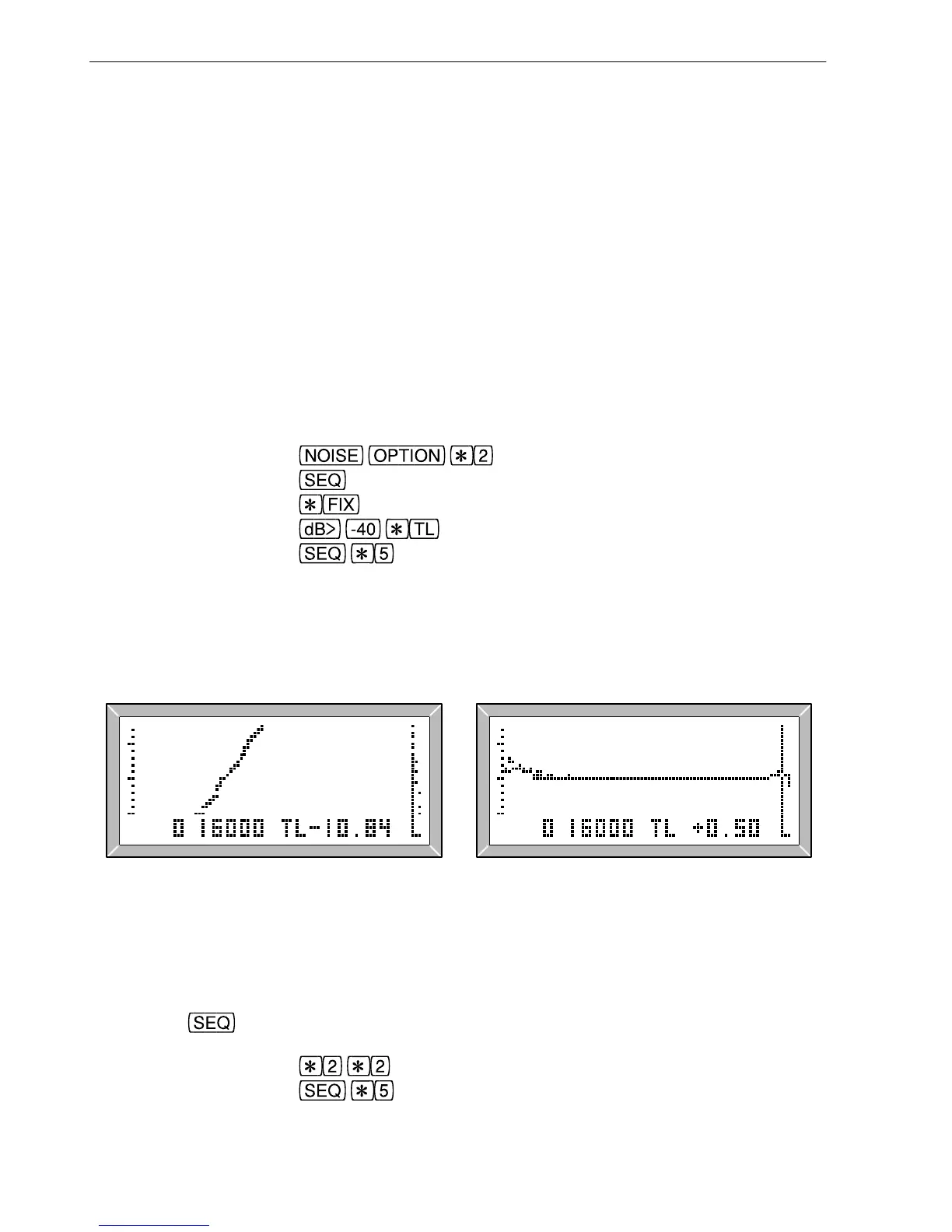
The result is shown in fig. 3.23, but accuracy has been lost due to the steep roll-off of the
filter, the slowness of the rectifier to respond to the rapidly changing level, and the large
dynamic range over which the measurements have been taken.
Fig. 3.23 Test with a Flat Sweep Fig. 3.24 Test with a Weighted Sweep
The solution is to use a weighted frequency sweep using the inverse of the CCIR
weighting filter, as provided by the LA101. Stop the LA101, and return to manual mode
by pressing
, leave the -40dB test level set and then enter the following:
LA101:
To select CCIR-inverse weighting
Run sequence 10 (repeating sweep)
58
3. Sequence Testing



 To Next Page