28
Planing and moulding
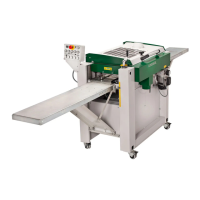
A planer/moulder is not a jointer, it only dimensions and moulds
the workpiece. For this reason, the cutting parts in the machine
should be as close to each other as possible to avoid jointing
operation. Panelling and other mouldings are normally not
machined in a jointer.
A jointer makes the sides of the workpiece straight, but does not
dimension it. A jointer has long tables that guide the workpiece
straight over the cutter. After that the board has to be run through
a planer, dimensioning planer or a moulder to get the correct
width and height. Usually, only shorter work pieces are machined
in jointers, workpieces that will be used for cabinet-making or
producing windows, for instance.
These tow types of machines should not be confused with each
other. They each have their own functions.
Wood
Wood shrinks when drying. Most of the shrinkage happens when
the wood is drying from 25% moisture content to 10%. To get a
ne surface you should not plane timber that has more moisture
content than 20%, and that is about as dry wood can get when
drying outdoors. Preferably, the timber should be kept indoors
before it is machined.
Along the board, in the direction of the bres, the wood shrinks
very little. In most cases you do not have to take this shrinkage
into consideration. Along the annual growth rings the wood
shrinks about 8% and across the rings about 5%. Consequently,
it is better to have standing annual growth rings in the boards.
In the course of time, boards warp and crack. To avoid such
problems as far as possible the timber should, in most cases,
be turned so that the heartwood side is facing outwards.
When making vertical siding, you should let the heartwood side
of the outer boards face outwards and the inner boards should
be turned the opposite way in order to make the wall as tight
and close as possible.
The result
Hard materials gets a better surface than soft. Small indentations
that look like light blotches, are caused by wood debris
surrounding the edge that is then pressed down in the wood. This
phenomenon increases when the knives lose their sharpness.
Visible lines from the cutter strokes in the machined timber are
most often due to the knives not being set at the same height
or to the workpiece not being pressed hard enough against the
table or the fence when it is being processed. If the feeding
speed is too high it can also lead to visible cutter strokes.
Keep the feed rollers clean from wood debris. The out-feed roller
is especially important, since wood debris on this roller can make
marks in the planed surface of the workpiece.
Boards that are too warped should be run through a jointer or
be dimension planed in the PH260, the DH410 or the SH230
before the nal machining.
How do you know the material of the knife?
If you want to test a knife, you can hold it against a rotating
grinding disc for a short while. If the sparks it produces are
white, the material of the knife is soft. If the sparks are red, the
material is hard. Compare it to a material you are sure of, for
instance a Logosol HSS knife.
The angle of the edge
Logosol’s knives have a 38 degrees angle and are angled 20
degrees in the cutter heads. Some claim that a sharper angle is
more suited for hardwood. This cannot, however, be considered
as proved. On the contrary, a sharper angle of the edge gives
a worse surface on the workpiece.
Planing/moulding tips
• You can experiment yourself by adjusting the pressure of
the feed rollers. If you lower the machine table you can
easily access the nuts that supports the springs. Note the
original setting before you start screwing the nuts, so that
you can later nd back to that setting. Normally, the springs
should be tightened harder on the side of the stationary
cutter, especially when thin workpieces are to be machined.
The feed roller should be parallel to the workpiece, and not
press one side down more than the other.
• Never run the machine without starting the chip extractor.
Chips accumulate quickly in outlets and hoses. Always
adjust all chip deectors. Otherwise the entire machine will
be lled with chips and you will get a degraded result.
• If you have a board that is cut incorrectly into size, or if
you for any other reason want to plane away a lot of wood,
you set the machine so that it only takes away as much
as it can handle. Run the board several times through the
machine until you can set the machine to the correct board
dimension. This technique cannot be used when moulding
knives are mounted in the upper and the lower cutter.
• Try to avoid machining timber that is too warped; planing it
will not make it much straighter. However, planing warped
timber usually present no problems.
• A certain degree of jointing operation is reached if the rst
feed roller is set so that its pressure is somewhat lower
than the pressure of the feed roller behind cutter 1. The
board must then be positioned so that the convex side is
turned upwards.
• If the knives in the upper cutter protrude too much,
the last feed roller will not take hold of the workpiece.
Recommended protrusion is 1 mm.
• The machine emits a lot of wood debris. If you want to blow
the wood debris out of a heated room, build a chip pocket
so that you can recycle the warm air. Otherwise the room
will quickly become cold.


 To Next Page