384 Creating Multilanguage Text
By default, the Flash authoring application assumes that external files that use the #include
action are encoded in the traditional code page of the operating system running the authoring
tool. Using the
//!-- UTF8 header in a file tells the authoring tool that the external file is
encoded as UTF-8.
To include multilanguage text using the #include action:
1. In the Flash authoring tool, create a dynamic or input text field to display the text in the
document. For more information, see Chapter 6, “Working with Text,” on page 157.
2. In the Property inspector, with the text field selected, assign an instance name to the text
field.
3. Create a text file that defines the value for the text field variable. Remember to add the
header //!-- UTF8 at the beginning of the file.
4. Save the file in UTF-8 format.
5. Use the #include directive to include the external file in the dynamic or input text field.
For more information, see
#include directive in the ActionScript 2.0 Language
Reference.
Creating documents with multilanguage text using
text variables
You can include Unicode-encoded contents in text variables using the syntax \uXXXX, where
XXXX is the four-digit hexadecimal code point, or escape character, for the Unicode character.
The Flash authoring tool supports Unicode escape characters through
\uFFFF. To find the
code points for Unicode characters, refer to the Unicode Standard at www.Unicode.org.
You can use Unicode escape characters only in text field variables. You cannot include
Unicode escape characters in external text or XML files; Flash Player 6 does not recognize
Unicode escape characters in external files.
For example, to set a dynamic text field (with the instance name
myTextVar) that contains
Japanese, Korean, Chinese, English, Hebrew, and Greek characters and the Euro sign, you can
enter the following:
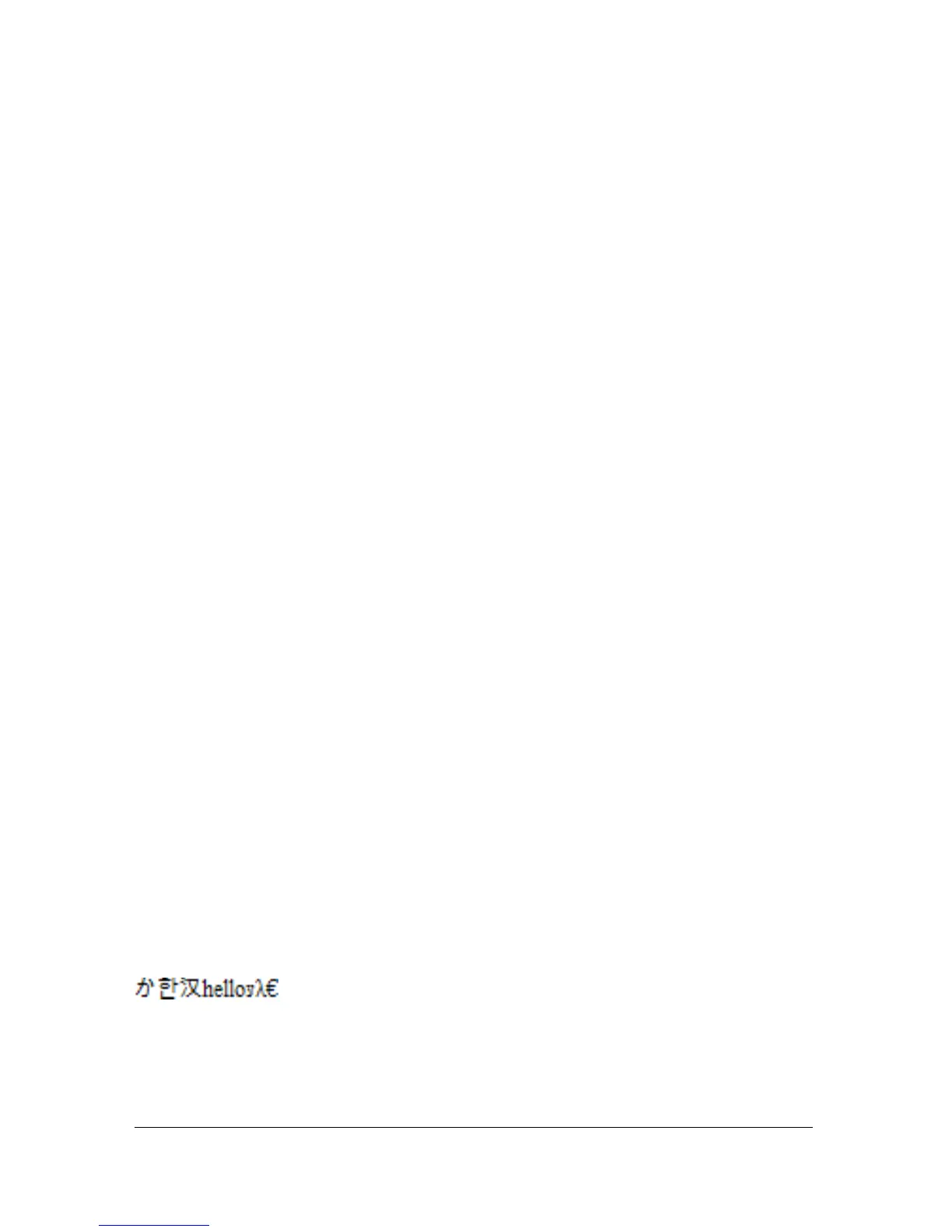
myTextVar.text = "\u304B\uD55C\u6C49hello\u05E2\u03BB\u20AC";
When the SWF file plays, the following characters appear in the text field:
For best results when creating a text field that contains multiple languages, make sure to use a
font that includes all the glyphs your text needs. For more information, see “Using external
text or XML files that are not Unicode-encoded” on page 385.



 To Next Page