10
MAGNAMED TECNOLOGIA MÉDICA S/A
2 Characteristics
Intended Use
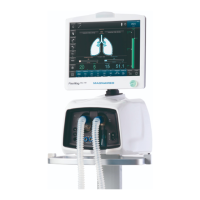
FlexiMag 15” comprises a family of ventilators developed to
supply invasive and non-invasive ventilatory support to
patients with impairment of respiratory functions in intensive
or semi-intensive care, post-operative care, post-anesthetic
recovery (PAR) or intra-hospital transport.
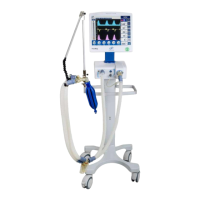
While FlexiMag model serves neonatal low weight, pediatric
and adult with morbid obesity patients.
Functioning Principle
FlexiMag is electronic and microprocessed lung ventilator,
whose operating principle is based on the integration of the
following modules:
• Pneumatic module (manifold)
• Electronic control module
• Electronic interface module
At the pneumatic module inlet, two valves regulate the
pressure coming from the hospital line or gas cylinders, in
order to assure the proper pressure range to the equipment.
After the pressure regulators valves, there are micro switches
that constantly monitors the gas pressure, to guarantee that
an insufficiency or absence of pressure of one or both gases,
is immediately indicated through a priority alarm.
After the micro switches, proportional flow control valves,
regulate the gas flow in such a way to guarantee that the
volume and oxygen concentration are suitable to each
situation.
After having the respective flows adjusted, the gases are
mixed to allow the measurement of O2 concentration and also
the resultant flow.
The oxygen concentration measurement is made through a
galvanic cell sensor or, optionally, through a paramagnetic cell.
The resultant flow measurement is made through a high
precision internal mass flow sensor, that allow the reading
without the need of calibrations and without pressure and
temperature influence.
The patient exhaled flow is measured by a hot-wire external
sensor, connected to the exhalation valve.
The system pressures are taken through existing points in the
pneumatic module, which are connected to existing
transducers in the electronic control module.
All these flow and pressure measurements are converted into
digital signals by the electronic control module and serve to
feed back the control algorithm continuously, ensuring a
gradual and secure adjust of the respiratory process.
The pneumatic module also comprises safety valves, and the
overpressure valve and the anti-asphyxia valve.
The input and output information are processed by the
electronics module interface. The information entered by the
operator via the touch screen or via button, are translated,
interpreted and sent to the electronic control module for serial
type communication through secure protocols. With this
information the ventilator sets the appropriate parameters to
work in each different situation.
As receives information, the control module also sends to the
interface module. All measured or calculated data is sent, also
via serial, to the interface module. This module process and
displays this information to the operator in a friendly and
intuitive way.


 To Next Page