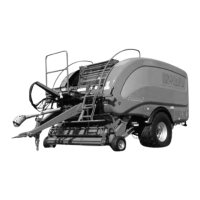
McHale V Series Baler
98
Release the hydraulic pressure from the tension arm by pressing the density release
(button 9) on the control box until the pressure on the clock falls to zero before carrying
out any work inside the chamber or under the tailgate.
The hydraulic and spring pressure is now released allowing the operator to clear any
blockage inside the chamber or carry out specific maintenance operations.
In order to grease the bottom two tension arm rollers the tailgate should be closed
completely before applying the tailgate lock. The lower roller grease points are now
accessible through slots in the chamber walls, two on either side.
To release the tension arm lock, once work has been completed inside the chamber,
the lock lever ‘B’ should be returned to the working position, before opening the tailgate
fully to release the stop and then closing the chamber again. The belts are now re-
tensioned and the machine can resume as normal.
9.15 Brake overview (if brakes fitted)
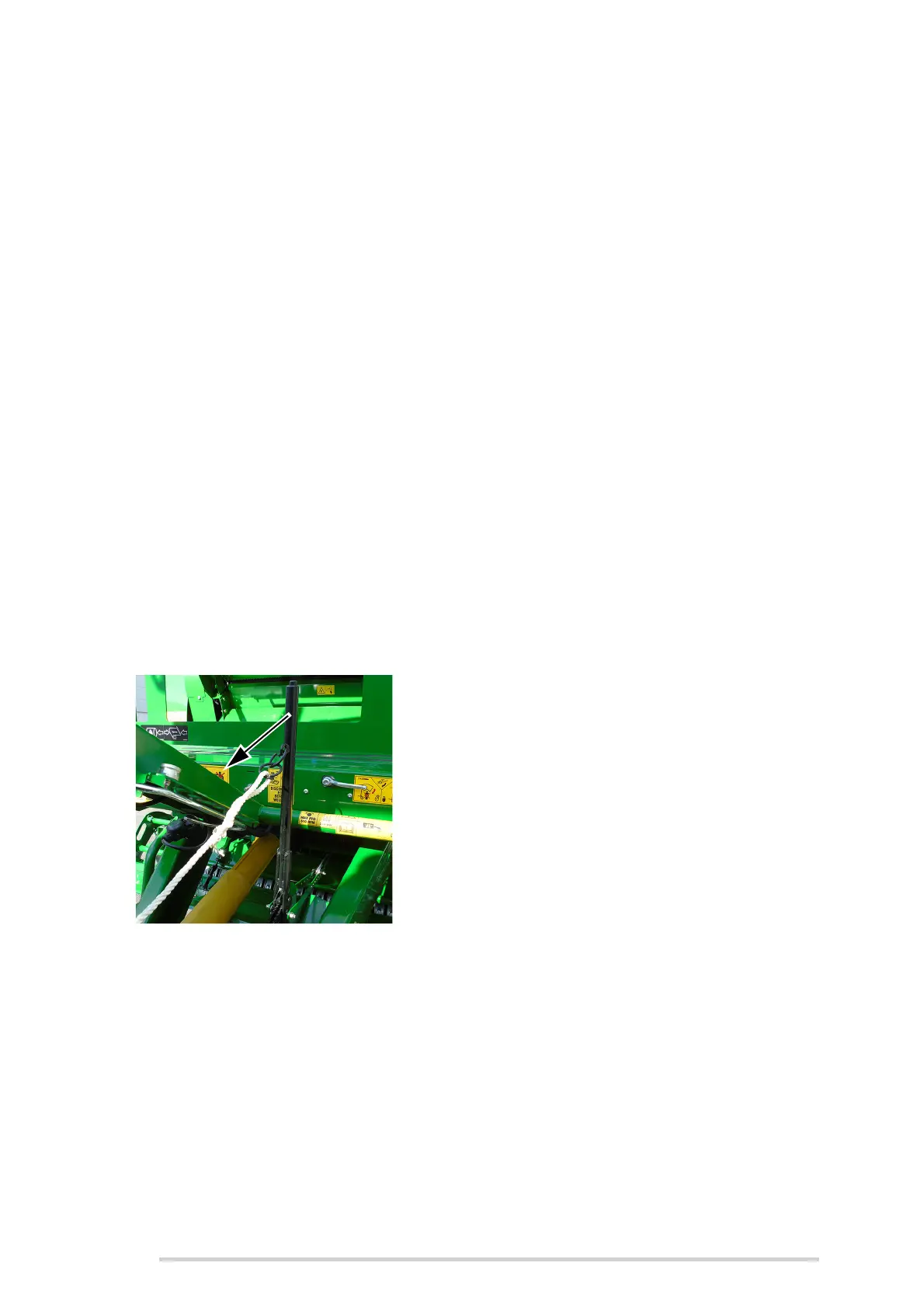
The machine comes with either hydraulic or air brakes. The machine is fitted with a
hand brake which must be applied when the machine is detached from the tractor. This
also serves as a ‘break-away’ brake, when the actuation cord is connected to the
tractor. Always obey local road regulations!
9.15.1 Hand brake
The machine is equipped with a manual parking brake (hand brake).
9.15.2 Air brakes
The machine is equipped with a dual-line air brake system. There are two hoses that
must be attached to the tractor for the air brake system to function:
The yellow hose is the service line which controls the rate of braking of the
machine.
The red hose is the emergency line, which if disconnected applies the brakes
on the machine.
Pull the lever to activate the brake. The brake
performance increases as you pull the brake
(using a normal pulling force), reaching a
maximum when the lever stops. The brake
performance is at it’s best when the cables are
adjusted correctly, all moving parts are
lubricated and the teeth on the ratchet and
pawl are in good condition. If the teeth on the
ratchet or pawl become worn or damaged, they
must be replaced immediately.



 To Next Page