4.3 KF Moisture determination
774 Oven Sample Processor, Instructions for use
41
water
[
µ
g]
t [min]
vial humidity
in
µ
g
system drift
in
µ
g/min
determination interval
total blank value
drift
[µg H
2O/min]
t [min]
min. extraction time
blank
sample
min. extraction time
determination interval
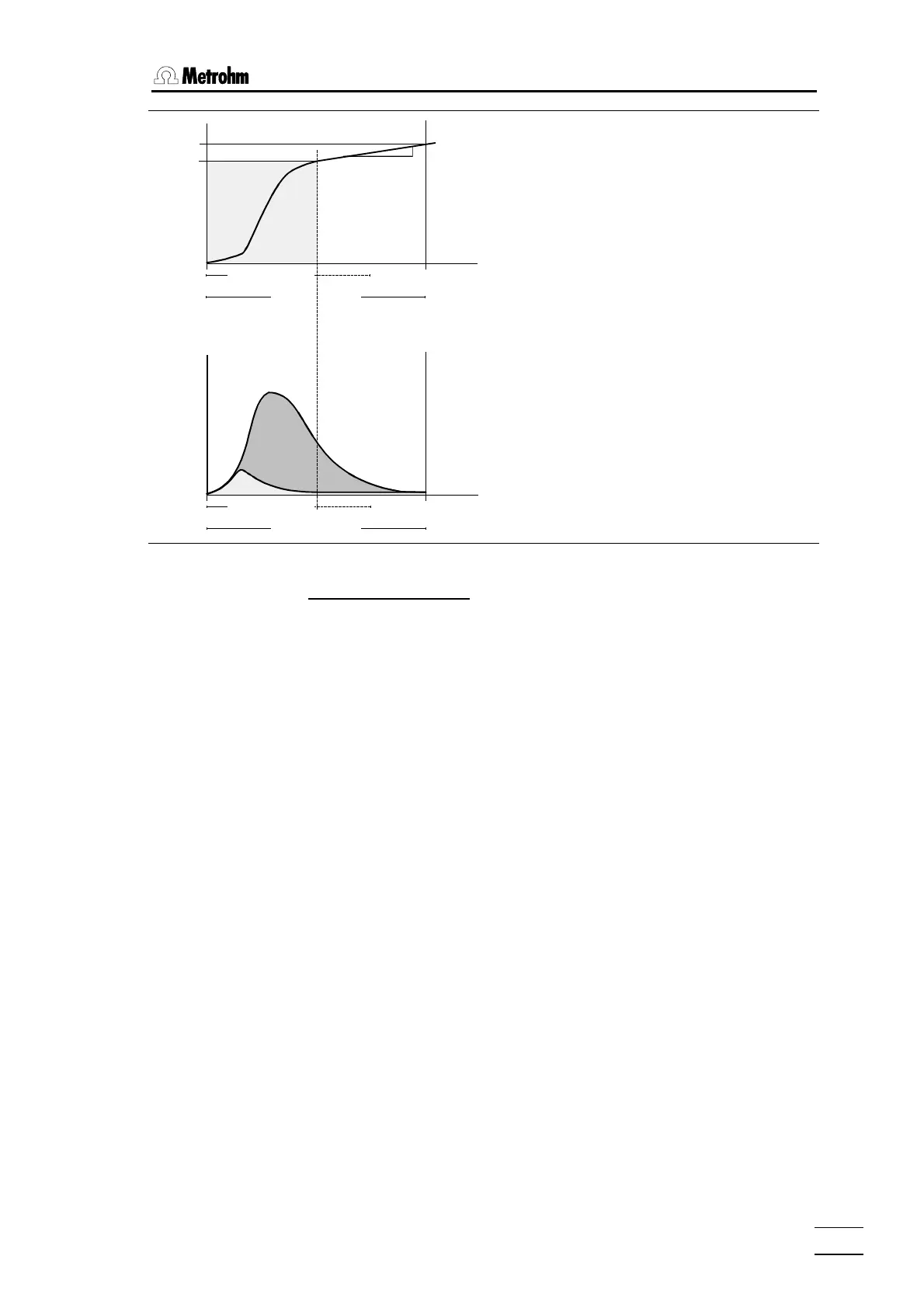
The blank value is made up of the moisture
which adheres to the sample vial * and a sys-
tem drift which is latently present and whose
cause can be found in a minimal residual mois-
ture in the carrier gas and possibly leaks in the
tubing system.
*
The use of pre-dried sample vials has no significant advan-
tages. On the contrary, this causes the reproducibility of
the results to be adversely affected.
The accompanying diagram shows the theoreti-
cal course of a sample determination with the
774 Oven Sample Processor. It is clear that, in
order to determine the amount of water correctly
(dark gray area), the blank value must be sub-
tracted from the total amount of moisture deter-
mined.
Sample determination
• When the reaction medium has been conditioned fully the gas flow is in-
terrupted, the sample moved to the oven and introduced into the oven
block with the help of the penetration needle.
• The gas flow is switched on again and the sample determination started
at the Coulometer or KF Titrator. Definition of an extraction time ensures
that a minimum determination time and therefore heating period will be
observed.
• The driven-off moisture is now transported to the reaction vessel by the
stream of gas. The transfer tube heating ensures that no moisture can
condense in the tubing.
• When the determination is finished the moisture content of the sample is
calculated taking the previously determined blank value into considera-
tion.
• The gas flow is switched off again and the conditioning vessel again
move to the oven.
• When the needle has penetrated the conditioning vessel septum the gas
flow is switched on again and the reaction medium is conditioned.
• When conditioning has been carried out the next sample can be deter-
mined, see above.
Care must be taken that the septa are still airtight after penetration by the
hollow needle and that no moisture can escape. The septum of the condi-
tioning vessel is particularly at risk as it is penetrated many times during the
sample series.





 To Next Page